
Video version: https://www.youtube.com/watch?v=mhRl0LgXPFI
Cover:
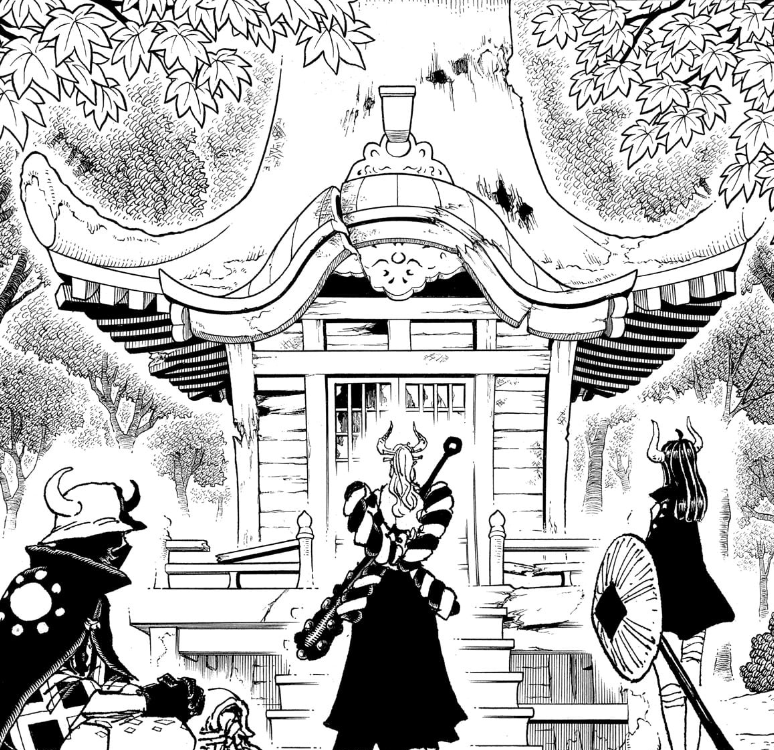
On the cover, Yamato finally reaches Enma Shrine in the middle of Hakumai, where Yasuie’s katana is meant to be laid to rest to serve as his grave, as Wano has the tradition of taking one’s sword to the grave, with the people of Ringo using them as gravemarkers. As a reminder, this is a small shrine found in the middle of the Hakumai region, now ruled by Daimyo Kawamatsu, where Zoro and Hiyori found refuge after escaping from the Flower Capital during Yasuie’s execution. The shrine is named after Enma, the God of Hell in Wano folklore (in reality a relic of Buddhism) and the one after which Zoro’s sword was later named as well. Yamato was asked by Kin’emon to travel all the way to Hakumai to leave this sword so after this the only final destination will be Ringo, where Yamato should meet with what likely will be Daimyo Kiku and come to a decision about the end of this journey.
Imu’s haki
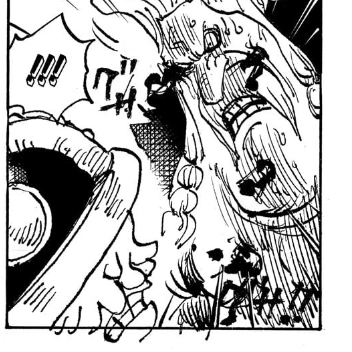
The chapter opens with the children’s parents all rushing towards them, but being unable to touch their kids due to Sommers’s thorns. Interestingly though, this page is partially unfinished, at least in the magazine release, though more subtly than you might imagine. If you look closely, you’ll notice a considerable amount of lines and drawings spilling out of the panels, including the edges of entire characters, which are usually cleaned out after drawing. Similarly, the sound effects in the top middle panel are blended in with the character in a way that they’re almost unreadable. It’s unknown what caused this mistake, whether it was a lack of time to polish these final details or if they accidentally didn’t submit the finished version, but it’s likely this will be fixed in the volume release.
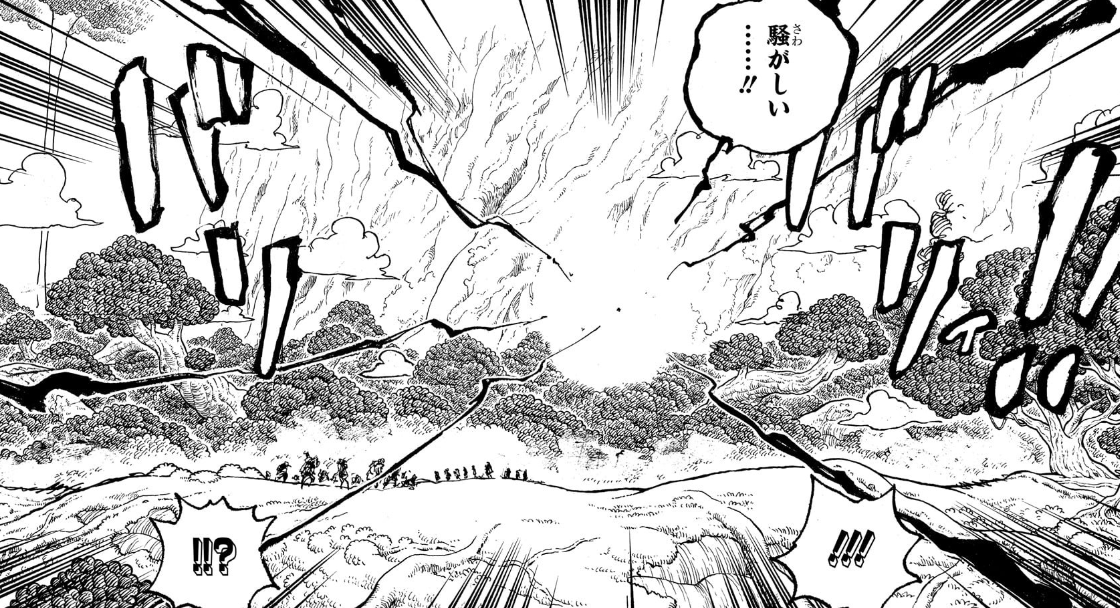
As Imu floats upwards though, she finds the commottion annoying, and so launches a powerful blast of conqueror’s haki, which we can assume Imu is doing through Gunko’s body, confirming Imu as a conqueror’s haki user. This was already established earlier by the use of the baribari “バリバリ” sound effect, which represents the cracking of thunder and is used to show strong haki, such as Gaban having this sound effect last chapter too. This sound effect was already present last chapter as soon as Imu appeared, so Imu’s very appearance commands strong haki, and similarly the same sound effect was used when the likes of Saturn appeared from the Abyss, showing that powerful haki is manifested during a summoning. However, if those with the mark can use conqueror’s haki, then it might be thanks to their link with Imu rather than them natively having conqueror’s haki, as I assume this is Imu’s and not Gunko’s conqueror’s haki.
This might explain why the Gorosei were able to use conqueror’s haki in Egghead, seemingly all of them, as we saw at least Warcury, Saturn, and Mars using it, so presumably all of them can. However, while I do not question their ambition, it would be weird if all five of them happened to have it, since only one in several million awaken conqueror’s haki, so perhaps it might make sense if it was part of the extension granted by Imu’s powers. Though perhaps with their bodies the effect of the haki might be more limited, as Imu’s haki knocks out the parents, the children, and even some of the Giant Warrior Pirates, which while impressive, is a far cry from Joyboy’s haki which virtually knocked out all the Marines on Egghead aside from Kizaru, an Admiral. By the way, the pirate getting knocked out by Imu’s haki looks a lot like Raideen, a giant that had been training Hajrudin during Big Mom’s flashback, and that had originally appeared as far back as the Little Garden flashback as well, but it’s hard to say from this small panel if it’s really him.
Imu the Devil
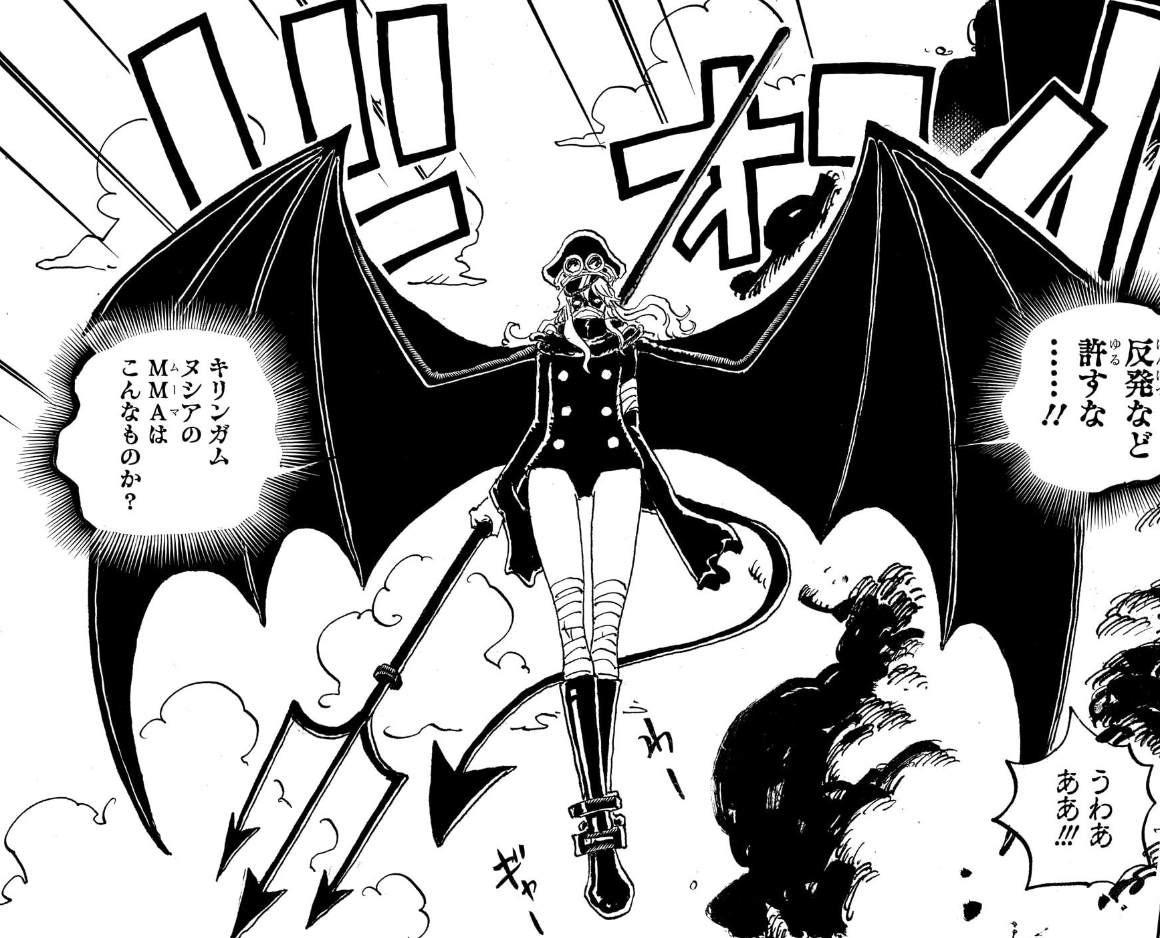
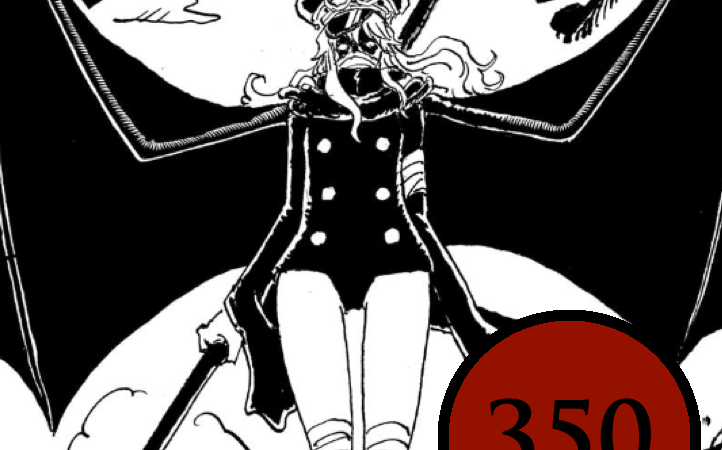
And at last… we finally get to witness Imu’s true form… well, partially. Imu is still only possessing Gunko’s body so it’s not the same as seeing full Imu in action, but this transformation certainly gives us a very good idea of who Imu really is… and I’ve been saying this for years now, I’ve theorized this for the longest time, but at this point there’s pretty much no doubt left: the King of the World, Nerona Imu, is almost certainly the Sea Devil, the entity cited as the origin of devil fruits.
The appearance is unmistakable, as defined by a few key traits. As we had long since speculated, Imu looks not just like the devil, but specifically a cartoon devil. For one there are the gigantic bat-like wings, a symbol of the devil. The triangular tail, a sign of the devil and something that is most likely what we already had guessed: the very same triangular tail that originally killed King Cobra. One that may have been extended in some form to Gunko’s powers as the Aro Aro no Mi, but there’s no doubt here that this one here is the original that Imu used to assassinate Cobra. And finally, the devil’s trident, a symbol often associated with the devil, especially when its ends are pointed like a devil’s tail. The trident is also often a symbol of the sea, which could connect with the identity of the Sea Devil. By the way this is displayed as well, this is likely to be Imu’s hybrid form, if it even operates like a devil fruit that is.
Distinct however is what we mentioned last week, being the longer hair. Back then it was perhaps questionable by some but here it’s undoubtable, Gunko’s hair has extended considerably from before, seemingly to match Imu’s form. Since the devil isn’t really associated with having long hair this seems to be a trait more similar to Imu rather than to the devil powers. Which suggests that Imu could be a woman with long hair (admittedly a man with long hair too, but given the way it looks here let’s run with woman for now). If Imu were to be a woman though, this would cause an incongruence: Ivankov stated that 800 years ago, St. Nerona Imu was a “Saint”. But in One Piece, female Celestail Dragons use the term “Saintess”, which while not much of a thing in English, in Japanese male Celestial Dragons use sei (聖, saint), while female Celestial Dragons like Shalria use gu (宮, what would be saintess, though more accurately it is closer to something like “princess”). Meaning that unless Ivankov was wrong, the original Nerona Imu, a human king, was a man.
But that was 800 years ago, and so Imu’s gender could have changed across those years, or even, potentially, Imu’s own body could’ve changed. Becuase something we’ve speculated for a long time, despite the skepticism of many, is that Imu may have traded bodies with Nefertari Lily given his obsession with her, and might even explain why Imu would have such a massive portrait of her in Mary Geoise. This is particularly possible as when Doflamingo spoke of the living national treasure of Mary Geoise during Dress Rosa, which we know from Japanese to be Imu themselves, he brought up two elements of the Ope Ope no Mi that would be vital in taking control of Imu’s body: the personality switching operation and the perennial youth operation. And the second is something Ivankov already implied Imu has, so what if Imu went two for two and used the personality switching operation, which we had seen in Punk Hazard, to swap bodies with Lily? Well for the moment being, at least under Gunko’s body, I’ll use her for Imu.
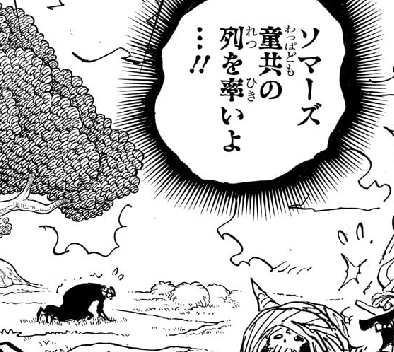
Even more oddly, as we’ve explained before, Imu has a very bizarre speech pattern in Japanese. Imu seems to use very archaic and dated language, yet at the same time speaks rudely and crassly like an angry child. For example, within this chapter alone, Imu uses “wappadomo” (童共) to refer to the children, which is an incredibly archaic term to refer to a child that is simply incredibly rare to be seen in use today, and one that while I could deduce its meaning, I myself hadn’t even heard before, and something I can imagine even many Japanese speakers may be unfamiliar with, with the closest English examples I can think of being “juveniles” or “younglings”. This old speech obviously gives the idea that Imu has been around for a long time.
Furthermore, Imu uses the first person pronoun Muu as we’ve mentioned, but also uses the second person pronoun “nushia” to refer to others. “Nushia” is likely derived from “onushi”, which is an archaic pronoun often associated with rulers speaking to their subordinates, except here it lacks the honorific “o” so it comes off as even more rude, as Imu sees all those beneath as inferior. Even more interesting of note though is that in this chapter we see Kiringham and Sommers referring to Imu as “ontai” (御大). This is a rather peculiar term that is used to refer to one’s superior, usually a politician, leader of a company, or an expert in their field, though it is a particularly interesting term to refer to a king as, since previously all we’ve had is “Imu-sama” which is just applying a honorific, so it was translated as either “great Imu” or “King Imu” (keep in mind that regardless of if Imu is a man or a woman, the term “King of the World” in One Piece is used as gender neutral). You could translate “ontai” as something like “great leader” but it’s not the easiest term to translate.
As a quick side tangent, when Kiringham addresses Imu, he speaks incredibly politely, in a tone far more reserved than what he used earlier with his colleagues, as if he were speaking to royalty, which he basically is. He explains that he’s opened up several “Nightmare Holes”, which are written phonetically in katakana as those English words and are written with the kanji “akumuana” (悪夢穴), which means the same in Japanese. From these holes the MMAs are continuously regenerated, as we see the very Fenrir that Saul defeated reappearing again, making their onslaught endless.
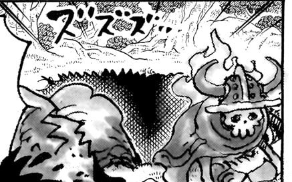
Eitherway though, going back to the previous argument, Imu being largely confirmed to be the devil explains a lot about her current powers. Beyond the devil’s tail we saw used to kill Cobra, we also saw Imu transforming into a large jawed creature, though we also witnessed a semi-transformed state, similar to that of the Gorosei, in which they very slowly morph into their devil forms, something the anime also showed is a slow process where they attain this blob-like shape, what some originally mistook as just being shadowing. However, doesn’t this silhouette remind you of something? Because quite clearly it is incredibly similar to the depiction of the Devil shown in the Harley, what as we assumed is most likely a depiction of the Sea Devil and in turn Imu, represented with the same large devil wings.
According to what Ivankov said St. Nerona Imu was supposedly originally a human king who became one of the twenty founders of the World Government, so it doesn’t seem like Imu was originally born as a devil, but rather became along the way. Either through the power of a fruit or likely as some point of origin of devil fruits, particularly as the Sea Devil was cited as the point of origin of all devil fruits. In Chapter 19 Shanks explained that the myth of devil fruits relates to these fruits being the supposed incarnations of the Sea Devil. Eating these fruits grants you the powers of the Devil, but in turn the Sea Devil also rejects you for having attained its powers to the point water itself rejects you, paradoxically enough.
The concept and entity of the devil though, especially as depicted here through Imu, is something that dates way further back than even the Void Century. If we assume that the One Piece world is much like ours, the concept of the Devil is one that dates to times immemorial. While a figure of many different religions, the concept of the Devil has existed across so many different cultures. While different cultures worship different Gods, all share a common fear for the figure that to them embodies the “Devil”, the personification of evil itself. Some call it “Satan”, others “Lucifer”, “Iblis”, or “Beelzebub”. Some even associate it with the figure of Lilith, what some believe to be the origin of the concept of a bat winged devil, a name that is eerily similar to that of Lily.
All of these different tales and myths of the Devil from across history may have been lost in the finer details across the tides of time, particularly after the world underwent its first calamity. However, traces and ideas of it remained, and at the very least, the unified idea of the Devil, the incarnation of all evil, persisted across history, and likely took form into whatever Imu became. Even within the story we’ve seen mentions of the Devil time and time again, some treating it like a myth, others using expressions such as “she’s like the Devil” or likening others to the Devil itself (such as Oars who was considered so fearsome they called him “the Devil”), and others outright worshipping the Devil like the people of Harahettania. As such I firmly believe that the Sea Devil as we currently know it is the incarnation of all the ideologies of the Devil across history, fundamentally an incarnation of all the fears of humanity made manifest, sort of similar to the concept of Chainsaw Man’s devils if that makes sense. And as such I have to ask myself the question: is Imu a human who attained the powers of the Devil to further his greedy ambitions or was Imu even outright taken by the Devil, perhaps something similar to a failed Zoan awakening, and is now nothing more than the incarnation of all the evil and fear of humanity? Regardless of which, even if Imu is still in control, I really believe that Imu represents not just their personal evil interests, but the accumulated evil of all mankind.
Particularly iconic though is the Devil’s presence in the tale of Genesis, where in some sources it took the form of a snake and deceived Eve into biting into the forbidden fruit of knowledge, resulting in Adam and Eve’s expulsion from the Garden of Eden. In a similar way, Imu may have done the same within this future too: Imu used the devil fruits of what may be the devil fruit tree Eve to tempt others as the devil, resulting in the expulsion of the Lunaria from the top of the Red Line. The difference here is that Imu then seized control and placed himself firmly as the King of the World. Imu somehow tricked the entire planet into believing the Celestial Dragons are gods, when in reality it’s a cult of literal devils that took control of the reigns of the world. And to oppose it, the complete opposite figure needs to stand against Imu: the Sun God Nika, the god that encompasses the good and joy of humanity. If Nika represents all the hope of humanity, the good parts of religions and people’s faith for a better world, then Imu encompasses all the cruelty of mankind, the horrors of manipulative dominant religions and people’s greatest fears embodied.
Imu’s Attacks
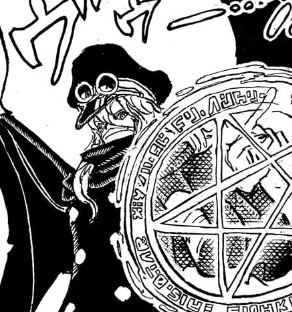
Regardless, even just beyond appearance, it is clear that Imu’s powers relate to the old depictions and ideas of devils that we mentioned earlier. Imu can seemingly summon pentragrams, from within items can appear, such as summoning cannons to fire cannonballs at the giants. These pentagrams have writing on them similar to the Abyss, what seems to be a language similar to Latin letters but with some differences. Imu is also able to summon what looks like a Grand Grimoire, being the the magic book used in the myth of the Goetian Grimoires to summon devils. In this case Imu summons from the book a…. uh, gun and small dagger, though one of immense size to be able to shoot Brogy’s arm’s cleanly off. Goofy as the idea of a gun is this not only shows that Imu’s powers have immense versatility for combat, but also that they quite similarly mimic Nika’s powers, as we’ve long since established Imu’s cartoonish depiction of the devil clearly parallels that of the Sun God Nika’s cartoonish superhero appearance.
But more than anything Imu has the power to grant what she calls the “aku no chikara” (悪の力), the “Power of Evil”. Though it should be noted that evil in Japanese, much like English actually, forms part of the word for “devil”, “akuma”. Imu claims that in exchange for “freezing their aging, they will attain immortality and increased strength, under the dominance of Muu”. It’s not fully clear if this is the same as giving them the mark or a simplified version of it compared to the God Knights, though it’s hard to say given how on one hand they appear different but on the other given how much Gunko seemed to be missing her similar memories. Particularly as Imu claims to rid them of their common sense and make them live as “devils”.
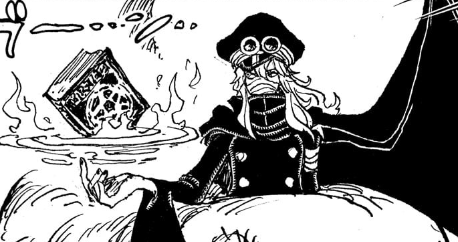
More specifically though, this technique is called “Aa Kuwaru: Domi Reversi”. The first half is written in Japanese with the katakana “aa kuwaru” (アー・クワール), which while confusing as it’s basically complete jibberish is likely meant to be a pun on the Japanese words “Aku” and “Waru”, which both mean evil, literally making it mean “evil evil”. The kanji however reads as “akuma keiyaku” (悪魔契約), which translates to “deal with the devil”. The other half, being also the title of the chapter, “Domi Reversi” (ドミ・リバーシ), more simply derives from Latin, which means to “return home”, though more specifically it can also mean to “return to one’s original form”. However, given that the kanji reading reads as “kuroten shihai” (黒転支配), which translates to “darkening domination”, it’s likely that this “domi” just stands for “domination”, and thus this might just mean a reversal of who is dominating them. This is fitting as this “shihai” is the same that Imu used at the end of last chapter, claiming that she’d show them the “dominance of God”, so we’re quite literally seeing that in action here through a move that literally involves dominance. The move is also likely literally referencing the game reversi itself, as the giants stuck between the two devils are “reversed” just like in the game, which once again shows how goofy Imu’s powers can be.
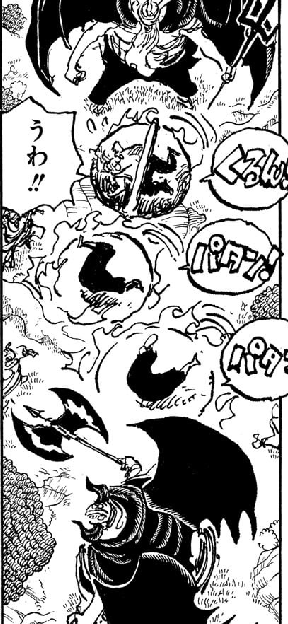
Those sucked by it are literally reversed, or flipped upside down, turned into an immortal devil whose broken hand begins to regenerate. Other giants also end up being transformed, and according to one of the giants it is simply due to being between their range, though we don’t know if this is the case or if Imu did it, because if this acts like a contagious virus it’s even more broken. I assume there’s a limit to this based on haki as always, so someone like Luffy wouldn’t be turned, but the fact that two monsters like Brogy and Dorry with bounties over a billion were caught so easily makes for a concerning turn of events (heh). As we see in the final page Imu seems to confer the Power of Evil to some of the MMAs as well, making them even larger or have demonic features, including a terrifying powered up version of the mom.
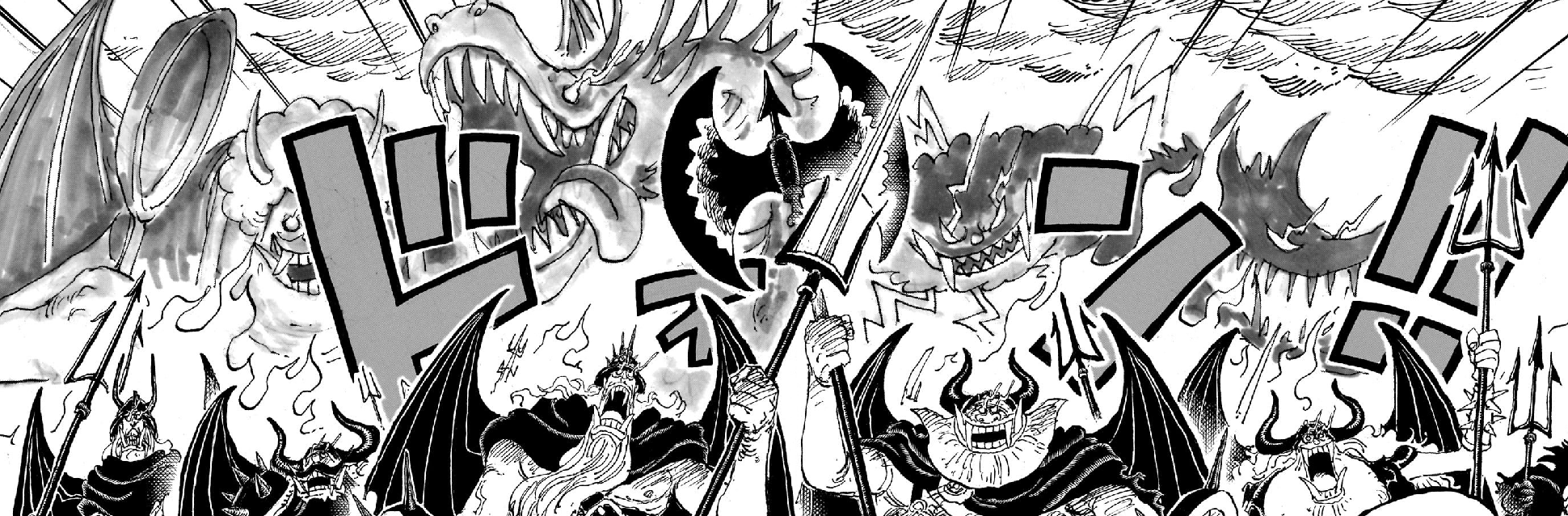
However, in all this context, it’s easy to forget how this may explain older plotlines. Particularly, we’ve always questioned why there was an Abyss in the throne room of Aurust Castle, but now knowing that Imu can literally turn people evil, there’s a very real chance that Harald’s betrayal was a lot more straightforward than we thought. What if instead of simply being a bad king that pretended to be good all along, he truly was good all this time but was simply reversed by Imu, and so Loki found no other option but to kill him? And then the Government shelved the matter until later because that’s how politicians operate. At this point, given how things went, and given how Gaban fell to the Underworld after failing to stop Gunko, it really seems like the only option to stop Imu and her army of devils rests down to those in the Underworld, likely having to team up together if they even want to put an end to this living nightmare.
 The Library of Ohara
What if Imu’s ability to transform giants has to do their ancestry as onis? Maybe they were once demons but at some point betrayed her and now they are simply being reclaimed.
LikeLike