
Here’s an analysis for the past 5 chapters! Sorry for not having shared this earlier, but I was recovering from sickness, so I hope you can enjoy these!
Video version: https://www.youtube.com/watch?v=ePjIgyjIeY8&feature=youtu.be
Covers:
On the covers, Yamato defeats Who’s Who, helping liberate the kidnapped ladies and the carpenter who built the hideout while also recovering from him the sword that, if you remember, he was supposed to bring to Yasuie’s grave all the way in Hakumai, which should be our next stop before ending in the region of Ringo. Ulti and Page One are safe as well, and they ultimately ask to become Yamato’s followers. After all, even with Yamato having renounced Kaidou as a father, the three of them are still technically siblings, since Kaidou had adopted Ulti and Page One from Hanafuda, the Warlord who had been defeated by Ace, and this ultimately parallels Oden who also got two followers from the start, so who knows if more might join Yamato. At the same time we also see that Raizou has become the daimyo of Udon, which makes sense as he is from this region and is where he met Oden. This leaves one wondering who will be the daimyo of Hakumai and Ringo, though most likely they’ll be Kawamatsu for Hakumai and Kiku for Ringo considering she’s from that region.
1143
As Saul pursues the kids, he reveals some more of their names, which include Mag and Ronja. Ylva is mentioned again, who is later brought up to actually be Yarul’s great-great-granddaughter (玄孫). Mag could potentially be named after Magni, one of the sons of Thor. Ronja (pronounced Ronya) may instead be named after Ronja rövardotter, a famous Swedish fantasy book set in viking Scandinavia which famously got adapted into a fairly iconic Japanese anime.
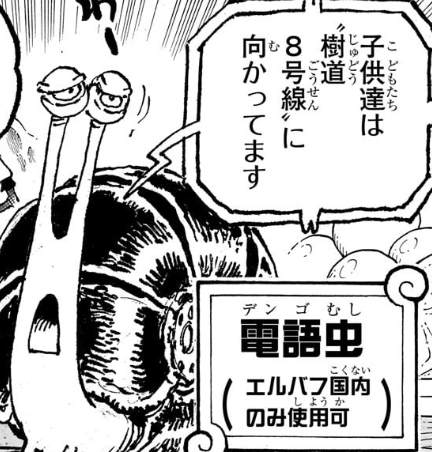
The giants across Elbaph try to stay connected via phone, except in this case they use a species called a dengo mushi instead of a denden mushi, with its key difference being the fact it is giant sized, making it comfortably realistic for giants to communicate without needing to use minuscule den den mushi. However, of course, its name is a pun. You see, den den mushi are named after an old Japanese name that was used to refer to snails, except that its kanji changes the words “denden” into “electric communication” (電伝), making a pun off of “denwa” (電話), the Japanese word for phone.
In this case, though, then dengo mushi changes the second kanji for that of “words” (電語虫), basically translating to “electric diction” snail, once again trying to make a pun off of denwa, phone. The difference is that in this case it’s meant to sound like “dango mushi”, which is the Japanese name for the pill bug. The pun is visually evident as the dengo mushi does in fact look like a pill bug, with a round carapace to boot.
In this communication, the giants refer that the kids are heading towards “Tree Road Nº8” (樹道8号線), showing that the giants have given particular numbers to the routes that connect the Treasure Tree Adam as a way to identify them, in a similar way to how we would number routes and roads.
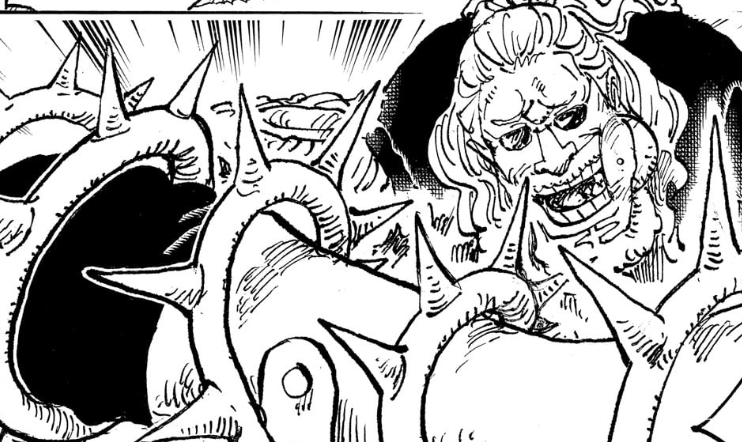
We get a clarification for the fruits of the remaining God Knights. Starting off with Sommers, his fruit is indeed just what we expected, the Iba Iba no Mi, or Thorn Thorn Fruit. It is named after the word “ibara” (いばら), which means “thorns”, usually referring to those of a rose. Indeed, it makes him an “ibara ningen” (荊人間), or “thornman”. It really seems to be as simple as him being able to set thorns that sting all those who try to touch them, which he can apply onto others and likely even himself, giving him quite the powerful immunity and attack power. This power quite befits his theatrical dramatic attitude, claiming that “some would die for love” and “there’s real emotion in killing”. Though I wonder if this rose/thorn-related power can be simbolically connected to some type of demon to make the devil pattern of Imu-conferred powers consistent, much like how Gunko’s arrows make her like an ittanmomen devil.
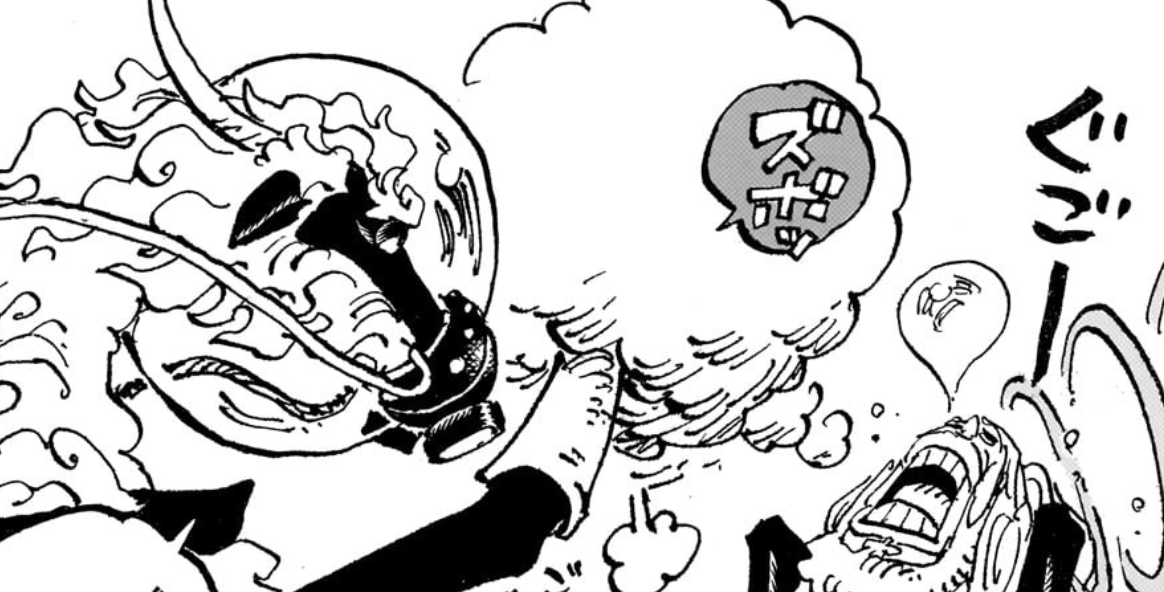
Similarly, Kiringham has what we expected to be a Kirin mythical power, particularly being the Ryu Ryu no Mi, Mythical Model: Kirin. Now before getting into the details of the fruit, this name is a bit messy, particularly because the word “ryu” in Japanese means “dragon”. However, in the past this term was used for the fruits of dinosaurs (or other saurs like pterosaurs), translating as the “Saur Saur Fruit”. The reason for this is because in Japanese, dinosaurs are referred to as “kyouryuu” (恐竜), which literally just means “scary dragons”. The reason for it is because in ancient China, dinosaur fossils were mistaken for being bones of dragons, and etimologically the word stuck until present day. So in One Piece, what were models of the “Saur Saur Fruit” were instead written as Ryu Ryu no Mi (Dragon Dragon Fruit) in Japanese due to that etimological root. This is also likely why Kaidou’s fruit is a model of the Uo Uo no Mi, or Fish Fish Fruit, to distinguish dragons from saurs.
However, in this case, Kirin is said to be a Ryu Ryu no Mi, Mythical Model: Kirin. This is likely because the kirin has some dragon-like features and is sometimes associated with one, but this causes a bit of a headache in translation because Oda is likely playing into the double pun aspect of dragons and dinosaurs sharing an etymology which just doesn’t really communicate in English. So this is something that definitely gets lost in translation. This also adds an extra layer of confusion as this is an actual devil fruit and not just an innate devil power. It’s still possible it could be conferred by Imu, given how Gunko has a named fruit but also has the dark flames that are native to those who have been conferred Imu’s powers. As such, Kirin’s power could still be granted by Imu, but I suppose in the form of a fruit. This also makes one question if the devilish abilities of the Gorosei are also just actual devil fruits, or if they are the special case in particular (same thing with Shamrock’s sword only being referred to as the “Cerberus”).
As for how his powers work however, it’s just as we expected it, making him a Dream Materializingman (夢具現人間), showing that, just as we thought, he did put the kids to sleep and materialize their fears. In this case, he pulls out aspacchee rock salt (アスパッチ岩塩) out of Sommers’s dream to add seasoning to their food, which seems to imply he can’t pull stuff out of his own dreams (which makes sense since he’d be asleep), so he at least needs someone else to do it. By the way, that I can tell “aspacchee” isn’t a word in Japanese, but is likely referring to a location within One Piece, and is likely meant to be a reference to the famous apalachee salt (アパラチー) from the mountainous region of the same name in North America, salt which is favored for its gourmet taste. In this case though, the salt bears no calories as it’s just made of dreams.
Sommers refers to the beings that came out of the dreams Kiringham conjured as “MMA”s, but pronounces it as “muuma”. This is likely in reference to 夢魔 (muma), literally meaning “dream devils”, or basically nigthmares, demons that appear in your dreams. As they mention this, in the background you can spot the Níðhöggr, a draugr, and Nika marching forward.
Interestingly Sommers continues his weird expressions, as he claims that this game they’ve set up is so easy that it becomes a “Nuruge” (ぬるゲー), which is a gamer term that is a combination between “nurui” (lukewarm) and ge-mu (game). You may have heard similar combinations, such as kamige (god-tier game) or eroge (erotic game), but it’s basically a gamer term for a video game that is so easy it only appeals to filthy casuals and not hardcore gamers.
Switching back to Loki, he mentions that the Ragnir can’t be lifted by others, which explains why it was left with him. This lines up with the myth of the Mjölnir, where only those who are worthy can lift it. Similarly, the Ragnir still retains some lightning around it, but I wonder how it works, if it’s related to Loki’s powers or if it’s some sort of mineral that retains static electricity. However, while Luffy punches him with a fairly weak non-haki coated gear third, it’s enough to make Loki collapse, as he was pretending all along to be perfectly fine as a way to trick Hajrudin, befitting of a trickster like him.
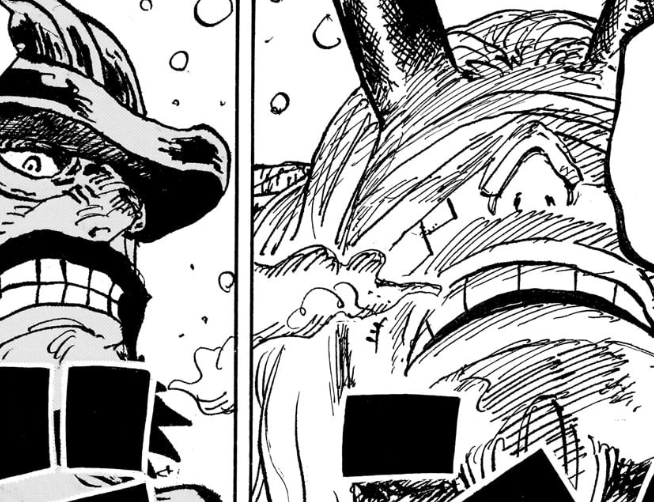
With his helmet off, though still having his eyes covered, we see in fact that Loki’s horns are due to his ancient giant heritage, different from Hajrudin likely due to their different mothers. Interestingly, Loki covered his eyes while as a kid as well, which makes me wonder as to why is the reason. However, Loki breaks his silence as he implies he indeed wasn’t the one to kill his father, just as we all expected.
1144
Meanwhile, the Adam Tour continues, as Franky and Ripley reach a place called the “Facility” (施設, shisetsu), hidden within the groves of the Adam Tree. This is an ancient scientific-looking building that has supposedly existed here in Elbaph since times of old, to the point not even the giants know what it is. Its old age and futuristic appearance almost certainly seems to point to the idea that this building is from the original First World.
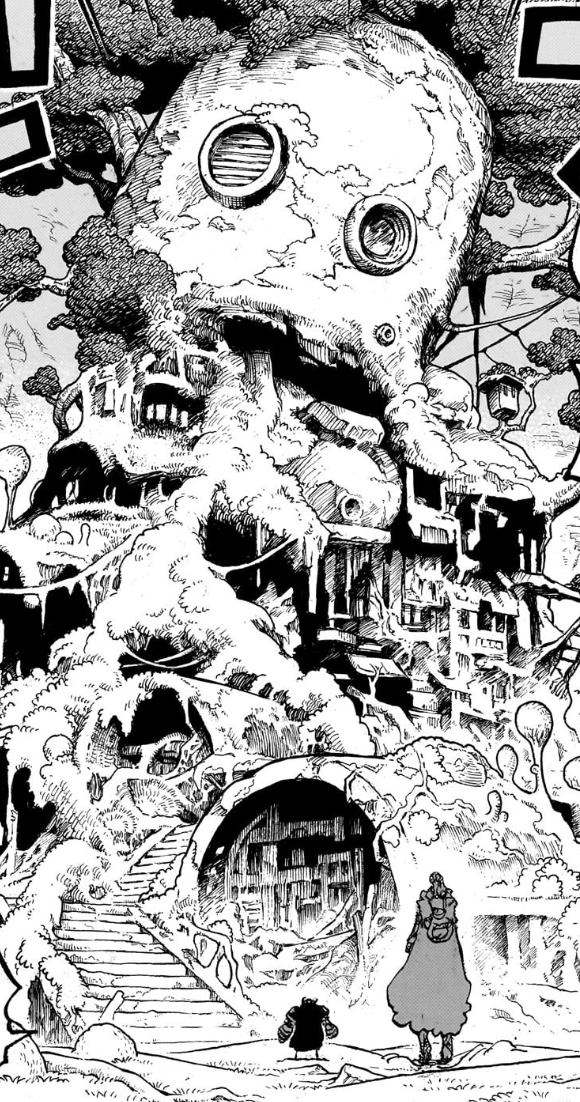
Though some people have likened this building to looking like a robot due to the shape of its roof, if anything I’d have to say that it far more resembles the Third Research Institute, the laboratory from Punk Hazard, with the way it’s built like a layered structure. Particularly as well, its round dome is heavily reminiscent of the style of buildings on Egghead, which reinforces the fact this building is supposed to give off some futuristic vibe.
Lilith, who stumbled into the building, claims that even to her lowest estimates, the building must be over 3000 years old. Which is an astounding date to mention, but more than anything this is Oda finally giving us some proper timeframe for the First World, that of over 3000 years ago. Now admittedly, all this gives us is a frame of reference for a time when the First World happened, not necessarily when it ended. However, at the same time, I feel like Oda giving us this date is to give us a better frame of reference, and I don’t think that enormous of a time happened between the overindustrialization of the First World and its end, particularly with the Harley stating that as people seized the forbidden flame, seemingly soon after it led to the apparition of the first Nika and the calamity of the Earth God and the Hellflame Serpent. So at the very least, I think this can give us a good reference that the end of the First World may have happened some 3000 years ago.
This would discount the idea that the end of the First World was in the year 0 of the Kaienreki Calendar (or Sea Circle Calendar), around 1524 years ago, but rather twice as much further back. While the Void Century started in 600 Kaienreki, or 924 years ago, even further back than that would be the Year 0. This means however the Kaienreki Calendar may have started for a different reason, and this may explain how before it the Tenreki Calendar (or Celestial Calendar) mentioned by Robin in Alabasta may have existed beforehand, fundamentally leading from a Gregorian Calendar to the Tenreki Calendar to the now Kaienreki Calendar, setting the world of One Piece in a distant 3000 years in the future. Given how the Kaienreki Calendar and the Tenreki Calendar mention two of the three planes the ancient weapons are named after, particularly being the underworld, the sea, and the celestial sky, I wonder if the original Gregorian calendar could here be called something like the Underworld or Hell Calendar, particularly with the mentions of the Hellflame Serpent and whatnot. It was mentioned in the Databook that the dates Robin made up for the calendar were completely made up, but we don’t know for sure if the calendar itself she did actually reference from an existing calendar.
At the very least, this larger space of time may explain better how civilizations and races redeveloped across the centuries. With that said, it was mentioned during the Alabasta arc how the Alubarna seat of power represented “4000 years of history”, meaning that the history of the civilization of Alabasta, perhaps even before it attained that name, spanned as far back as the First World, and may have survived across both calamities. Similar is the story of Ohara’s Tree of Omniscience which is said to be 5000 years old.
Lilith is fascinated with this facilty, claiming that she may want to live here, which could be the seat of her new laboratory now that Egghead is gone. However, Bonney claims that “it’s amazing inside of it”, suggesting there’s even more fascinating ancient relics to be seen within. This prompts Franky to head inside the facility but they are interrupted by one of the MMAs, being the fear of storms, particularly dangerous for it can unleash lightning that risks burning the tree and destroying this priceless historical site.
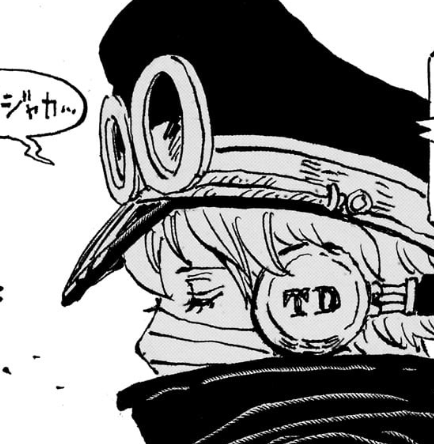
After the God Knights have finished their luxurious meal, Gunko relaxes by listening to some music. She’s using headphones with the inscription “TD” on them. In case you don’t remember, these are TDs (Tee-Dees), standing for “Tone Dials”, essentially the One Piece version of CDs that use the technology of the tone dials from Skypiea that record noise to record music and thus resell it that way. We were particularly told about this during the return to Sabaody where Brook was said to have surpassed over a million TDs in sales, which for the less populated world of One Piece and the difficulty of their distribution is actually pretty impressive. However, much like CDs, these TDs need to be pre-recorded, so they can’t really stream music and they’re likely not the easiest to obtain depending on the country, but not that it should be an issue for a God Knight like Gunko.
When asked about what her favorite song is however, Gunko responds with “New World”, which is referring to Soul King’s iconic song that he sung during his final concert in Sabaody. Sommers wonders if this is due to Gunko wishing for a newer world, but I wonder if this ties with her fear of Nika in some form. We also get Sommer’s laugh, which is “gi ha ha”.
Saul tries to desperately stop the kids from going into the fire, and with it we get the names of a few others: Skadi, Olaf, and Björn. Skadi refers to the jötunn giant goddess known as the goddess of winter, involved in a lot of ways in viking myth, particularly being the one who tormented Loki during his imprisonement with serpent poison. Olaf was a norse king, supposedly the grandson of King Harald, first king of Norway, while Björn was both also a king and is also the old word for “bear”, referring to how bears were feared in norse myth due to their incredible strength. However his efforts are thwarted by the Fenrir, who Saul suspects may be controlled by Kiringham, which makes me wonder if he can actually order the MMAs around.
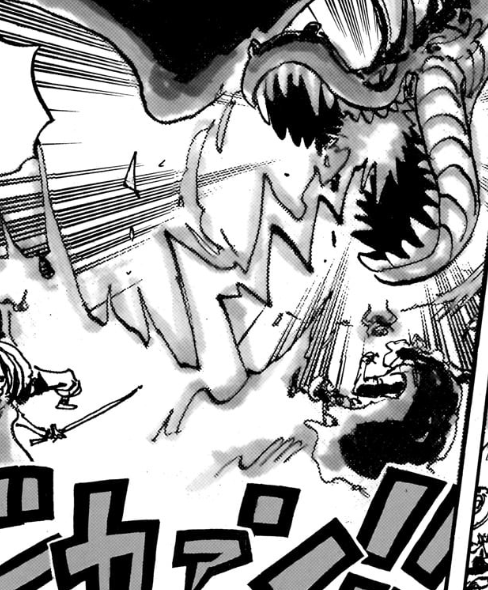
The West Village keeps getting assailed by even more MMAs, including the Níðhöggr, a ghost, and what seems to be a Loki. Fittingly, the Níðhöggr doesn’t blast fire but lightning, since it is known as the lightning dragon. Their attack is however stopped by Dorry and Brogy, who ride into battle on the Great Eirik while unleashing a “Hakoku” (覇国), their iconic attack from Little Garden which translates to “Conqueror Country”, using the same “ha” as in “haki” to give an idea. They are joined by Gaban, who should help balance things out a bit, though unlike Dorry and Brogy, he is still continuing to drink, with a jug with the kanji for “alcohol” (酒) on it. But with Shamrock out of the picture I do wonder where the real challenge this arc will come. A big part of the problem is the situation with the children and the fire not being something you can overcome with sheer strength alone, but we’ll have to see if the God Knights can still measure up as worthy rivals for the Straw Hats.
1145
Back in the Underworld, Zoro and Sanji hunt down a dinosaur to provide meat for Loki with their iconic combo move, “Armée de l’Air Power Shoot”, with the first part translating to “Air Force”. Just like all the other beasts in Elbaph, this is a creature that originally appeared in Strong World, after Shiki seemingly took many animals from this island, this one being a Groggysaurus (グロッキーサウルス), similar to a diplodocus or brachiosaurus but with a beareded mane.
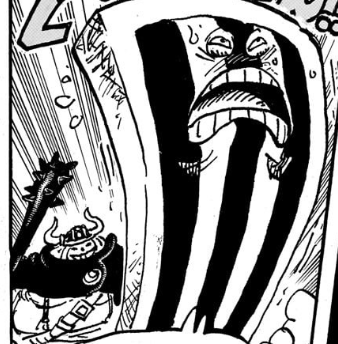
Goldberg fights back by using his shield, whom he refers to as “nasshu” (ナッシュ), which could be translated in different ways such as nosh or nache. However, there’s likely a wordplay here with Goldberg’s own speech pattern, as he ends his sentences with “shu”, similar to a lisp, so Nasshu’s name just follows pattern. As we had assumed, it is indeed a homie, as it seemed to express, and Goldberg gives better context that it became a homie after his father tried to take down Big Mom. This seems to have been after Big Mom left Elbaph since she had the fruit, so it was probably around the time she was becoming a powerful pirate when giants tried to stop her but even the warriors of Elbaph were powerless against the natural born disaster that is Big Mom.
Loki tells the group about the God Knights, mentioning the fact that if he’d made it far enough up the ladder to have fought them, then he would’ve gone as far as becoming King of the World. This is befitting as the King of the World Imu is the one ruling over the God Knights, but I wonder if Loki was just making an example or if he knows anything.
Loki however also comments that he too looked up to a pirate once upon a time, where he asked him to let him on his crew. We see that this was back when Loki was still a kid, so given the fact that Loki is currently 63 years old, him looking like a 10 year old means this must’ve been somewhere around age 20, so around 40 years ago.
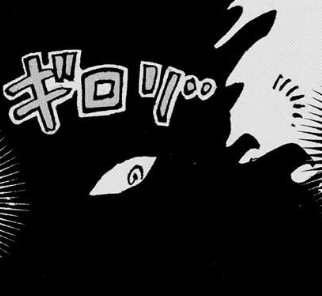
And that period of time lines up pretty well with the era of the Rocks, where legendary pirate Rocks D. Xebec had assembled an incredibly powerful crew to terrorize the world, until he was defeated 38 years ago in the God Valley incident. As such, this individual, who also has the same spikey hair, could very well be… Rocks D. Xebec himself!! This is reinforced by the fact that there’s a man telling him “Don’t tell me you used a blade when your opponent was a little kid?”, to which the man replies “Shut up, Newgate!!”. Newgate is of course referring to Whitebeard, Edward Newgate, as clear by the mustached silhouette, which reinforces the idea that this really was Xebec. As a reminder, in Japanes his name is written as “jibekku”, meaning the pronunciation is Xebec (jebeck), rather than ksebec, zebec, or any other. This is also the first time we get to see Xebec’s eyes, though they are still very shadowed, as well as his speech pattern, which is what you’d expect being the rude speech pattern of a gruff pirate.
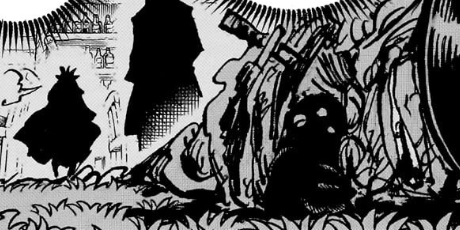
Meanwhile, back at the present, the children keep marching down the Tree Road Nº8, which in this case is also described in the chapter title as being on the 第2樹林区 (dai ni jurin ku), which generally translates to the “2nd Tree Forest Ward”. This is similar to the subdivision terminology that is used to name Tokyo’s wards or those of other cities. As they are about to burn, however, they are saved by Jinbe, who uses one of his signature moves, Ipponzeoi, though this time combined with umigumo, sea clouds. Ipponzeoi (一本背負い) referring to a sumo move where an opponent is defeated with an over the shoulder throw, similar to the over the shoulder move Jinbe makes.
However, Gunko takes note of them, and so hops on their svarr to confront the Straw Hats and potentially kidnap Colon as well, or make him pay for his interference.
1146
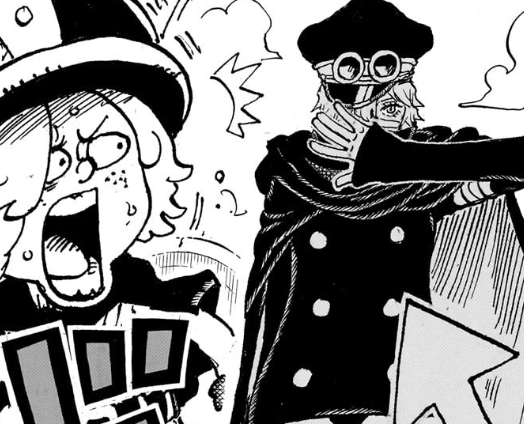
As she does, Nami exclaims “shinnyusha” (侵入者), which means “the intruder!”, but Colon replies by repeating the same, except “shin” in his case is written in hiragana (しん入者), which in this case makes it read like “the newcomer!”. The joke here is that “intruder” is too complex of a word for a kid like Colon, so he is unable to understand the first kanji and thus misconstrues the word as “newcomer” instead of “intruder”, but this is a joke that’s quite hard to convey in a translation.
When Gunko mentions that she’s not a human, Brook looks confused, which is later followed by the fact that he wonders if she might be one of the God Knights, though the simpler joke could also be the fact that he himself isn’t exactly a normal human, but a skeleton. I’ve seen some people wonder how Brook knows about the God Knights, but beyond the fact that he is old and cultured, the reality is that we don’t know how secret the existence of the God Knights is, and by all means may be as publicly known as the Gorosei are.
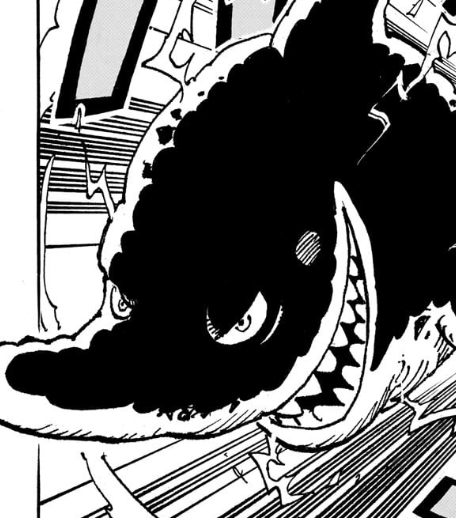
Nami retaliates with an attack she calls Thunder Shark Tempo, whose kanji reading is basically just the Japanese words for thunder and shark (雷光鮫). This attack is quite fitting however, as it obviously ties to Nami’s previous history of being oppressed by the shark fish-man that is Arlong and her being able in a sense to retake this as a way to prove her own strength.
Gunko however makes a very interesting speech, stating that “The world… will one day suddenly disappear. Or so it was supposed to. However, some of the human race took notice and made it known to the world…!! Now that it’s come to this… it cannot be stopped. No one can stop it anymore…!!! It’s only a matter of time. An immense war that will engulf the entire world is about to begin!!! So when that time comes… who will the giants follow? You could say this is a matter that could heavily change the tides of war.”
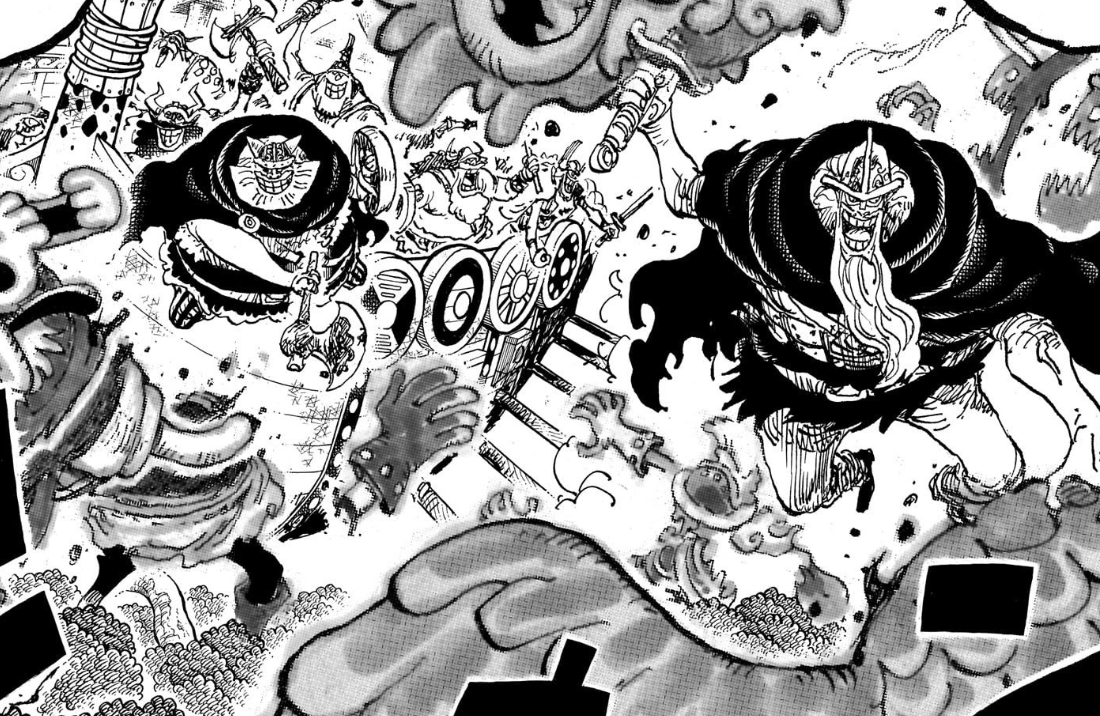
This speech in turn makes reference to several iconic speeches across the series. On one hand, the claim of “it cannot be stopped” harkens back to Roger’s iconic quote: “These are things that cannot be stopped: inherited will, people’s dreams, and the swell of eras.”, while the “no one can stop it anymore” also harkens to Law’s iconic speech in Punk Hazard: “I’ve destroyed that gear!! Now no one can stop it anymore!!!”. But most importantly, she claims that “an immense war that will engulf the entire world is about to begin” harkens to Whitebeard’s final speech where he said “Sengoku… you and the World Government fear the immense war that will engulf the entire world one day!”. Worthy of note is that this “immense” used to describe it is also identical to the description of the “immense” kingdom of the Void Century, so there’s certainly a level of thematic consistency intended here. So this makes it very clear that the war that Whitebeard was speaking about is just about to begin! This also pretty concisely explains the God Knights’ long plan in trying to get the giants of Elbaph on their side and the reason they were even willing to make someone like Loki a God Knight for that sake.
Her speech also ties into the chapter’s title: “Seichuu ni Dou Ari” (静中に動あり), which translates to “Within the stillness, there be motion”. This sentence structure may sound familiar, as it is identical as the first line of the Harley verses, such as “Within the earth there be flame”, except this one doesn’t match any of the three, rather being a fourth unique verse made to sound like it. “Within the stillness, there be motion” could be interpreted as the idea that the world was meant to sink without anyone noticing, but then the humans began to notice, began to move, and ultimately started causing a stir that resulted in this great conflict.
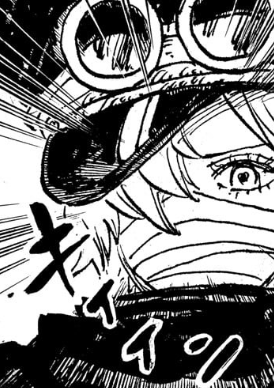
As Gunko explains, Usopp tries to shoot her, but before he hits her the sound effect “kiin” plays on screen. This is the sound effect often used for future sight within One Piece, especially when Katakuri used it, but you could also interpret it as a strong glare or reaction so it’s hard to say for certain, but at the very least the sound effect provides the idea that Gunko definitely reacted to the attack but seemingly couldn’t even be bothered to dodge it.
Gunko however regenerates herself, just as the Gorosei do, showing that anyone with the mark has the power of regeneration, and potentially the perennial youth too, though we don’t know if that’s separate due to involving the Ope Ope no Mi or if it is part of the regeneration. But it certainly makes the God Knights a lot more troublesome as they are just as difficult to deal with as the Gorosei, and seemingly only a massive amount of haki like Joyboy’s can get in between their powers.
Brook however comments to this by saying “being revived like that is so gross”, which is obviously ironic given his circumstances, but he follows this up by referring to her powers as “the height of folly” (愚の骨頂), which you may recall as the title of chapter 1105 but more precisely it is written with the kanji etymology of “the tip of the bones” to signify “height”, which might make it a hidden skull joke.
Also, Gunko’s speech being overlayed with both Luffy and Loki having their bellies full definitely gives this idea that Loki is going to be following Luffy as an answer to Gunko’s conundrum.
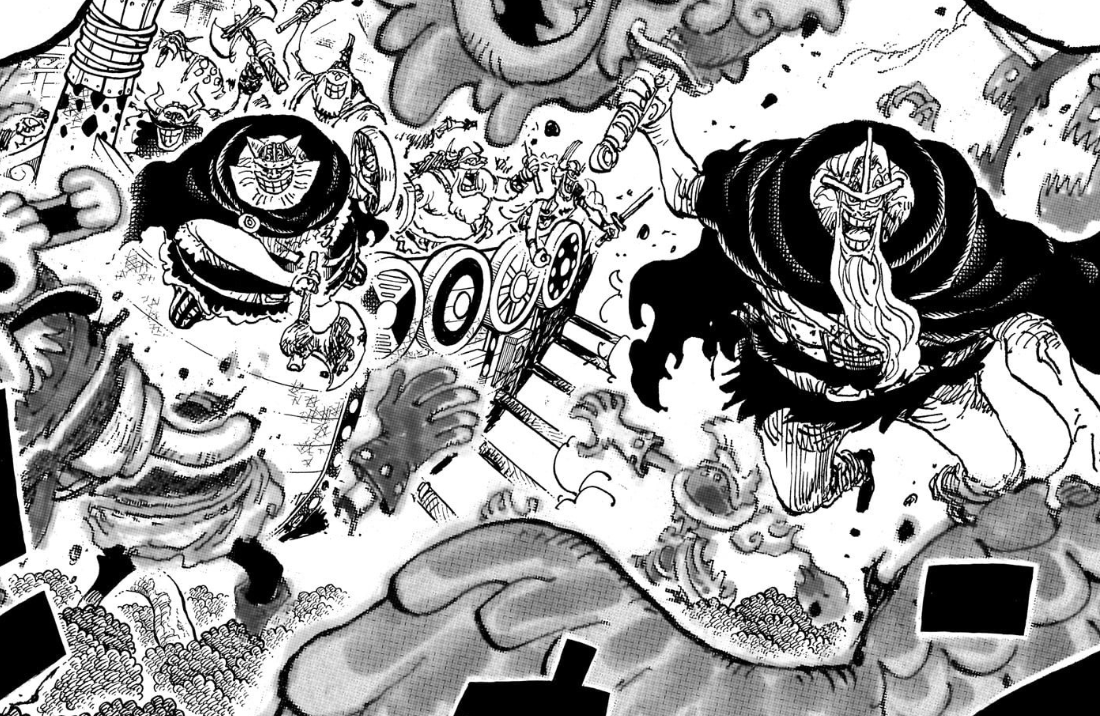
Gunko fights back by using an attack called “Arroe”, forcing Jinbe’s Gosenmaigawara Seiken and Brook’s Gavotte Bond en Avant on each other. It is written with the kanji for “fated arrow” (矢印縁) but might be a pun between arrow and aloe. As she deals with the other straw hats too, if you look at the panel, you can see she throws all of them off the svarr while she kidnaps Collon away.
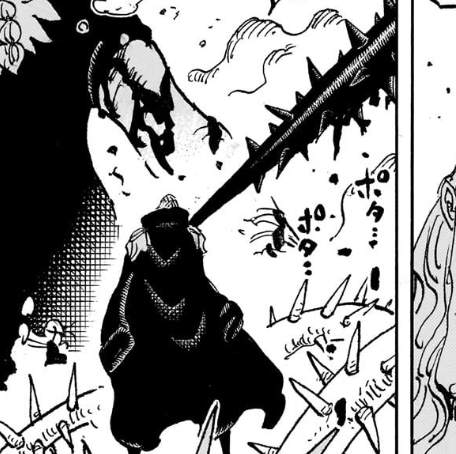
Meanwhile, Kiringham is attacking the school while Sommers is taking care of Saul, exposing his existence to the Government. Sommers seems to use a massive mace, spiked like the thorns he generates. Sommers also blames Harald screwing up for Elbaph turning into a peaceful country, which suggests that Harald was not quite the king we thought as many of us did speculate, though it’s still not clear how exactly he failed the Government.
1147
Saul recognizes Sommers as a God Knight, claiming to have seen them before, which likely was during his tenure as a Vice-Admiral.
We see then that Gunko has rounded up all the Straw Hats together, and tries to force Brook to become her slave. Particularly in Japanese, she uses the word dorei (奴隷), slave, but the phonetic reading is changed to “mono” (もの), or “thing”, basically stating “become my property/slave”. However Brook replies to this with an incredibly powerful line of “I’d rather die than live without humanity!”. Gunko kicks Brook back but she feels a swelling in her chest, likely feeling conflicted about having to hurt her idol.
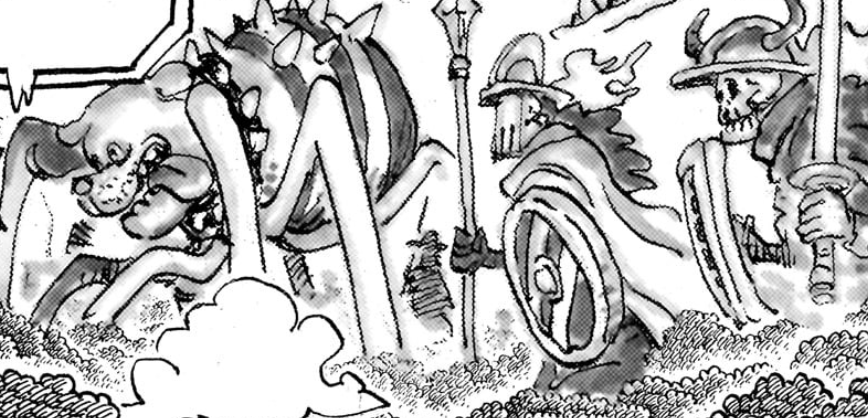
As Sommers begins his transmission, we get a look at several other places around the Sunworld. In one village, we see something that looks like a Jack-O-Lantern, which isn’t of Norse mythology, but more Irish/Celtic, but you could consider it close enough. Across the forest we see more draugr marching, as well as what seems to possibly be a sea king, given its fish-like serpentine appearance, as well as a… uh, dog spider? Being completely honest there is nothing I could find about a dog spider in Norse mythology, the closest would be the… just dog Garmr that guards Hel’s gates, but the spider part may be the result of a more creative kid.
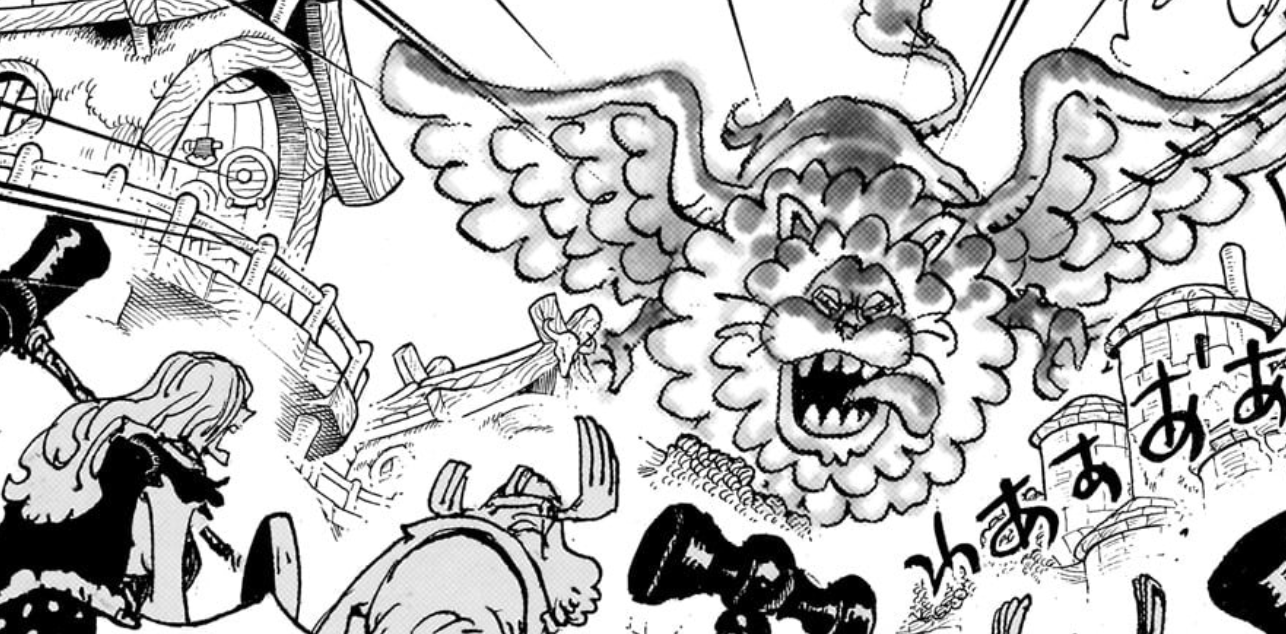
We see a couple of Elbaph’s other villages, such as the Craftsman Village, or Shokunin Mura in Japanese (職人村), which is a village predominantly composed by craftsmen it seems. This makes sense as we see all in the village armed with hammers, perhaps signifying they are like blacksmiths of sorts. The village also seems to possess more conical houses as its distinguishable architecture and is located on the Sunworld’s south-eastern side, so not too far from the Warrior’s Spring. They are attacked by what seems to be a Gryphon, a mix between a lion and an eagle and the namesake of Shanks’s sword; gryphons are usually depicted as having the head of an eagle and body of a lion, but plenty of depictions do also show them with the head of a lion like we see here. The Gryphon pertains more to Greek mythology, but again seems like a case where more global mythology was learned by the children of Elbaph. As a fun fact though, in the world of One Piece gryphons do actually exist as an animal species, as Big Mom claimed having captured one in the South Blue and keeping it in her collection within her library.
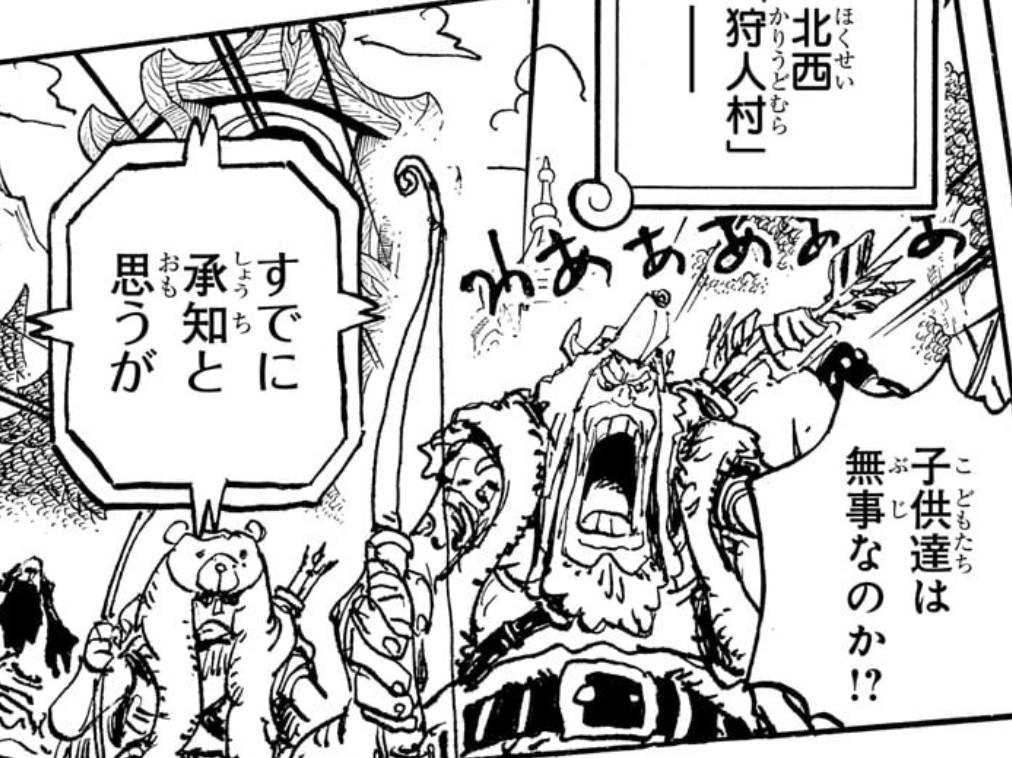
We see another village, which is the Hunter Village, or Kariudo Mura in Japanese (狩人村), which in turn seems to be composed by hunters, with the giants wearing animal pelts and holding bows. Their houses seem to have conical roofs, even if they are covered a bit, and behind them we can see mountains as well, which we know exist within the Sunworld too, having accumulated on top of the branches. This village is located to the north-west, placing it just above the West village, which from what we’ve seen acts as the capital.
Meanwhile Sommers moves along the branch on top of his thorns, which they seem to have taken the form of a snake. Behind him you can spot the defeated Saul as well as another wolf-like creature, perhaps another Fenrir or some other being, but it’s too covered to say.
Sommers introduces himself as the “dagger” from Mary Geoise (or “kaiken” in Japanese, 懐剣), which is an interesting way to present himself.
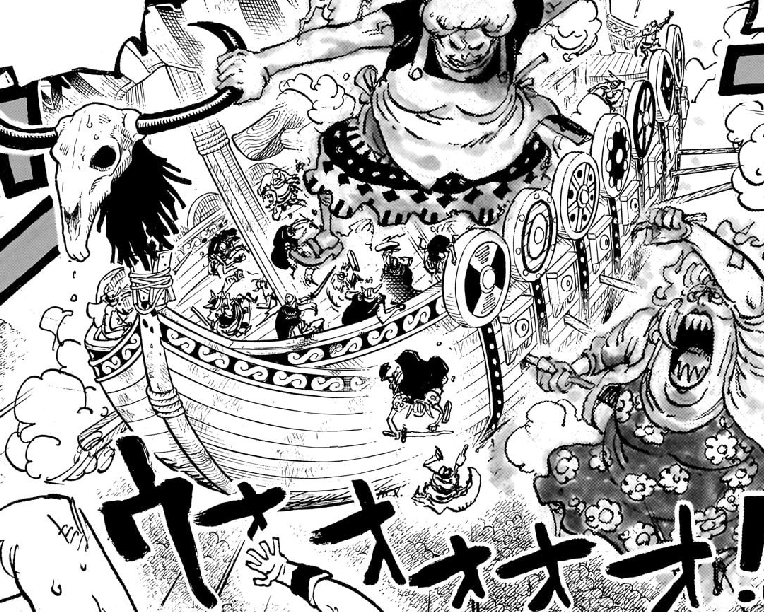
The Giant Warrior Pirates’ ship, the Great Eirik, is surrounded by a bunch of MMAs, including a dog, a cow-like being, and the most fearsome of all creatures, the mom. This causes it to crash somewhere between the Warrior’s Spring and the West Village, which happens to be close to the Facility where Ripley, Franky, Lilith, and Bonney were at, giving us a general idea of where it’s located.
Ange rounds up the names of the kids, so we might as well go through them. First is Ylva and Skadi, who we were already told about earlier on so I won’t repeat myself. Then is Olaf, who is actually Oimo’s grandkid, and is a scandinavian name that was historically famous for being an important King of Norway, actually being the great-grandson of Norway’s first King, Harald.
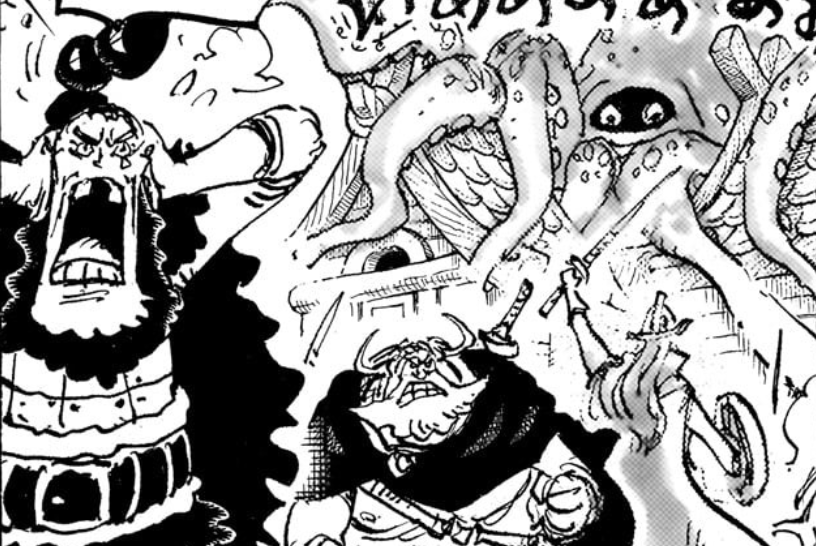
Next is the negative Karin, whose name may be romanized just this way as Karin is a scandinavian name. Mag was mentioned earlier, as was Ronja, who is clearly the daughter of this viking fighting the kraken, apparent not just from him stating it, but by their matching appearance, down to the teeth.
Bent was mentioned just this chapter by his dad who seemed to recognize the MMA as his wife, since Bent feared his mom the most, which we fittingly see here as he claims that his mom will get angry at him for this. Then there’s Yohanna, a name of Hebrew origin but spread in Scandinavian countries, who seemingly claims to not have parents to be saved by, potentially being an orphan raised by the village. And finally is the cowardly Björn, who was also previously mentioned, on top of, of course, Colon himself, whose name may come from the famous Puerto Rican wrestlers instead given how some giants in Elbaph are named after wrestlers.
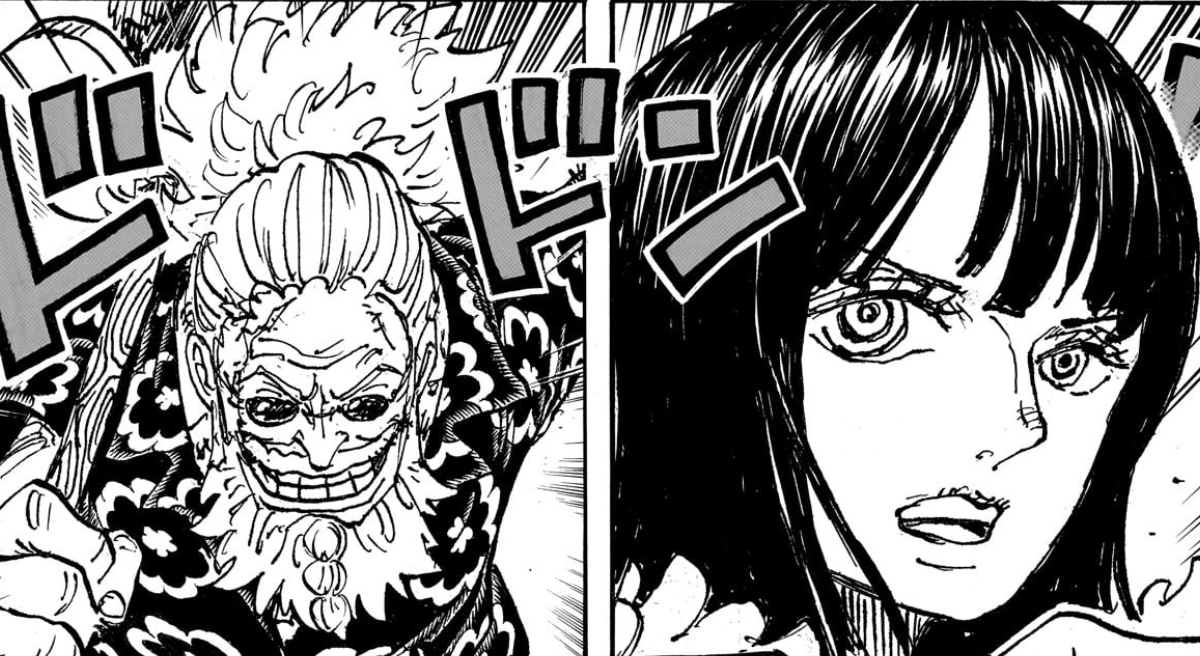
Sommers then asks to burn the school and the library as proof of their allegiance to save the kids, and leaves the choice down to Jarul, who is the closest Warland has to a leader right now. This is particularly fitting since Jarul was the only survivor of the encounter between Loki and Harald, so several people have been suspecting him so far. However, in order to avoid such an atrocity from happening, both Robin and Gaban lead the front lines, with Robin wanting to protect the books of Ohara within the library while Gaban rushes in to save his son.
 The Library of Ohara
just wanted to add That Salt always has Zero calories, even in the real world
LikeLike