
Video version: https://www.youtube.com/watch?v=28M18byPf68
Chapter Titles
First we gotta start at the chapter titles, with the one from last chapter being “Adventure in the Country of Mystery”. This naming pattern follows a long-standing tradition of naming One Piece arcs as we venture into a new island. All the titles so far have been:
Chapter 133: Adventure in the Nameless Country, where the Straw Hats venture onto Drum Island, which had just abandoned its name as Drum Kingdom, thus being left without a name.
Chapter 162: Adventure in the Country of Sand, crossing the Sandora Desert in the Alabasta Kingdom.
Chapter 245: Adventure in the Island of God, heading into Upper Yard.
Chapter 304: Adventure in the Long Island, arriving at Long Ring Long Land.
Chapter 324: Adventure in the Capital of Water, heading into Water 7.
Chapter 442: Adventure in the Devil’s Sea, entering the Florian Triangle.
Chapter 444: Adventure in the Ghost Island, disembarking onto Thriller Bark.
Chapter 497: Adventure in the Archipelago of Bubbles Dancing in the Air, making landfall on the Sabaody Archipelago.
Chapter 515: Adventure in Nyogashima, as Luffy landed on the island of Nyogashima, or Women Island, where the Amazon Lily Empire is located.
Chapter 526: Adventure in the Great Prison, as Luffy descended into Impel Down.
Chapter 606: Adventure in the Deep Sea, heading towards Fishman Island.
Chapter 609: Adventure in Fishman Island, exploring the underwater paradise.
Chapter 656: Adventure in the Burning Island, crossing the gates of Punk Hazard to meet Dragon Number 13.
Chapter 701: Adventure in the Country of Love, Passion, and Toys, walking down the streets of Dress Rosa.
Chapter 711: Adventure in the Country of Little People as Robin found herself in the Tontatta Kingdom.
Chapter 804: Adventure in the Country on the Back of an Elephant, climbing all the way up to the Mokomo Dukedom on top of Zou.
Chapter 831: Adventure in the Strange Forest, getting lost in the Seducing Woods of Whole Cake Island.
Chapter 911: Adventure in the Country of Samurai, as Luffy finds himself stranded on the Kurigahama beach of the Wano Country.
Chapter 1062: Adventure in the Country of Science, as the Straw Hats and Bonney emerge on the futuristic landscape of Egghead.
And now Chapter 1127: Adventure in the Country of Mystery, as the Straw Hats awaken in this mysterious toy world.
Cover
On the cover, Yamato discusses with Inuarashi, now the Daimyo of Kuri, about the disappearances. A nice detail is that they are eating onigiri, and a common plotline across this cover story arc is how everybody often appears to be eating. This is a subtle but effective way to showcase how the new Wano is different, and it’s a place where everyone can eat to their hearts’ content.
Country of Blocks
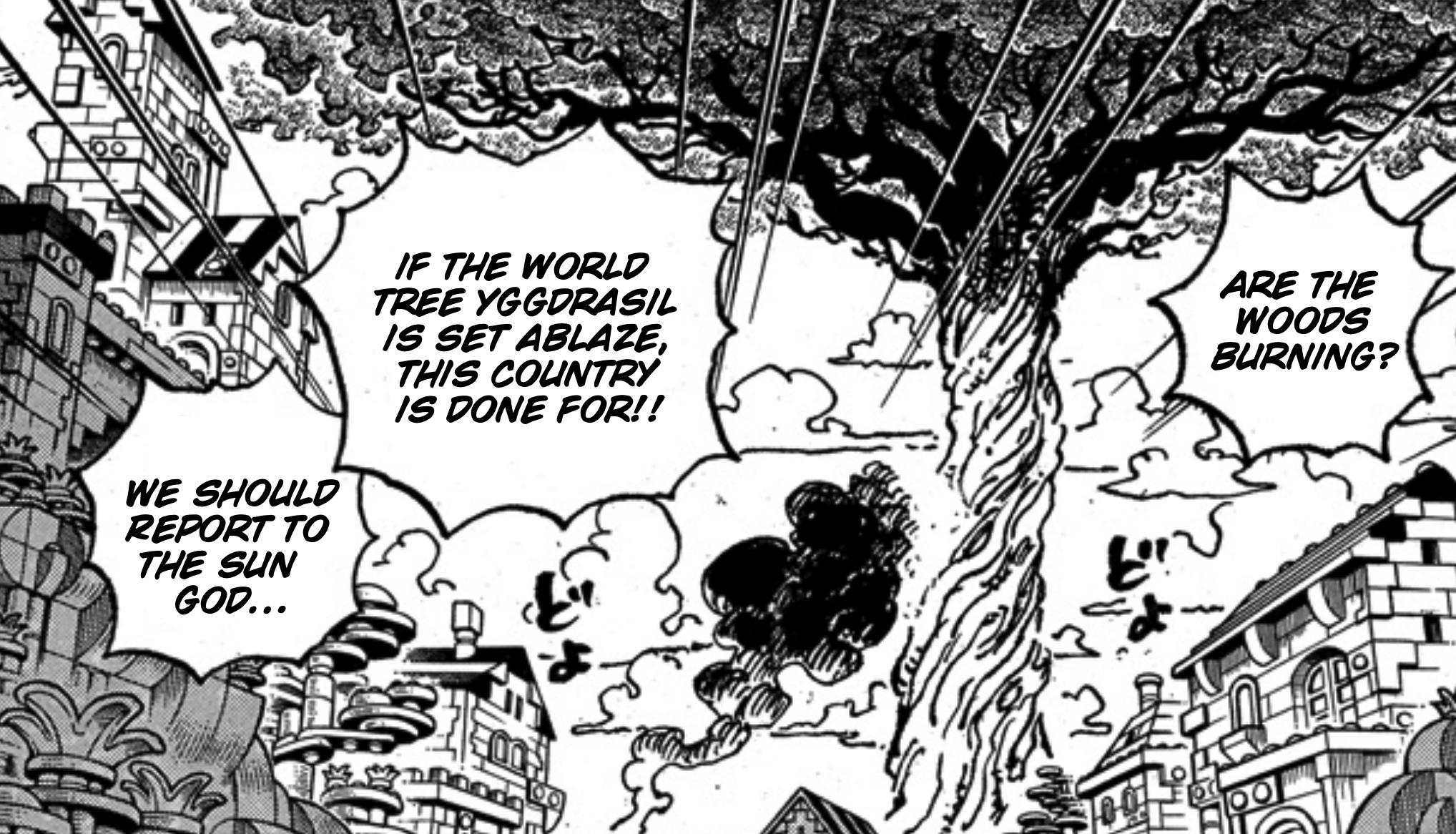
As we get a better look at the country they are in, we see a bunch of giants gathering around the city made of bricks, showing that not only the castle where Nami is in, but this whole landscape is made of buildable LEGO-like bricks. These giants, all clad in traditional Elbaf clothing, mention several terminologies that are quite important, so let’s break them down one by one:
First, they notice a large fire taking place, as they exclaim that the “Mimigami” has been defeated and roasted alive. “Mimigami” in this case translates to “Eargod”, and is seemingly referring to the giant rabbit that Luffy, Zoro, and Sanji attribute to defeating and eating whole later on. The Eargod is referred to as being “gigantic”, despite these giants supposedly already being quite gigantic themselves.

At the same time, the giants are surprised to see that giant bees have been defeated, which they call “Stingmor”, with the kanji reading instead being “mitsubachihei” or “bee soldiers”. However, there’s something that doesn’t add up. The giants refer to the “eargod” as being “massive”, and while we know that the creatures of Elbaf are definitely gigantic as well, would they be big enough that giants would be terrified of them? Furthermore, these bees are massive compared to normal bees, and yet their proportions compared to the giants are the same as the one we see Nami defeat in the next page. Meaning that if the bees are the same size, so are Nami and the giants. Do you see where I’m going? This means that these aren’t actual giants but human-sized individuals, which means this isn’t exactly a village of giants. This becomes more apparent later on, but let’s go through it step by step.
The not-giant inhabitants worry about the fire generated by the rabbit being roasted, as it could cause the massive tree at the center of town to catch fire, and thus spell an end to their country. They refer to this tree as the “Yggdrasil”, with the kanji reading being “World Tree”. This is obviously referring to the Yggdrasil, the colossal tree from Norse Culture upon which the realms rest upon, for which it is also known as the world tree.
The thing is, Elbaf already has its own massive tree that many of us assumed would be a type of Yggdrasil, but it looks quite different to this one. Instead of being so slender, the real tree at Elbaf is far thicker and wider, which doesn’t add up. But again this makes sense as this likely ins’t the real Yggdrasil, but an imitation of it in this fake world.
Furthermore, they mention that they should report the burning to the “Taiyoushin-sama”. This term translates to the “Lord Sungod”, which obviously raises some questions, as we know very well who the Sun God Nika currently is. That said, it’s written slightly different from the Sun God we are all familiar with. Nika has been referred to in Japanese as “Taiyou no Kami”, which translates to “the Sun God”, as “Taiyou” means Sun and Kami is just “god”. However, Taiyoushin doesn’t use the connecting particle and thus essentially makes it just one single word, making this translatable as something like “Lord Sungod” without a space. Or you could alternatively translate it with a synonym of God, like the Sun Deity, or Sun Godhead, basically it’s the same thing but written slightly differently, likely to avoid confusing readers between the several Sun Gods here. It’s likely that this Taiyoushin is in some way connected to the Elbaf adoration of the Sun God Nika, but the slightly different names at least help us differentiate the two. We get to see this Taiyoushin in person later on, but we’ll get to him in a moment.
Bigstein Castle
As we move towards the castle where Nami is located, we get its name, which is “Bigstein Castle”. The naming pattern here is likely derived from the German “stein”, which means castle, similar to that of other real life castles such as Neuschwanstein Castle in Germany, which as a curious fact served as the inspiration for Drum Castle. So Bigstein Castle literally just means “big castle”, though the addition of “castle” in Japanese after “stein” basically just makes the name “Big Castle Castle”.

Nami deals with a Stingmor thanks to Zeus, but then runs into a large hedgehog. This hedgehog is later revealed to be called a “Harigami”, or “Hedgegod”, a combination of “Harinezumi”, the word for “hedgehog”, and “gami”, or “kami”, god.
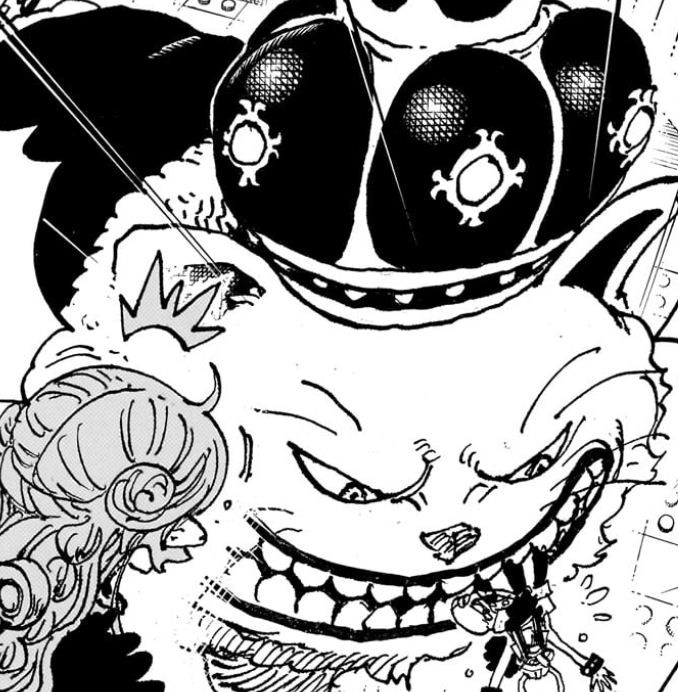
Nami tries running away from it but instead runs into a giant cat wearing a crown, which we later also get the name of, being called in Japanese as “Isukatto”, or “Iskat” when romanized. The name could potentially be derived from the “Skogkatt”, mythical cats from Norse mythology said to pull Freyja’s chariot. This Iskat seemingly can transform into a lion at will, but we don’t know why this is the case. The most obvious answer is that it’s a giant cat that has eaten the Neko Neko no Mi, or Cat Cat Fruit, Model: Lion, and thus can transform into one. But it also makes one wonder if this could be some outside influence or power affecting it.
After all, in Norse Mythology, it is said that Thor once wandered into the castle of Utgard-Loki (not to be mistaken with the similarly named Loki, who is actually Thor’s brother), and tricked him into wrestling a cat, but he is unable to quite move it out of place. It turns out the cat was in reality Jörmugandr, the colossal serpent that encircles the entire world, but transformed thanks to an illusion, hence why Thor couldn’t move it… or at least not by much. So in this case perhaps this cat is also an illusion by someone else, though it having a Zoan would also be the easiest answer. At the very least, the parallel could simply be symbolic.
This Iskat however is later explained to be the lord of the castle of Bigstein, essentially making it his house and thus the reason why Nami and Usopp were being chased and driven out. This is evident in the castle’s courtyard, where several skulls and bones can be seen, clearly previous humans who were too unlucky to wander into Bigstein, or even maybe placed there to be human sacrifices.
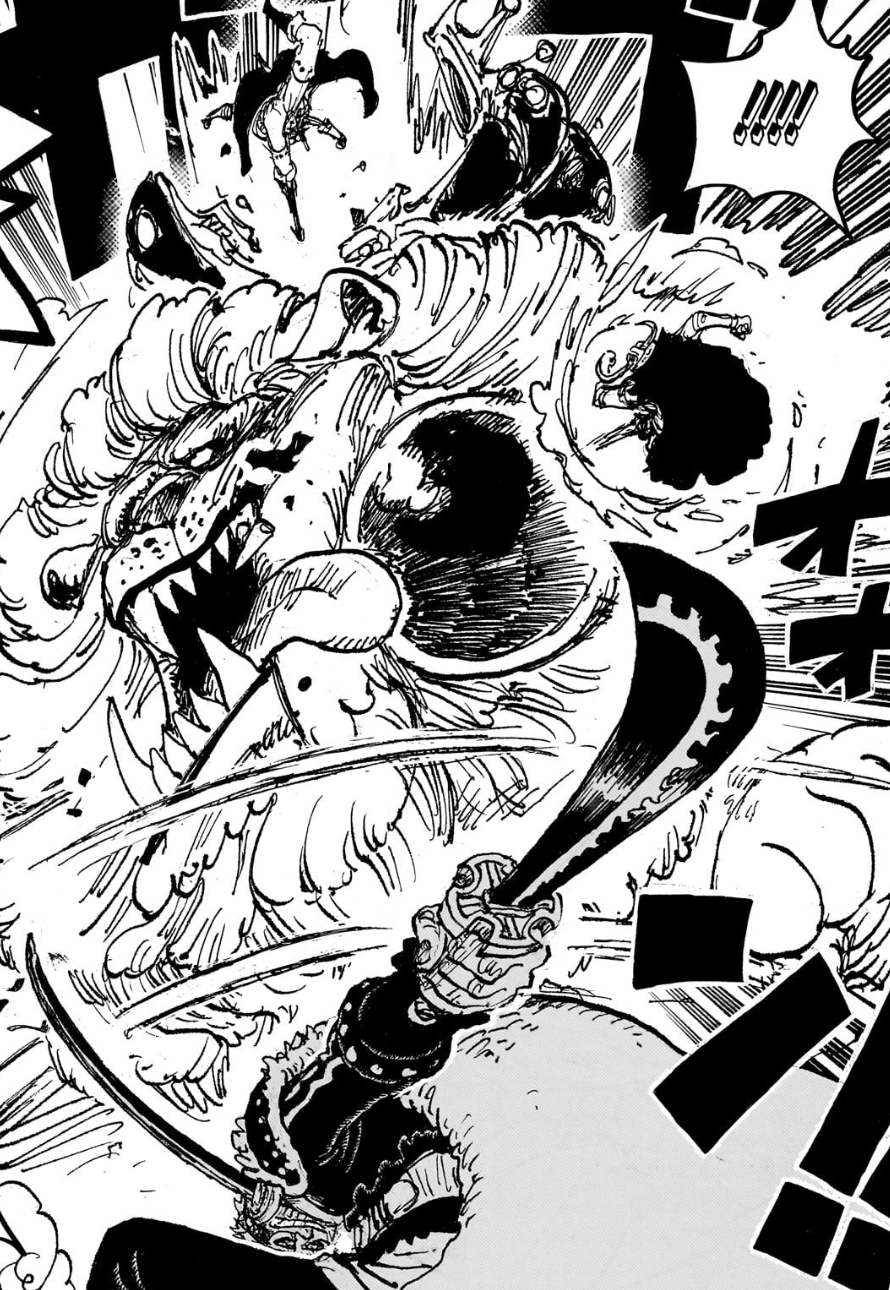
However, the cat, or lion, or whatever thing it is, is stopped by Luffy, Zoro, and Sanji, who deliver a combo attack by combining “Ifrit Jambe Epaule Strike, “Gear Fourth Gomu Gomu no Elephant Whip”, and “Santoryuu Kokujo Otatsumaki, or “Black Rope Big Dragon Twister”. In this case Luffy calling it Gear 4th is likely a mistake, since this should be Gear 3rd, which is likely to be fixed in the volume release.
The page in which they attack the giant lion though is a clear callback to a scene from over 20 years ago where the three of them defeated a Great Sandora Lizard in Alabasta, a giant species of lizard in much the same fashion. The panel between both scenes is evidently identical.
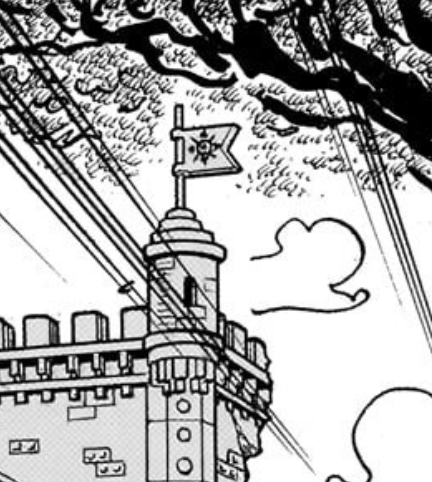
If we zoom out though, we can spot flags on top of Bigstein, which appear to be in the shape of a sun, with eight protrusions. These of course are similar to the symbol of the ancient kingdom and the people of the D., the sun, which would strongly suggest this is the flag of Elbaf, but it’s hard to say for sure since we aren’t exactly sure of what this place is.
Nami mentions how some things simply don’t add up. The trees are artificial, the island shouldn’t be to their size if they are humans, meaning they must’ve been gigantified, and despite the vast open landscape, there isn’t a single breath of air flowing about. A man approaches in a grasshopper bike, illustrating some better context for this location. Nami and Sanji are creeped out by the grasshopper, moving away. This is a nice callback to Jaya, where it was explained that both Nami and Sanji have a phobia of bugs, being scared of spiders in the woods of Jaya’s South Grave Forest, while Usopp didn’t really mind them since he knew they weren’t that dangerous.
RPG
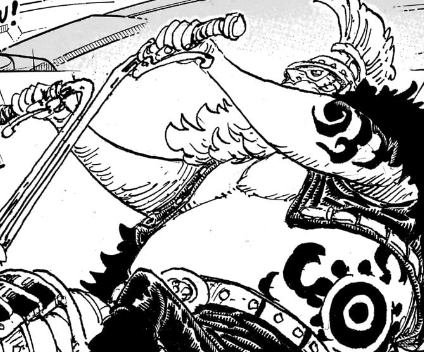
The man speaks in a crass tone, calling the Straw Hats “kisama”, a fairly rude second person pronoun, and speaks in a rather archaic speech pattern, what may be a sign of a local dialect, but he appears to have good intentions. He explains that everything in this big land belongs to the Taiyoushin, the Lord Sungod, and they similarly seem to adore the creatures residing in this land, such as this man claiming to be the aide to the lord of Bigstein, Iskat. He also adds that “you could call this a Country of Gods”. This terminology is interesting, as the term “Kamigami no Kuni” is quite similar to that of “Kami no Kuni”, romanized into English as “Godland”, the terminology used for countries of Angels, such as the Godland Skypiea or the Godland of the Lunaria that was found atop the Red Line. It could just be a coincidence of terminology, as here “god” is written in plural, but it could make sense if this land was somehow trying to replicate places like the paradise once found atop the Red Line.
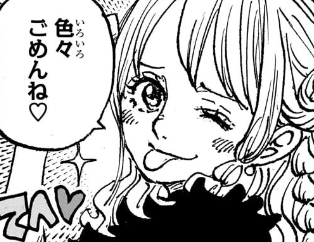
The man invites the Straw Hats to town, saying that they’ve got “fodder”. This is literally written in katakana as “fodaa”, with the kanji reading “rations”. The word “fodder” refers to the food that is given to cattle, meaning that they are being treated no better than animals. He further adds a warning that they must never approach the area beyond the castle, as that is where the temple of the Sungod lies, which is guarded by fierce warrior creatures. However of course this just makes Luffy dive into what sounds like adventure, with Usopp telling the man “Thank you for everything” while Nami tells him “Sorry for everything”. She does this while hitting her head with her tongue out as the onomatopoeia reads “tehe”, which is essentially a Japanese meme for a woman pretending to be dumb and an airhead for a mistake that they very intentionally caused.
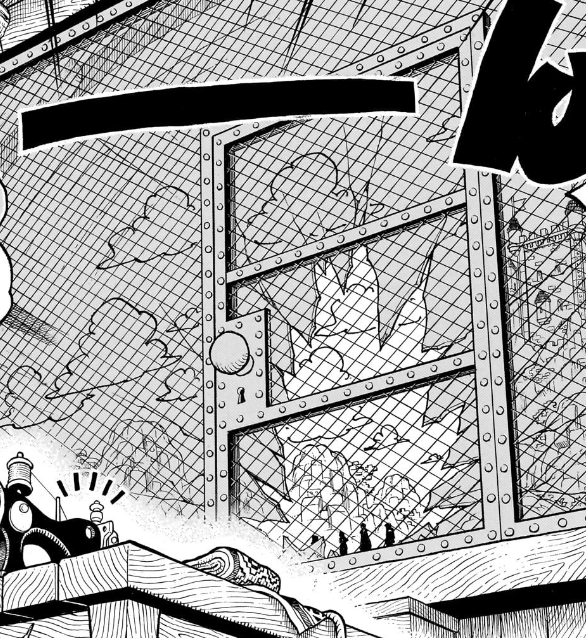
As they run forward though, the Straw Hats seem to realize that the horizon appears to loop. Luffy then crashes into himself as he slams into a mirror, revealing the trick behind this country. The country is entirely contained within a room in a giant’s house. Fake ceilings and mirrors are built all around this room in order to give the illusion that its land stretches forever, but it is simply contained within this square room. One of the mirror walls however is a movable door that leads into a gigantic room that appears like a studio. On the bookshelf to the left we can see inks, books, and fabrics, on the table we can see a sewing machine, while to the bottom right we can spot LEGO-like pieces scattered about.
All the pieces in the puzzle suddenly fall together to explain what is going on here. This entire country the Straw Hats found themselves in is nothing more than the playset of a giant. A passionate craftsman who likes building a toy world inside his own house, much like many other passionate LEGO builders who have their own cities and large landscapes built within dedicated rooms in their homes. However, this fun hobby has a much darker side than this. Because the person building this micro world isn’t just content with dotting it with minifigures, but rather dots it with living creatures. Taking advantage of the fact that they are gigantic, they take humans who aren’t strong enough to stand up to them and kidnap them to live out in this toy world, forced to play along and live within it if they wish to survive. The reason they wear giant clothing isn’t because they are giants, but rather it was the custom-made clothing that this craftsman created, which is how the Straw Hats were outfitted as well.
Furthermore, it is evident that this craftsman has some kind of god complex, as it is evident whoever created this place is in fact the Taiyoushin or Lord Sungod that has been mentioned several times. He has built himself to be a god, likely inspired by the Sun God Nika of Elbaf myth, and having these small people revere him and treat him like a deity, while also making the citizens live in fear of the other creatures he has let roam around the island, which have evidently taken many lives as indicated by the skeletons in the castle. He even calls his studio room a “shrine”, and this location “his country”, adding to the god complex.
Essentially, this Lord Sungod is seemingly playing out a tabletop RPG, what is also known as “Dungeons and Dragons”, or “DnD”, an elaborate board game on a toy world where people simulate adventures and civilizations through microscopic toy figures. LEGO are a popular option for DnD campaigns as they help depict locations and characters with ease and freedom for creativity. However this tabletop RPG comes with a twisted twist, as the pieces are in fact living creatures who are forced to live in this simulated world of fantasy, having to survive around all these giant creatures and thus being forced to eat fodder rations like cattle. This is likely the reason behind the name of the chapter’s title, being “RPG”, or role-playing game, in reference to the tabletop RPG they are forced to role-play in. And thus it also makes sense that this Sungod kidnapped the Straw Hats to add new players to his RPG, though how he managed to snatch them from the ship of the Giant Warrior Pirates is unknown.
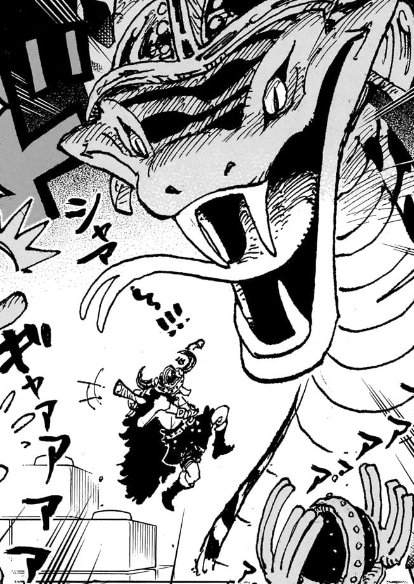
As the Straw Hats realize what their surroundings are like though, they are suddenly ambushed by a giant snake, which we later find out is called “Hilmungandr”. This is a reference to the Jörmungandr, the world serpent which in Norse mythology is said to envelop the entire world while biting its tail. Fittingly enough, this deity has been previously mentioned in the manga. At the end of Little Garden, Dorry and Brogy mentioned that the only thing their strength couldn’t destroy was the “blood-stained snake”, referring to the Jörmungandr that envelops the world. What they were talking about though was likely the Red Line, which from their perspective is just like the giant snake that envelops the world, depicted as a blood-stained red in some cases.
They are further attacked by giant rats and a giant crow with a skull, the latter which is called “Mugin”. This name is derived from Munin and Hugin, the two crows of Odin that survey the world according to Norse mythology. Luffy transforms into Gear 5th to fight back, though in this case his viking helmet merges with his hair, making him look as if he has horns. As he defeats the Hilmungandr, you can also spot Zoro slashing the Mugin. However, suddenly, a tall figure enters the room, being the Lord Sungod himself. The Straw Hats climb back towards the toy world, with Nami riding on top of reindeer Chopper if you notice, as they prepare to escape.
Sungod
The Lord Sungod is quite the mysterious being. He appears to be tall, but it’s hard to really get an idea for how tall. As he enters the room, he appears to be the size of a giant. However, in the final page he appears far larger than that, almost the size of an ancient giant like Oars, completely dwarfing the Straw Hats. Maybe he has some sort of size manipulation power, but given how Sanjuan Wolf already basically has that, this could likely just be forced perspective from Oda.

Sungod also speaks in a very bizarre way, as he uses the first person pronoun “sessha”; a masculine first person pronoun that was once used by samurai, which you may recall was commonly used by samurai of Wano like Kin’emon and Kiku. The term though can simply be taken as a very ancient-sounding pronoun, as the Sungod speaks in a quite archaic way, using old fashioned terms in Japanese like “yokumo” or “nu” instead of “nai”. This gives him the feeling that he’s like some sort of ancient entity, or like they speak an old dialect from a country that hasn’t interacted with the outside world in a very long time.
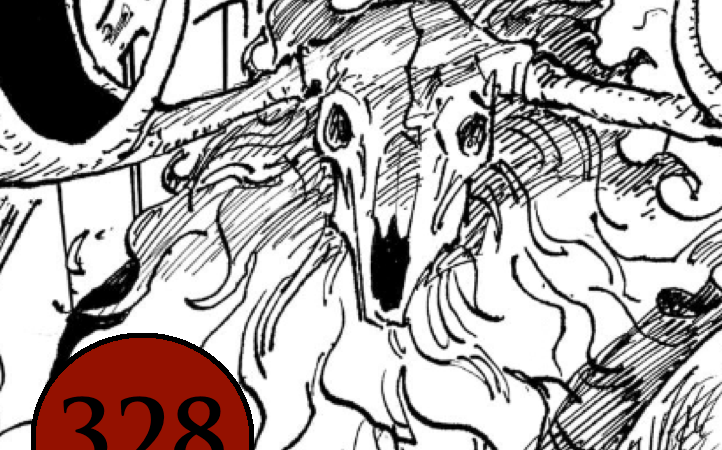
Furthermore, he carries a staff with a circle on it that has eight protrusions, which again makes it look like the sun symbol of the ancient kingdom. Similarly, he also has a shield on his back which features the same circular shape with the same eight protrusions, also looking like a sun. However most striking is clearly the giant reindeer skull, which appears to be a mask as in the final panel we can spot what looks like an eye beneath it. This type of skull has already been seen in Elbaf decorations, often being hanged atop houses which of course is derived from how vikings used these types of skulls for decorations as well. So this Sungod could be using the mask as a way to appear like a deity to the “mortals” of his game. The boots that he wears are also similar to those we’ve seen on other giants like Gerth or Road from Hajrudin’s crew. Could this be a hint to their true identity or is it just standard Elbaf fashion?
However, upon closer inspection, it is actually evident that we’ve seen this same skull before. And it was actually… in God Valley of all places! During the God Valley incident, but for a brief panel, we can see Garling assembling the God Knights. Alongside him is a dark-haired woman and also a man wearing a reindeer skull mask. The horns are hidden by the speech bubbles, but it is very evidently identical. And there’s also the fact he appears to carry a staff, just like the Lord Sungod in this chapter. There is a chance that this could just be a coincidence, especially as that God Knight appeared to be of normal size rather than being a giant like this one, but surely there has to be some kind of connection here. Just what would a Celestial Dragon God Knight who was present during the historic incident of God Valley be doing in Elbaf of all places playing at being the god of a toy world?
 The Library of Ohara
Sungod wears a deer skull, the guy in Godvalley wears a cow/bull/bison skull.
Even if you can’t see the horns of the skull of the God knight, their angle is very different to those of the deer skull, that point slightly downwards
LikeLike
Hi Artur,
Stein means Stone in German.
The mask of the God Knight ist not the same. The shape of the horns is different.
LikeLike
hello hello 😀
I would like to put a little german comment here.
I tthink the Bigstein Castle could also be a wordplay, because LEGO bricks are also called, LEGO Steine in german. So i would mean it’s a Castle made out of giant bricks
BR Schaltairiks
LikeLike
“Stein” means stone or brick in German, it is the word used for a Lego brick (Legostein). It does not mean castle.
LikeLike
as a fan of Norse mythology for years, always nice to see the deep cuts like utgard Loki used, since most has been used so much in fiction lately.
not just a cat as jormugandr, a grandma that’s old age and a drinking horn connected to the sea haha.
but yeah, totally expect Luffy to blow this charade wide open. I’m super curious how they got kidnapped, hard to sneak up as a giant besides just using a DF. Didn’t notice the similarities to the knight though, very curious.
even after 20 years the start of arcs is always so much fun, my first one was whiskey peak I think? Like 2002?
LikeLike
The german word “stein” means “stone” and not “castle”. Sometimes it can also translate to “brick”. So Bigstein Castle does not mean “Big Castle Castle”, but rather “Big Stone Castle” or “Big Brick Castle”. This is probably a reference to the fact that the whole castle is made of large Lego bricks.
LikeLike
Essentially, this Lord Sungod is seemingly playing out a tabletop RPG, what is also known as “Dungeons and Dragons”, or “DnD”, an elaborate board game on a toy world where people simulate adventures and civilizations through microscopic toy figures.
First of all Microscopic things cannot be seen with the naked eye. You may want to change every instance of “micro” with miniature.
Second of all you don’t seem to know jack shit about DnD if you think what the dude here is doing resembles even a tiny bit DnD.
He’s got a dollhouse/terrarium, not running a goddamn campaign.
LikeLike
A little translation correction: the german word “Stein” does not mean castle, the translation is stone or rock. In connections with place names the suffix “-stein” usually means a rocky hill or mountain. For example the “Schloss Neuschwanenstein” means litarally “palace new schwanen(gau) rock”. There are different words in german like Burg=castle, Schloss=palace, Festung=fortress wich are not used consistent. Neuschwanenstein is kind of a modern romantic knight castle replica. So here the name means kind of the new castle on the “rocky hill” of schwan(gau).
So the name Bigstein Castle is a combination from english and german words and means litarally big rock/stone castle or in german it could be Großstein Burg (big=groß). After a short google search, there are some german places, towns or castles called Großstein or Groß Stein maybe because there was a Rock or rocky hill that stoud above the surrounding rocks or hills or in an another way was outstanding.
But nevertheless I really like your analysis 😀
LikeLike