
Video version: https://youtu.be/ttau67RvHpc
Chapter 1176
As the Straw Hats move to douse the fires, Nami charges forward with a new attack, which she precedes with one of her iconic lines “iku wa yo” (行くわよ), which means “Here I go” and Nami has used several times as a trademark line before jumping into action. The move she uses is called “Pouring Rain Tempo”, which is read as such in its phonetic katakana (ポワリング・レイン テンポ), but its kanji is written as meaning “heavy rain -” (豪雨=), or what would be called a “downpour” in English.
Killingham attempts to stop Zeus by unleashing a MMA we haven’t quite fully seen before, being the Lindworm. The Lindworm is a mythological creature of European mythlogy, though with a lot of overlap with Norse mythology, known as a large serpent with draconic features, though often depicted with two legs. There are several different types of draconic creatures across different Western mythologies that a lot of people tend to mix together, but they are often distinguished by key biological features. The easiest way to distinguish between them can be generally by subdividing them into three general families:
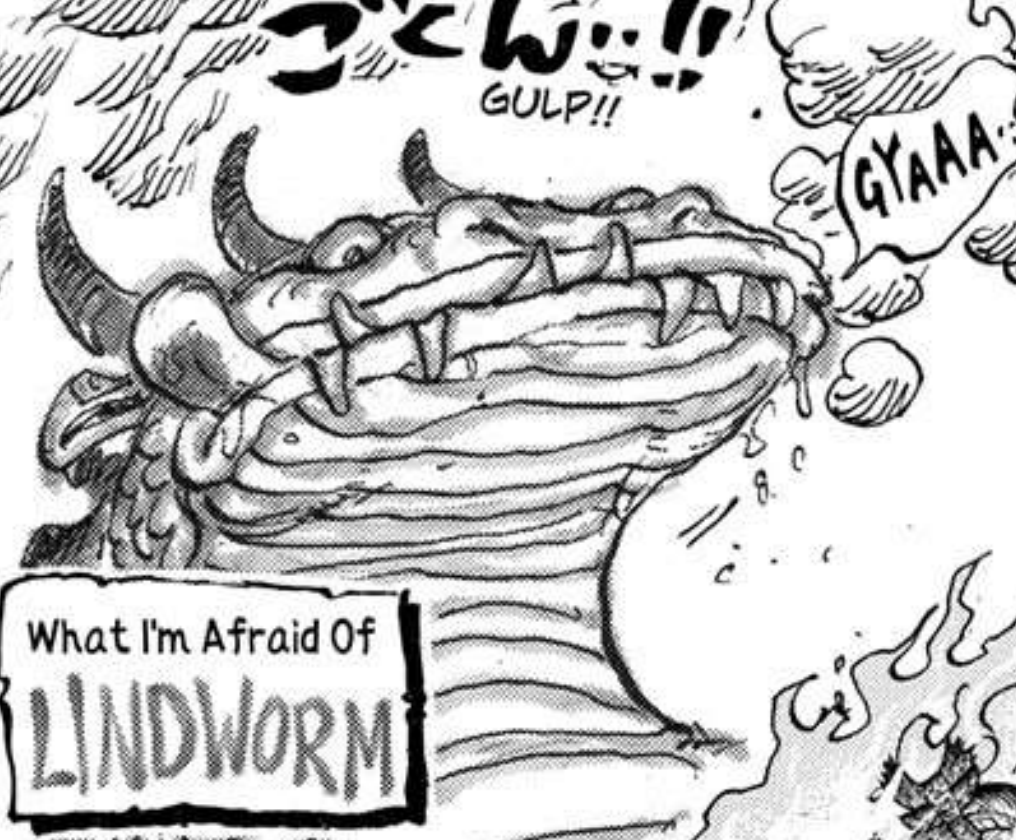
- Dragons (or western dragons) are usually depicted as large imposing quadripedal creatures with large wings on their back. The Nidhoggr as we see with Loki, is a dragon of colossal proportions. Wyverns instead are smaller dragons where their arms and wings are one and the same, and are usually small enough to be used as ridable steeds.
- A drake is fundamentally a quadripedal dragon, but without wings, and usually smaller, being a terrestrial creature. Mythical creatures like the hydra are considered a form of drake, and a distant relative of it could be considered the kirin, which is more likened to a giraffe or deer but has draconic lineage, which is why Killingham’s fruit is known as the Ryu Ryu no Mi.
- And finally there’s the wyrms, which are fundamentally serpentine dragons with no arms. Here is where we get the variaton of the Lindworm, which is known for often having two smaller arms, but still being bipedal. Another relative of the wyrm is the amphitere, which is a breed between a wyvern and a wyrm where its arms also serve as wings.
Plenty other subdivisions exist, such as aquatic dragons like the knucker or zilants (which are amphiteres but with separate wings), but beyond these three categories, there is the long, or the eastern dragon, of which there are several types such as the seiryuu (the azure dragon), which we see with Kaidou. But while the long resembles a lyndworm except for being quadripedal (although Kaidou’s fruit has him being bipedal), they’re still a completely different species originating in a different mythology. Still, we’ve seen many depictions of dragons in One Piece already, between Loki’s Nidhoggr, the dragons of Punk Hazard, the lindworm MMA, the kirin, or the seiryuu, so I do wonder if Oda may ever touch into other species like the wyvern or the amphitere.
Anyway, in this case, the lindworm is not only distinguishable by its name, but also the kanji reading that Oda uses for it. The lindworm reads as “hebi ryuu” (蛇龍), which means “snake dragon” due to its more serpentine shape. Interestingly though, here Oda uses the kanji for “eastern dragon” despite the lindworm being a creature from western mythology. However, given how in One Piece western dragons are generally associated with the large winged kind like the nidhoggr, while eastern dragons are more associated with the wingless serpentine kind like the seiryuu, it makes sense that Oda would associate the lyndworm being in the latter category, despite it originating in western mythology.
Regardless, Lilith manages to freeze the Warrior’s Spring using a technology she calls “ODC”, or “Omni Drain Converter” as it is spelled phonetically (オムニドレインコンバーター). However, it’s also written with the really complex kanji of “bannuo kyuushuu henkanro” (万能吸収変換炉), which translates as “universal absorb-convert reactor”, which isn’t that different from the meaning of “omni drain converter”, fundamentally taking any energy source and being able to convert it. Lilith then takes that energy and transfers it to a cola, calling it the “Super Vega Cola” (スパーベガコーラ). We already saw during the Egghead arc when Luffy and Bonney were using the vending machine where a vega cola appeared, so I guess Vegapunk already had experience creating an energizing cola.
Jinbe also moves to save Zeus, but Killingham is grossed out by him for being a fish-man. But seeing Sanji stand up for someone like Jinbe is actually quite a meaningful moment. Not just because he’s defending a nakama who isn’t a woman for once, but also because of the brief history they have together. During Fish-man Island, Sanji demanded to Jinbe to atone for everything he did to Nami by slicing his belly, but Nami instead prefered to just forgive Jinbe. So it’s nice to see in a sense that Sanji now values him just as much as well.
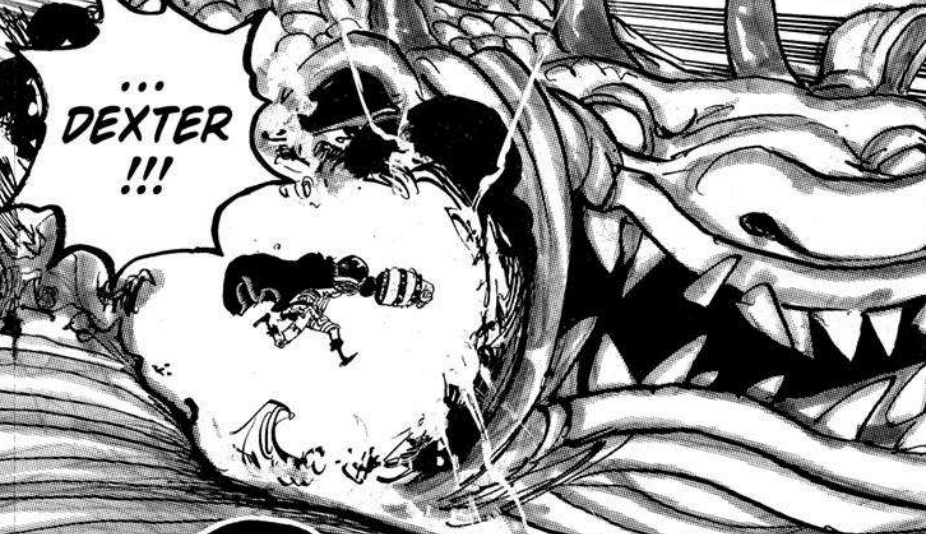
And thus, the whole trio unleashes a series of powerful attacks. First, Franky unleashes a new variation of “Strong Right” called “Super Strong Dexter” (スーパーストロングデクスター). The word Dexter here reads with the kanji for “right” (右), as “dexter” is an older word associated with the right hand, which is where words like “ambidextrous” come from. Jinbe unleashes “Gyojin Karate Ougi Buraikan” (魚人空手「奥義」武頼貫), or “Fish-Man Karate Secret Technique: Vagabond Drill”, which Jinbe previously used against Wadatsumi in Fish-Man Island. “Buraikan” is a word which here is just a bunch of kanji meaning “piercing martial art drill”, but “buraikan” phonetically usually refers to an outlaw, hence its localized name. Finally, Sanji uses “Ifrit Jambe Concassé”, which is an ifrit jambe version of concassé, the iconic move he’s used since defeating Satori in Skypiea. The kanji for Ifrit Jambe, like before, read as “majin leg style” (魔神風脚), since the ifrit is a majin, or djinn, whereas also like before, concassé’s kanji reads as “coarse crushing” (粗砕), the cooking technique that is called in french as “concassé”.
Back at the West Village, having nearly killed each other, Dorry and Brogy snap out of Domi Reversi for a brief moment in time, and so they decide to lay their lives down. This however, reverses the Domi Reversi. This isn’t new, as we saw pretty much the same happening for Xebec in God Valley. Rocks begged Roger and Garp to kill him, but when they did, using enough conqueror’s haki that they destroyed his body enough to kill him and not regenerate, then at that point, the reversi on Xebec was undone. Unfortunately by that point they were all too exhausted from the battle and Garling snuck in for the sneak kill to murder Xebec. Rayleigh and Gabin arrived to save Roger and Garp but it seemingly was too late as Xebec had already been killed. So here too we see that “killing” someone while in Domi Reversi, enough for them to not regenerate, undoes the spell, but after that the bodies are back to being mortal. The catch is that, of course, to kill someone who is boosted under Domi Reversi, especially if they were already a mighty warrior in their own right, is no easy feat. Just like we saw with Xebec in God Valley, it’s not an easy job to defeat strong opponents under the spell, but since Dorry and Brogy were the strongest of the bunch, it should be hopefully enough for our remaining group here to deal with the rest. Though if you play close attention, despite holding a shield, it does seem like Brogy’s left hand is indeed gone, so at least that wound is permanent.
Chapter 1177
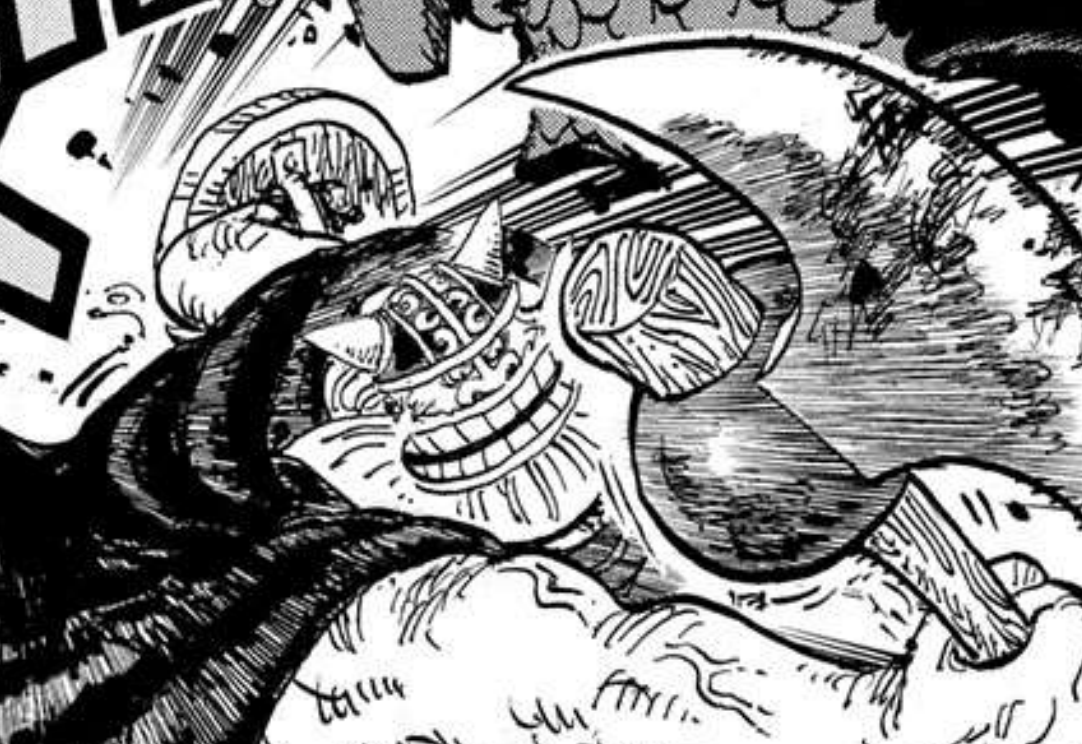
Meanwhile, Chopper’s group is attacked by two of the Giant Warrior Pirates, being called Rhodes (ローデス) and DD Tee (DDティー). Several giants are named after famous wrestlers (when they are not named after Norse names or terms), with Rhodes in this case likely referring to American wrestler Dusty Rhodes. DD Tee instead likely refers to the wrestling move of the same name (DDT). It isn’t exactly clear who is who, but the shorter bearded giant is one that we saw was part of the Giant Warrior Pirates during their attack on Egghead, seemingly acting as a lookout, while the other one was instead present too, but as the hat indicates, he appears to be the cook of the crew, having cooked for Luffy when he needed to replenish his energy. Kashi feels himself unable to hurt his comrades, unaware that it’s perhaps what he should be doing to undo their reversi, though it’s quite ironic how hesitant he is to harm them in any way while the others have zero hesitation to brutalize them. As they get ready to fight, the other giants decide to hide the kids like Collon, Olav, or Johanna inside the tavern, this being the same tavern from the start of the arc where everyone partied, while other giants are healing the wounds of the parents, such as Ronja’s dad who is visible in the panel.
Brogy also fights another giant named “Gantonio”, who is likely named after Antonio Inoki, another famous Japanese wrestler. The group strikes a counterattack against the reversi giants, with Hajrudin opening up with “Gungnir”. You may recall, Hajrudin originally used this move to defeat Machvise of the Donquixote Family during the battles in Dress Rosa well over a decade ago. The kanji for Gungnir (英雄の槍) reads as “Spear of the Hero”, in reference to the fact that Gungnir is the spear of the Norse God Odin. In case you hadn’t realized by now, “Hajrudin”, aside from being similar to the name of real life pirate Barabarossa, is also likely a reference to Odin, as the name “Hajrudin” includes the pronunciation of Odin within it.
Dorry uses Ikoku, which is the version of Hakoku that Big Mom used at Whole Cake Island to attack the escaping Straw Hats. People back then thought it may have been Big Mom’s own variant, but given how Dorry here is using it too, it seems that Ikoku may be the solo version of Hakoku. Considering we saw the three way version, this means there’s three tiers to this type of attack:
- Ikoku (威国): The solo version of the attack, which means “mighty country”
- Hakoku (覇国): The duo version of the attack, which means “conquering country”
- Goukoku (轟国). The trio version of the attack, which means “roaring country”
Interestingly, there was also a variation of the duo version which was done by Big Mom together with Kaidou in Roof Piece, which they called “Hakai” (覇海), or “conquering sea”.
Stansen uses an attack which he calls “Gigantrum” (ギガントロム). The kanji reads as “giant drum” (巨太鼓), and thus might be a play on words between “giganto” and “drum”. Zoro finishes off the series of attacks with a new move called “Santouryuu Akaoni Okomega” (三刀流赤鬼怒巨). The first part obviously means “three sword style”, whereas “aka oni” means “red ogre”, which is referring to Brogy’s epithet as the “red ogre/oni” that he’s been given. The kanji for “Okomega” instead reads as “furious giant” (even using the same kanji as the chapter’s title for a double pun), but the real pun is that despite sound like “omega”, it’s meant to read as “okome”, which means rice. This is because it’s similar to his attack “oni giri” (check the pose for the similarity), or “rice balls”, but instead in this case it’s cooked rice. The even deeper pun is that the shape of his attack is shaped in the form of the kanji for rice 米, or o-kome, with lines going in all directions. Interestingly, we saw Shimotsuki Ushimaru using a move with pretty much the same pattern when destroying the boulder to escape from the cavern he was trapped with Yamato and the other Daimyo, so I wonder if this is a move passed down the Shimotsuki lineage.
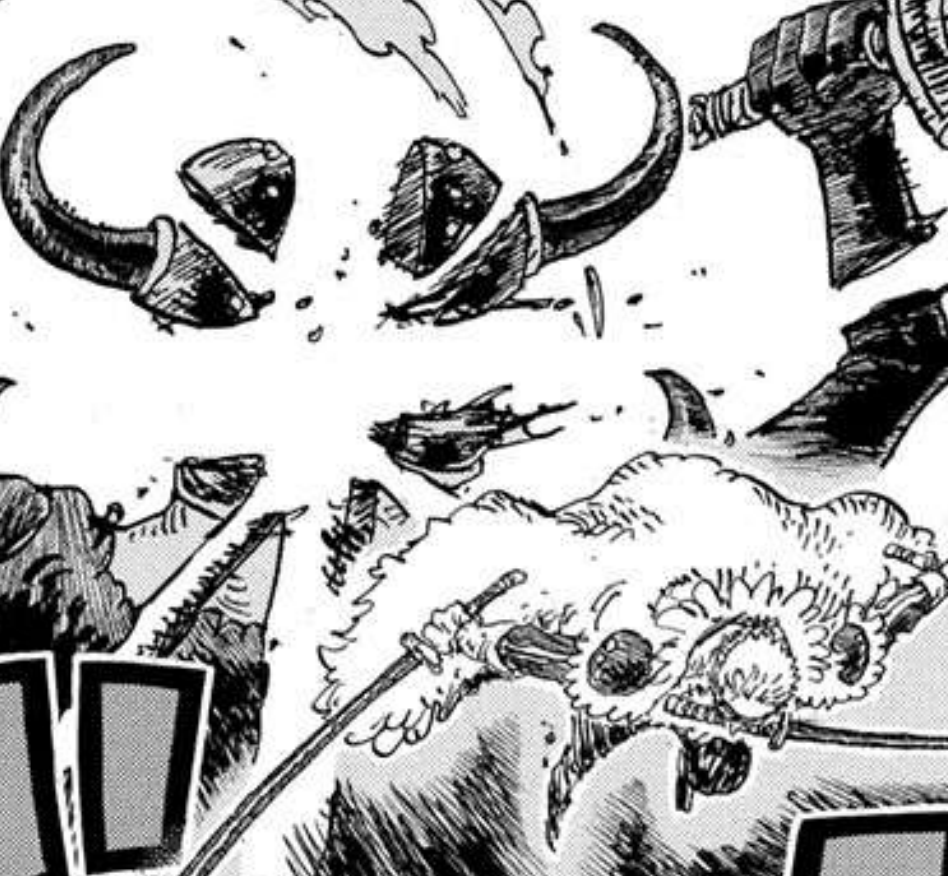
After Luffy gets scolded, Usopp joins Brook’s side to try and stop Imu possessed Gunko, but inevitably can’t manage to put much of a dent. Interestingly, she appears to hit Brook at a distance simply by extending her palm, making some sort of cracking sound effect. This attack seems very similar to the same move that Saturn used at Egghead, where he could harm others simply by gazing at them. We assumed that to be one of the powers of the Gyuuki, as legend says it can hurt others through its gaze. But I wonder in this case if this was a power extended by Imu or if alternatively this is a separate but similar power which allows Imu to simply hit at a range. If that is the case, then I wonder what the specifics of it are. Usopp tries to fight back by using a Skull Blastgrass, but interestingly he already tried using it against Gunko to no effect before, so I suppose more than expecting it to work he was just trying to make a statement. You’ll also notice that the infamous shield that supposedly parried Imu has been completely eviscerated, so I suppose it really didn’t tank that attack beyond a split second.
Thus, Imu is confronted by Luffy and Loki, though interestingly again, Imu refers to both of them by the names of their powers rather than who they really are, calling them “Nika” and “Nidhoggr”. This is interesting as Imu already referred to Luffy as “Joyboy” previously, so it seems in general that Imu seems to oddly regard others by their other associated roles, in the same way that he kept calling Xebec Davy Jones despite knowing they were separate people. Is this simply because of how disconnected Imu is or is there some deeper reason?
Chapter 1178
As the next chapter opens up, Imu interestingly begins to talk about a certain monster several years ago deep in the mist that only targeted World Government ships. More specifically, word by word Mu says:
“Several years ago… a ship of the giant race was sighted at sea.”
“Its captain was enormously huge”
“However, remaining hidden within the depths of the clouds, those beings continued to target World Government vessels, all while we were unable to confirm their identities…”
“Meanwhile, at the same time… there were rumors circulating of some gigantic flying creature…!!”
“I see. That makes sense…”
This whole statement is a bit odd, because Imu seems to be attributing the flying creature that targeted those Government vessels as being the Nidhoggr, as it wouldn’t make sense otherwise for Imu to bring this up otherwise when fighting Loki. The thing is though, when we’re talking of colossal creatures within the depths of the mist, the first thing that comes to mind is the Florian Triangle entity, the colosssal creature that was claimed to sink over 100 ships every year that passed through those waters.
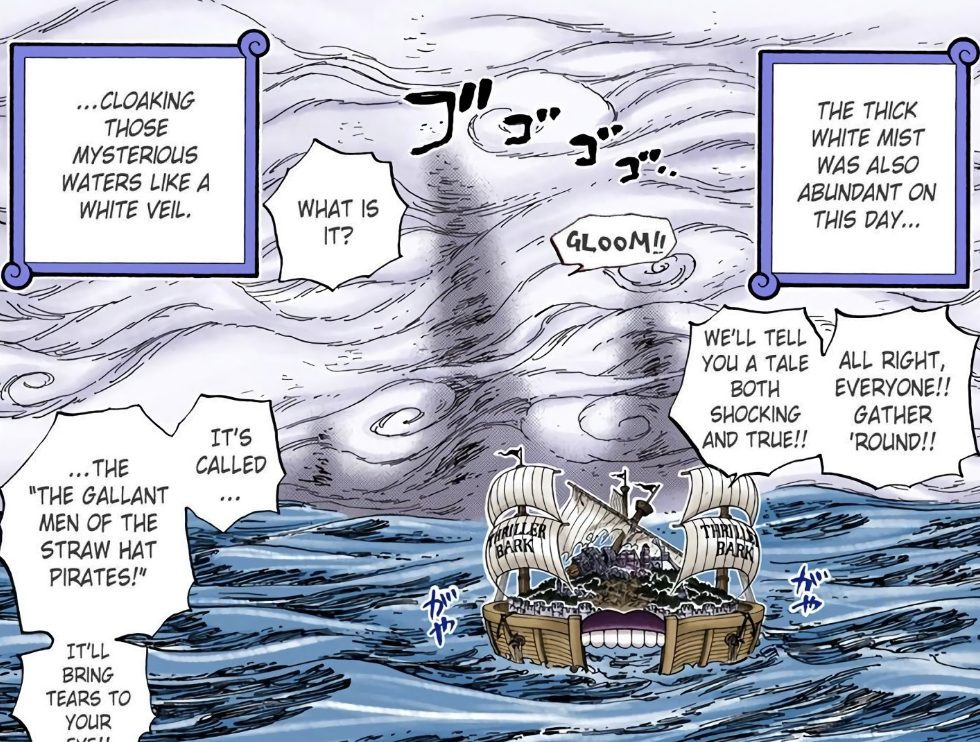
There’s a first assumption that can be made here that Imu is implying that the Nidhoggr was the Florian Triangle entity who destroyed so many ships every year, which theoretically could make sense. Maybe as a way to try and weaken the Government, Loki and his crew of guards would target Government ships while hiding in the mists of the Florian Triangle. The issue is that a few inconsistencies come up. For starters, the entity in the Florian Triangle appeared to be standing on the water itself rather than flying given the silhouette, and one panel even seemingly showed its eyes being close to water level. But more than anything, the timeline doesn’t quite add up.
On one hand, going far back, chapter 1167 showed that some 33 years ago, Harald was working for the Government by secretly destroying pirate ships within deep mists. This fits the description Imu gave, but obviously it’s not this supposed entity because Imu describes it as attacking Government ships and their identity remaining unknown. There is a potential for parallel that both father and son ended up doing similar activities, just for opposite sides of the Government, which could be a potentially powerful thematic throughline, but it falls apart quite fast. What matters most however is that at the time, Oda specifically had characters bring up the Florian Triangle and they distinctly said that no, this was not in the Florian Triangle, as sailors did not dare go to that area. Unless Oda is doing some really poor misdirection, this would imply that the entity was already active at that period of time. Long before Loki ate the fruit, when it was still sitting in a chest within the castle and Loki was still chilling with Ida.
Conversely, more closer to the present, we saw this entity as recently as just 2 years ago at the end of Thriller Bark, with confirmation from the newspapers that the attacks were still taking place. But Loki was defeated by Shanks six years ago, brought back to Elbaph, and chained up to the Adam Tree. So it wouldn’t really have made any sense for Loki to have been destroying ships in the Florian Triangle if he was chained the whole time to the Adam Tree.
So unless Oda has some easily explainable retcon, the Florian Triangle entity and Loki are separate creatures. And as such, I assume that Imu here is also referring to them as separate too, that there’s on one hand the entity from the Florian Triangle sinking ships and then there was Loki running rampant at sea sinking Government ships instead as the Niddhoggr during those years he was a pirate. It’s a bit odd that two very similar concepts like these exist, particularly with Oda already distinguishing the difference between Harald and the Florian Triangle Entity in the past, but I suppose that is what makes the most sense.
This leaves us still questioning what the Florian Triangle entity is, however. One of the leading theories is the idea that it could be another being from the same species as Zunesha, being a colossal elephant that much like Zunesha was given an order long ago to sink any passing ships and that’s why it attacks those that come through. It likely isn’t Zunesha directly because Zunesha is in the New World, not Paradise (unless it can somemhow climb the Red Line), and Zunesha could not attack Jack’s fleet until Momonosuke gave him the order. But it could be another creature from its family, or alternatively just a really large sea king, although that option is a bit more lame by comparison. But it’s not like we haven’t seen similarly large and deadly creatures in the story before, so it’s more likely to be something along those lines.
Imu’s shilouette extends from Gunko’s body, similarly to how we saw it extend in God Valley from Saturn’s body. This causes the trident and wings to vanish, although Gunko’s hair remains long. Imu then casts Ahku Wahru Domi Reversi on Loki and Luffy, but the attack doesn’t work, which doesn’t surprise Mu. While we don’t know why that is, there’s a fairly safe assumption we can make, and it’s the fact that Luffy and Loki already possess devil fruits, or at the very least Zoan fruits. If you recall, it’s been mentioned a few times in the series that there’s a belief devil fruit users have a devil residing within them. Jabra mentioned in Chapter 385 a rumor that “a devil lives inside your body” when you eat a fruit that possesses a will of its own. We know now that Zoan fruits possess a will of their own, something that’s been set up since as early as Alabasta, when Miss Merrychristmas mentioned that a certain scientist, later we find out this to be Vegapunk, discovered that devil fruits can be fed to inanimate objects as they have a will of their own. We are later told this applies particularly to Zoan fruits, which manifest more during a Zoan awakening.
So it could very well be that the will within all fruits, or maybe just Zoans alone, is like a “devil” that resides within the user like Jabra speculated. We can see with others affected by Domi Reversi within this chapter, all (like Rocks) not being fruit users, who apparently have some kind of devil within them that gets kicked out when attacked by Chopper. So we can infer it that Imu is fundamentally placing a devil within the bodies of targets which control what they do, but this cannot be done within the bodies of devil fruit users because another devil already possesses them. Jabra even speculated that eating two devil fruits causes both devils to fight against each other till they explode, although Blueno clarified that scientifically it’s been proven that those who eat two devil fruits simply end up exploding, leaving nothing of their bodies behind. I suppose in the case of Domi Reversi though the devil can’t even make its way inside the body through this transmission method. But it would make a lot of sense that the trick behind Domi Reversi isn’t the homeland as some speculated, but rather not having a devil fruit, and even then we’ve seen some cases like Rocks where part of their will still remain conscious even when taken over.
As a result of this, Luffy and Loki strike back with Gomu Gomu no Dawn Gatling, which again is written with the kanji for “white” under Dawn, and Nibelheim once more, which is still spelled out with this pronunciation. Things somehow seem to begin settling down, as we see several villages shifting away more from the MMAs onto putting out the fires caused by Loki, getting glimpses of previously seen settlements of Fishermen Village, Huntsmen Village, Craftsmen Village, and Brew Village where Estridda was from. Within the Owl Library, oddly enough all books have vanished, though it seems they were removed rather than burned down. Biblo, the owl who had the powers of the Iku Iku no Mi, or Grow Grow Fruit, is also gone. It’s possible that the books may have been shrunk to their original sizes (though that’s assuming all books had been enlarged and none were made big by giants to begin with), but even then, how could Biblo have moved them all somewhere else while being an owl? It makes one wonder if Biblo is actually some transformed humanoid, but again we know it has a Paramecia fruit so it surely can’t be a Zoan user, right? There’s quite a lot here that doesn’t add up unless there was some outside interference.
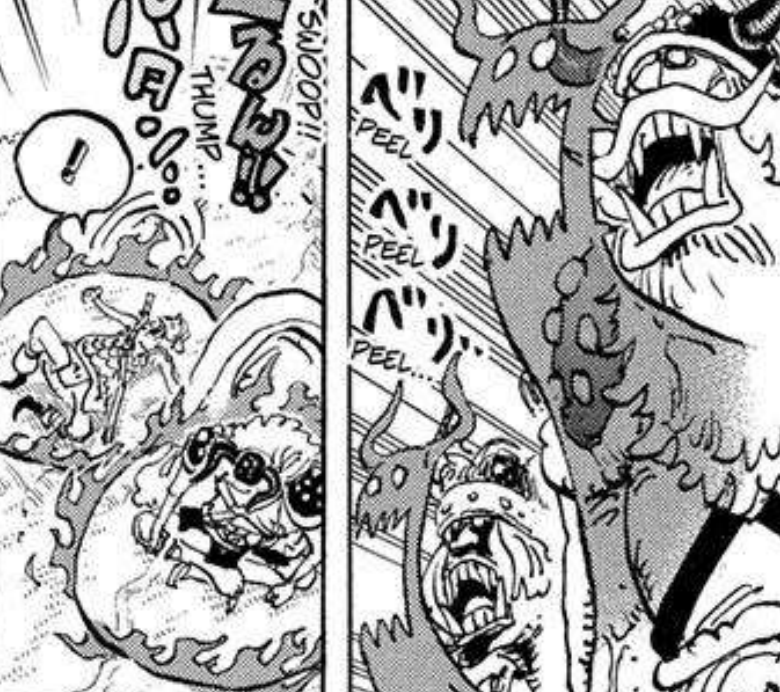
At the West Village, we get a bit of a follow on last chapter, where Chopper ends up being able to simply push the “devils” out of those who were Domi Reversi’d by just hitting them with his claw. As Zoro and he bring up, this definitely seems to have something to do with Chopper being special rather than something he did, and of course the only thing we can really think of has to be his devil fruit. Is there some special property of the Hito Hito no Mi that allows its “humanity” to dispel Domi Reversi? Or is Chopper somehow some more specific model of the Hito Hito no Mi that has some power that dispels the curse?
At the very least, I want to address a mistranslation I’ve seen float quite a bit, which is the mention of the Harley that the “Forest God tamed devils”, which led some to believe that Chopper could be the Forest God in some way. But the original Japanese more accurately means “The Forest God sent forth devils” (森の神は魔を遣わせた). The word used there, “遣わせた” (tsukawaseta), can mean to send forth, to unleash, or to use, to manipulate, or control someone (which is why that mistranslation may have tried to use “tame”, as in the meaning of dominating and controlling rather than subjugating). So if anything, it sounds a lot more that the Forest God either unleashed the devils upon the world or manipulated the devils to cause some damage on the world. The implication seems a lot more that this Forest God is the creator of devil fruits, or at least was responsible for unleashing them onto the world (and the correlation between forest, trees, and fruits seems fairly meaningful), rather than the Forest God being some entity that can “tame” devils. Since I’ve seen it brought up a lot I think it’s worth addressing, even if the possibility of Chopper’s fruit being some more complex God is still fully possible.
Outside the village, Sommers’s remains, destroyed by Loki, try to put themselves back together. Interestingly, what seems to be Sommer’s heart can be seen beating on its own, so I wonder if Loki didn’t finish off Sommers well enough like he did with Harald but may have been close. Oddly enough though, this heart appears to be a bit bizarre, seeming to be black or shiny in some form. We’ve seen hearts before in One Piece when Law took out the hearts of other users, and they looked like fairly regular organs back then, which makes it more comparable to now with how bizarre looking this one is.
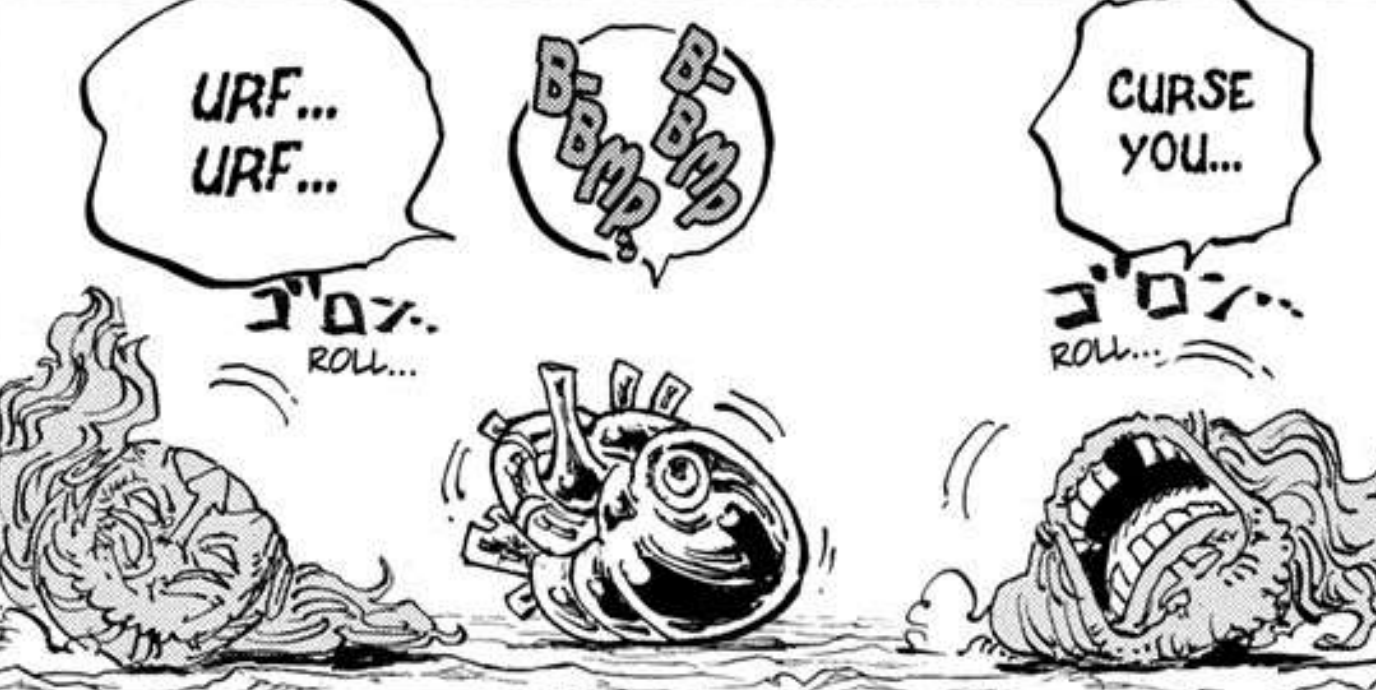
As we see in the next chapter, we get a confirmation that indeed this heart appears to be made of metal, with what even looks like some kind of pressure valve. I again wonder if this applies to all those with the covenant or if Sommers is particularly different, but I’m just confused as to why Imu’s devil powers would manifest with such specific machinery rather than something more magicky and demonic. Particularly as Sommers’s reaction seems to tell that destroying this heart would cause the immortality to cease once and for all, which may be the decisive way to kill a God Knight, and it may be how Loki killed Harald for example as he struck him right in the heart. There have been old theories for a long time that the devils of devil fruits reside within hearts and the like, so I wonder if this could tie with all of that.
At the same time, Imu decides to retreat from taking over Gunko’s body and goes back to the Holyland, within the Room of Flowers. In the shot of Mary Geoise, we can see that while the castle itself is fairly fine, the Land of Gods next to it is indeed on fire, some of it having the fire put out but some flames can still be seen in the background. We were told by Imu that the Holyland was a sea of fire, so it was odd to see the castle perfectly fine a couple chapters back, but now it makes more sense that it was just the city which was attacked, though again we don’t know who the responsible one is. Imu calls the Gorosei seemingly via den den mushi (though I wonder why Mu doesn’t just use telepathy in this case) and makes the statement that “Mu will descend from the Holyland for a little while”.
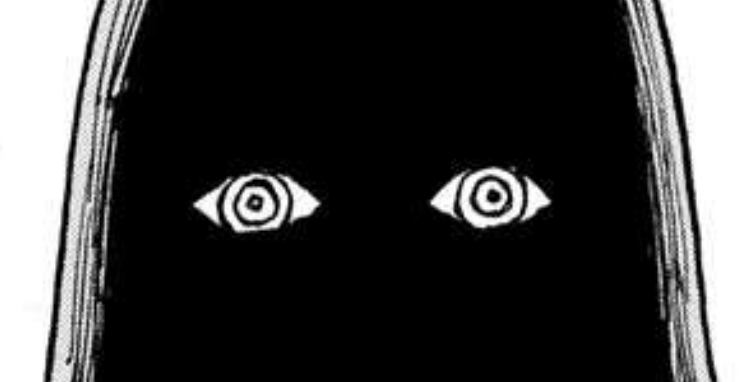
Considering how things seem to be getting resolved quite easily now, and the situation seems more under control, it makes sense that there needs to be a big escalation to bring back stakes into the arc, and what else could be bigger than the big great one descending directly. In such a scenario where we have to face the real Imu, I struggle to see how our heroes could win, at least at this point, which could be a good opportunity to have a setback for them…
Chapter 1179
The Gorosei are shocked about Imu’s claim of wishing to descend from the Holyland. Garling interrupts by claiming that the situation at the Holyland is getting resolved thanks to Shamrock’s return, who was subbed in with an extra God Knight to help manage the emergency, though we don’t know the assailant yet. It does still seem though that the supply issue continues, seen particularly with York, who has now been promoted to Celestial Dragon and living at Mary Geoise, but due to the lack of food she is now starving. It is quite ironic, as in her desire to seize more power than anyone else, she’s upset the world balance in a way that she now is suffering the brunt of it. In the end, those who seek only personal profit at the cost of the world will end up losing even that.
It also seems like the entire Labophase has been moved to Mary Geoise, with the power plant within it, which is quite surprising considering it’s been like… two days. But York probably used the same technology Edison used to abscond with Punk Records to make the Labophase fly all the way to Mary Geoise.
In general though, the Gorosei seem very hesitant to allow Imu to descend. They offer to either go themselves to Elbaph or to send the Admirals from Marine HQ, interestingly referring to the Admirals in the plural in Japanese (大将達), potentially suggesting sending in more than one. But as Nusjuro explains they shouldn’t be able to dispatch them as they are too busy with the current situation. Shockingly, Garling also makes a casual mention of needing to keep the world under control, including the “former Marine Headquarters” (元海軍本部). I wondered at first if this meant former as in Marineford but it wouldn’t make much sense. If anything, the context of the sentence somehow seems to imply that they’ve lost control of Marine Headquarters. Has Sakazuki decided to rebel against the Government or something? Is that why the Gorosei say it would be difficult to send an Admiral since there may be a schism in hierarchy? Or did somehow someone assault New Marineford and the Admirals are too busy fighting that off?
Imu however is the one that decides to take the matter most seriously. Mu orders Warcury to abandon all feelings, including those of “arrogance” (or alternatively, “luxury”, 奢り), “sloth” (or alternatively, “hesitation”, “idleness”, 怠惰), “alienation” (or alternatively mainting your distance, loneliness, 疎外心), and “pride” (プライド). Interestingly some of these can be associated with the seven deadly sins, although that may be a coincidence as not all quite do. But I think it’s just Imu’s very archaic way of telling the Gorosei to abandon all hesitation or pride in this moment.
This could be Oda’s way of justifying and explaining why this whole time the Gorosei have not really made much action towards Luffy. Even by the time of Marineford, Imu seemed fairly unaware about Luffy due to being mostly detached from the affairs of the world below. You have to keep in mind as well that both the pre-timeskip and post-timeskip happen over the span of like three months or so, and so by the time they really took action it ended up often being too late, but above all else all those feelings Imu mentions of hesitation or arrogance often ended up in them not taking enough of an action. In spite of all this though, it is interesting they seem so hesitant to let Imu go down, and it makes me wonder if it has to do with the fact Imu appeared to bleed upon landing, as if there is some consequence to Imu leaving the castle. It almost seems to imply the idea that Imu is almost quite literally allergic to the world below, which could potentially introduce the concept of Imu only being able to stay there for a period of time and thus giving a reason for Mu to leave after a certain point. I also wonder if, given how devil fruit awakenings work, if Imu has to pay some kind of price for awakening the fruit or being taken over by it for some period of time.
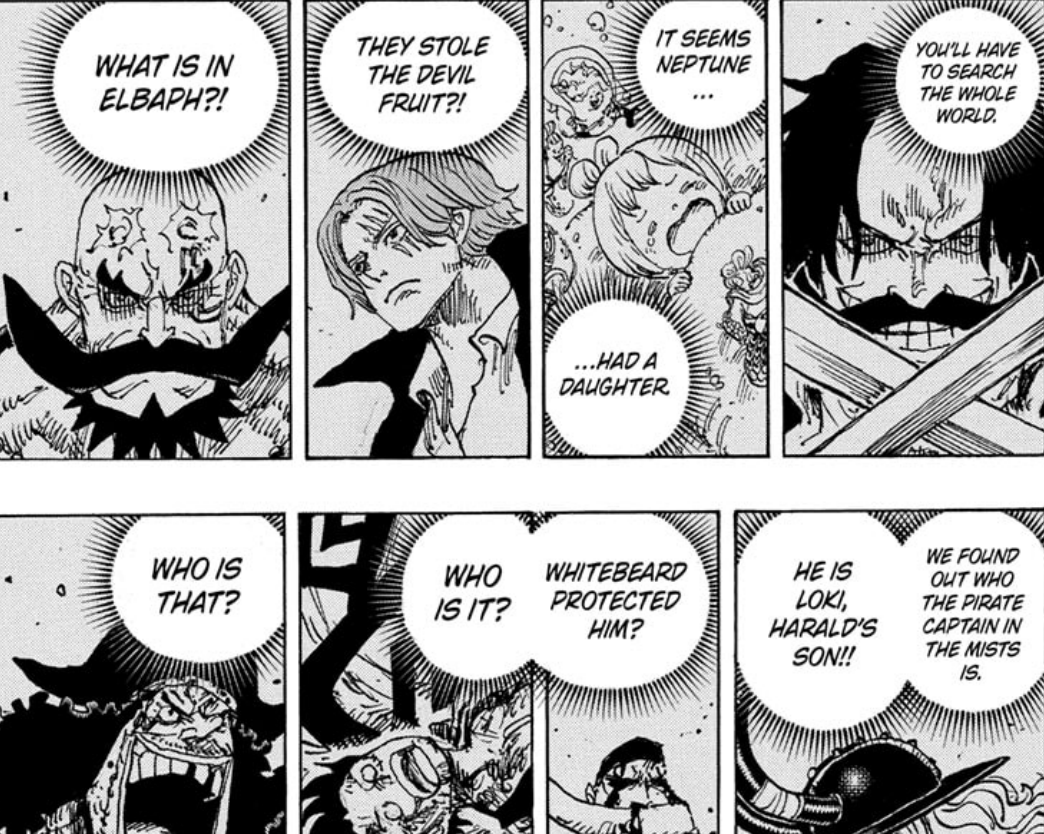
When Peter questions if all of these events being heralded by Nika’s return are a coincidence or an inevitability, Imu fully believes they are inevitable. The words used here particularly are those of 偶然 (guuzen, coincidence, by chance) and 必然 (hitsuzen, inevitable, certain). From Xebec’s declaration, to Roger’s execution, the birth of Poseidon, Shanks stealing the Nika fruit, the Niddhoggr being found in Elbaph and now being in the hands of Loki, the fact that Whitebeard protected Luffy, a D. The fact that Teach is also a D., and that Lily had been all along too. This recontextualizes the scene we saw at the Levely where Imu destroyed the pictures of Luffy and Teach, along that of Shirahoshi. The answer is kinda what we already expected, that Imu sees Joyboy in Luffy and Davy Jones in Teach, even complaining that they are “tormenting” Mu, while Shirahoshi of course is also a threat due to being one of the ancient weapons (though you have to wonder why Imu wouldn’t just plot to seize or kill her when she visited during the Levely). What this doesn’t quite clarify is why he had such an interest in Vivi since then. This was before talking with Cobra so I don’t think that he wanted her just because she was a D. and wants to exterminate all D. clan members, so I think there has to be some bigger purpose connected to Lily, particularly seen with the panel of Mu observing the painting of the late queen of Alabasta. It’s clear to Imu that these events have been set in motion from a long time, probably since what Lily did all that time ago. And so, Imu descends…
Nami notices a change in the atmosphere, as a black bolt like those of the Gorosei descends. Five of them come down, to form the points of a pentagram, which encircles the entire grounds surrounding the West Village in a circle of flames. Within it, the very environment begins to transform into devils. The houses, the trees, the environment itself turn into devils, almost as if being affected by a Paramecia fruit awakening, but we’ll get to that in a moment. The circle however later vanishes to leave what looks like a heavenly light. Imu descends onto the Abyss of Aurust Castle and lets out a wave of conqueror’s haki, as clear by the sound effect of cracking thunder バリバリ. Interestingly, Loki refers to this haki not with the usual kanji that is used most times (覇気) but rather with phonetic katakana (ハキ), perhaps to give a more gruffer sound to his way of speaking or to show he’s from a more isolated culture.
As Imu reaches the throne room however, Mu begins to cough, spitting out blood and seeming as if their usual black form is ripped apart, like something is coming out of it, what looks like wings but fully hard to make out. This generates an explosion, upon from which emerges Saint Nerona Imu… the King of the World!!
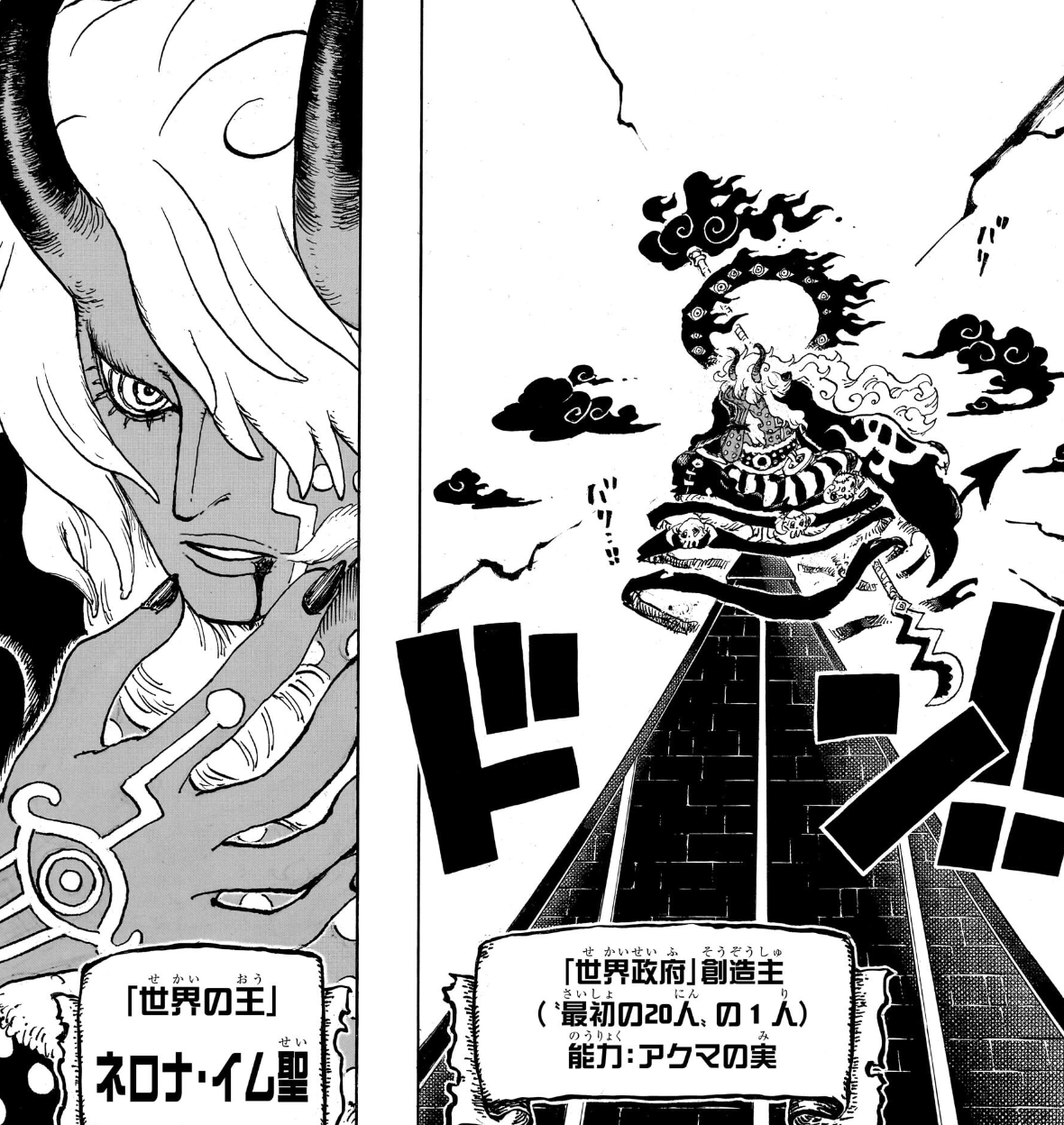
In what is nothing short of a historical moment for the series, the Devil Imu finally makes their appearance. It has been 8 years since 2018 when Imu’s silhouette first appeared during the Levely. Prior to that, Sakazuki hinted at Imu’s existence in Dress Rosa back in 2015, and so did Doflamingo even earlier the year before when talking about the national treasure. Even further back, Oda hinted at what seemed to be Imu all the way back in Marineford in 2010, what some think could be the Gorosei but given his later words regarding the national treasure likely was meant to be Imu. But really, if we’re realistic, the devil was first mentioned all the way back in chapter 1 of One Piece, meaning we’ve been waiting 29 whole years to finally see the devil’s appearance be revealed, even longer than I’ve been alive. This makes Imu the character with the longest period of time between being mentioned and finally appearing, surpassing the previous holder of Vegapunk (whose first mention was in Water 7, although first hinted at in Alabasta) and even before that Jinbe (first mentioned in East Blue but only appearing in Impel Down).
There is a lot of things to mention about Imu’s design, but let’s first focus on his official description: for starters, Imu is confirmed as being one of the first twenty, Saint Nerona Imu, something that both Cobra and Ivankov already took note of, so it’s not really a surprise. As a reminder, the name Nerona is composed by the kana that form the kanji for “God” (ネロナ、神), while Imu is composed by the kana that form the kanji for “Buddha” (イム、仏). What is more shocking, although definitely not surprising, is that Imu’s ability is described as being “the devil fruit”. Not a devil fruit, not the devil devil fruit, but literally just… THE devil fruit.
Particularly in Japanese, the word “ability” is written as “nouryoku” (能力). In One Piece, this word has always been used to refer to devil fruit users, who are referred to as “ability users” (能力者), so Oda is inferring an ability as in a devil fruit power. But instead of being a traditional devil fruit, the name listed here instead is that of “akuma no mi” (アクマの実), or literally just THE devil fruit. What is interesting is that akuma, meaning devil, is usually written with kanji in One Piece (悪魔), but in this case here it’s written with phonetic katakana. This is because all devil fruits have always been written with phonetic katakana (the name part at least, “fruit” still retains its kanji). So for example the Inu Inu no Mi, or Dog Dog Fruit, doesn’t really use the kanji for “dog” but rather just the phonetic “inu inu”. In this case “akuma” is also written phonetically to follow the pattern of devil fruits, which is also how Japanese readers can distinguish from “akuma no mi” in kanji (meaning all devil fruits in general) and “akuma no mi” in katakana (meaning Imu’s fruit in particular). The bizarre thing however is that all devil fruits have a very specific pattern of being composed by two kana in repetition, like gomu gomu, inu inu, bomu bomu, etc. This is because Japanese loves using two kana repeated to represent many sound effects or expressions, such as sube sube meaning silky smooth or mero mero meaning madly in love, so Oda extended this pattern to all fruits because it sounded cool. But in the case of this “akuma no mi”, it breaks all previous rules aside from being written in phonetic katakana. Akuma here is a single word, it’s not the aku aku no mi, it’s the “akuma no mi”, and furthermore a-ku-ma is three kana syllables rather than two. This goes to show how this power truly is above all others and works differently than other fruits. I wonder if by extention things like the fruits of the Gorosei are also similar to this where it’s just the “Gyuki no Mi” for someone like Saturn rather than the Kumo Kumo no Mi (Spider Spider Fruit), Mythical Model: Gyuki.
Honestly though, I wouldn’t be surprised if Imu’s fruit stands above all others. It may not even be a Paramecia or a Zoan or a Logia, but possess properties of all of them, which is why the powers are so varied and complicated. This could be why Imu seems to show properties of a Paramecia awakening when transforming the entire surroundings of the West Village into animated devils, while also showing the properties of an awakened Zoan by having a special transformation with a hagoromo scarf adorning it. Interestingly, Mu isn’t the only one to show this kind of properties, as Luffy also was shown to have both the characteristics of a Zoan awakening by being able to achieve a transformation while also having the characteristics of a Paramecia awakening by being able to turn other things into rubber. So I wonder if these two powers are special in this regard in a way that sets them apart.
Imu having the power of the devil isn’t particularly anything new though, as it has long since been speculated since the Levely, and it’s something I myself have been saying for a very long time ever since Imu’s introduction. Undeniably this connects Imu in some form to the myth of devil fruits, where Shanks mentioned the devil fruits being incarnations of the “sea devil”, but this already ties with the concepts of Domi Reversi we brought up before. As we mentioned though, Imu’s powers seem to undeniably be quite cartoonish, like an evil anthisesis to Nika, something we’ve been debating for a very long time. This is particualrly noticeable in the fact that all of the possessed houses begin to sing and dance, with musical sound effects like “zumu zumu”, “dororon” or “dadadan dadadan”, which is incredibly reminiscent of the “dondototo” of the drums of liberation, almost as if being a negative evil version of them.
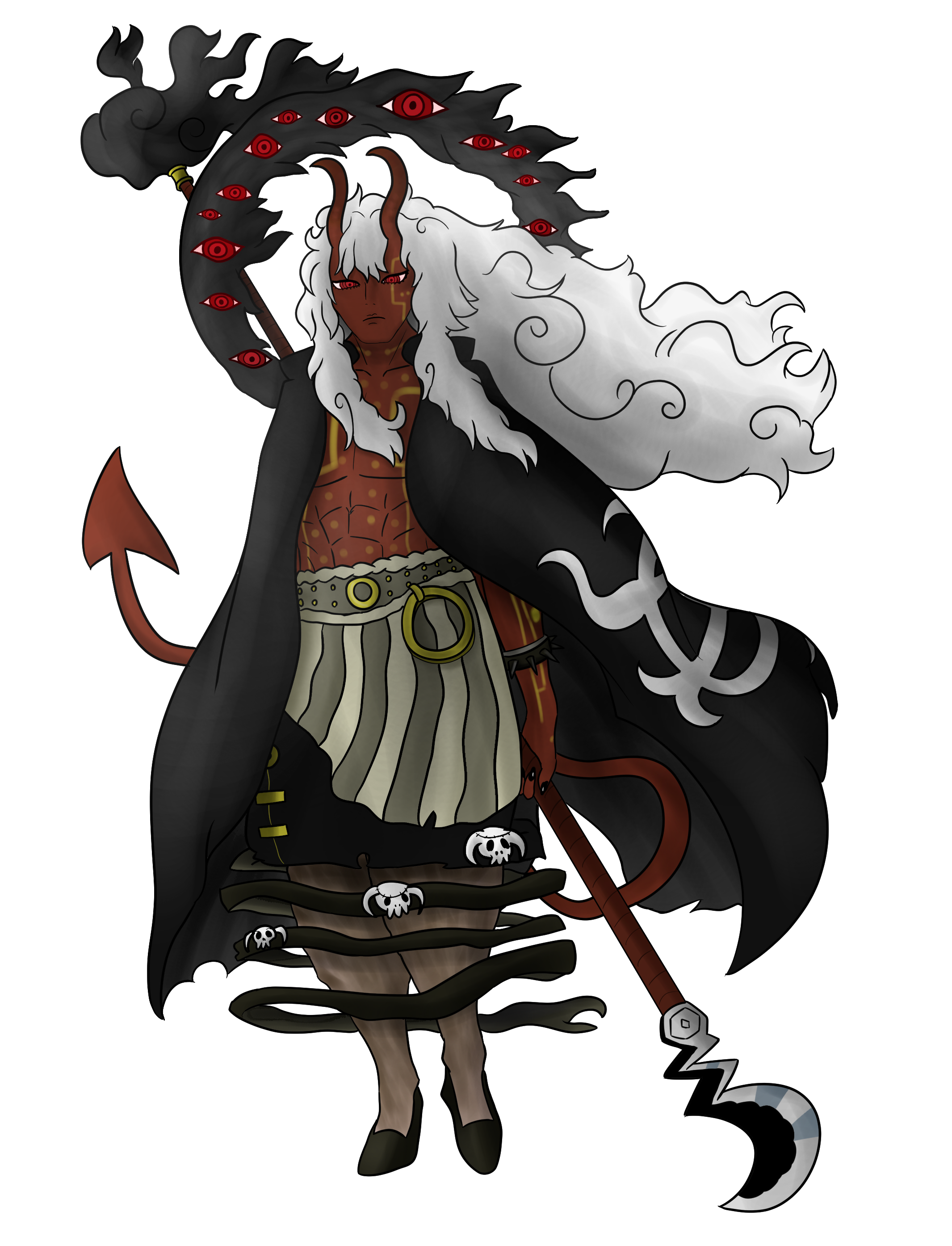
The motif of the devil is most noticeable on Imu’s appearance directly though. Given the hagoromo cloud scarf, Imu appears to be transformed in a hybrid form, or potentially a beast form as well depending on how hominid this devil is. So while I’ve seen some people think the dark tone on the skin is indicating Imu being of dark color like the lunaria, I think it’s much more likely that this is meant more like a red skin color that makes Imu look more like a traditional devil. Imu still has red eyes and white hair like the lunaria do, but they’re not the only ones who have this peculiar pattern. Nika’s awakening also depicts him as having red eyes and white hair, the sulong mink are also depicted with red eyes and white hair, as are those who have taken the energy steroids from the tamatebako, so there’s definitely some deep connection between those who have the power to attain white hair and red eyes, what seems to be depicted as the pinnacle of power.
From the hair of course we have sprouting two devil-like horns, and behind Mu is a hagoromo cloud scarf, although this one is quite unique as it has the symbols of Imu’s eyes on it. Imu appears to be barechested, which would seem to suggest, despite the more feminine beauty side of the face, that Imu may be a man. We know that Saint Nerona Imu was supposedly a man as “Saint” was used exclusively for male Celestial Dragons, while female use a different title, but there was some question as if to Imu’s current body was still that of a man. Regardless, Mu’s skin appears to be largely covered in what seem like marks, which are reminiscent of the kind of marks you’d see on a satanic circle but also have a slightly technological look to them, almost like a motherboard. The nails also appear to be painted, though rather than being painted by hand I think it’s more likely that they are dark claws like those of a devil, particularly as they appear to be sharp.
The cape atop Mu’s shoulders features the symbol of the God Knights, what we saw seemed to be the upgraded version of the mark which featured the round symbol similar to that of the World Government but with two horns added to it, to represent the devil. The cape appears to be slightly tattered, as a strip of it appears to twirl around Imu until it descends on the lower right. It may be easy to mistake this strip as being Imu’s tail, but that is separate. You will notice the tail is coming out of Mu’s rear and coming out to the right, whereas this strip of cloth is separate to it, swirling around Imu until its end can be visible under the tail. The tail of course is the traditional triangular shape with which we saw Imu skewer both Cobra and Sabo, although interestingly, while the tail was also visible in the transformed Gunko state, the wings seen there are not seen here, although I’d imagine Imu can probably both spawn wings and retreat them as we saw with Gunko too.
The cloth twirling around also appears to have three skulls on it, which is actually a very important symbol, because keen scholars of One Piece may remember how the three skulls are the symbol of the devil in One Piece. Oars the “country puller” wore three skulls around his waist because it was the symbol of the devil. This is because Oars came to be known as the “Devil” by many people in his era 500 years ago, as so terrifying was his power that some believed him to be the devil incarnate. But it’s probably from this very transformation that said imagery convinced Oars to don those skulls around his waist. Similarly, the devil king of music Tot Musica from Film RED also bore the demonic symbol of the three skulls. And you don’t need me to tell you which pirate in this story carries the symbol of the three skulls in their jolly roger, and what implications that may have for their connections with that concept towards the future…
Imu wields a long lance, with a squiggly blade as well as what seems to be a cloud similar to that of a devil fruit found at its end. Is this because Imu is extending Mu’s powers onto the spear or will the spear actually have a separate devil power too much like Cerberus?
Interestingly Imu’s legs appear to be quite puffy, which could be a set of baggy pants like those of Enel, but at the same time also reminds me of the legs of a goat, like a satyr, similar to the depictions of many demons in common folklore. His hand also appears to be wearing a spiked bracelet, tying into the overall demonic appearance. Just in general Imu’s appearance is incredibly reminiscent of that of the Devil from so many cultures. There’s European motifs of horns, red skin, or goat-like details, but also eastern motifs reminiscent of not just sun wukong, but also hinduist devils or the demons of Japanese folklore. If anything this design feels like the accumulation of every single myth of the devil from all of human folklore. In different religions, in different cultures, in different folklores, there’s often been a concept of the “devil”. Call him Satan, Lucifer, Iblis, Beelzebub or Mara, the concept of an incarnation of evil has existed across all of mankind, and those dreams and fears likely took the form of what we see here, the devil fruit itself. If people’s dreams and their wishes to be freed from oppression led to the existence of the Nika fruit, perhaps their fears and their desire for control led to the existence of the devil fruit, humanity’s desire to be controlled by the one who stands at the pinnacle of the world.
 The Library of Ohara