
Video version: https://youtu.be/0XGa0G6Lhio
End of Flashback
With the battle against Harald coming to a stop, and a snow still falls on Elbaph, we get to see Aurust Castle left in ruins. These ruins match those we saw the Straw Hats crossing in Chapter 1137, which much of the same damage matching the one seen back then. The following two shots also show the hall where Road walked through and the stairs he took after, and not only does the damage on the architecture match here too, but even the corpses littered on the ground, which then became skulls in those later shots.
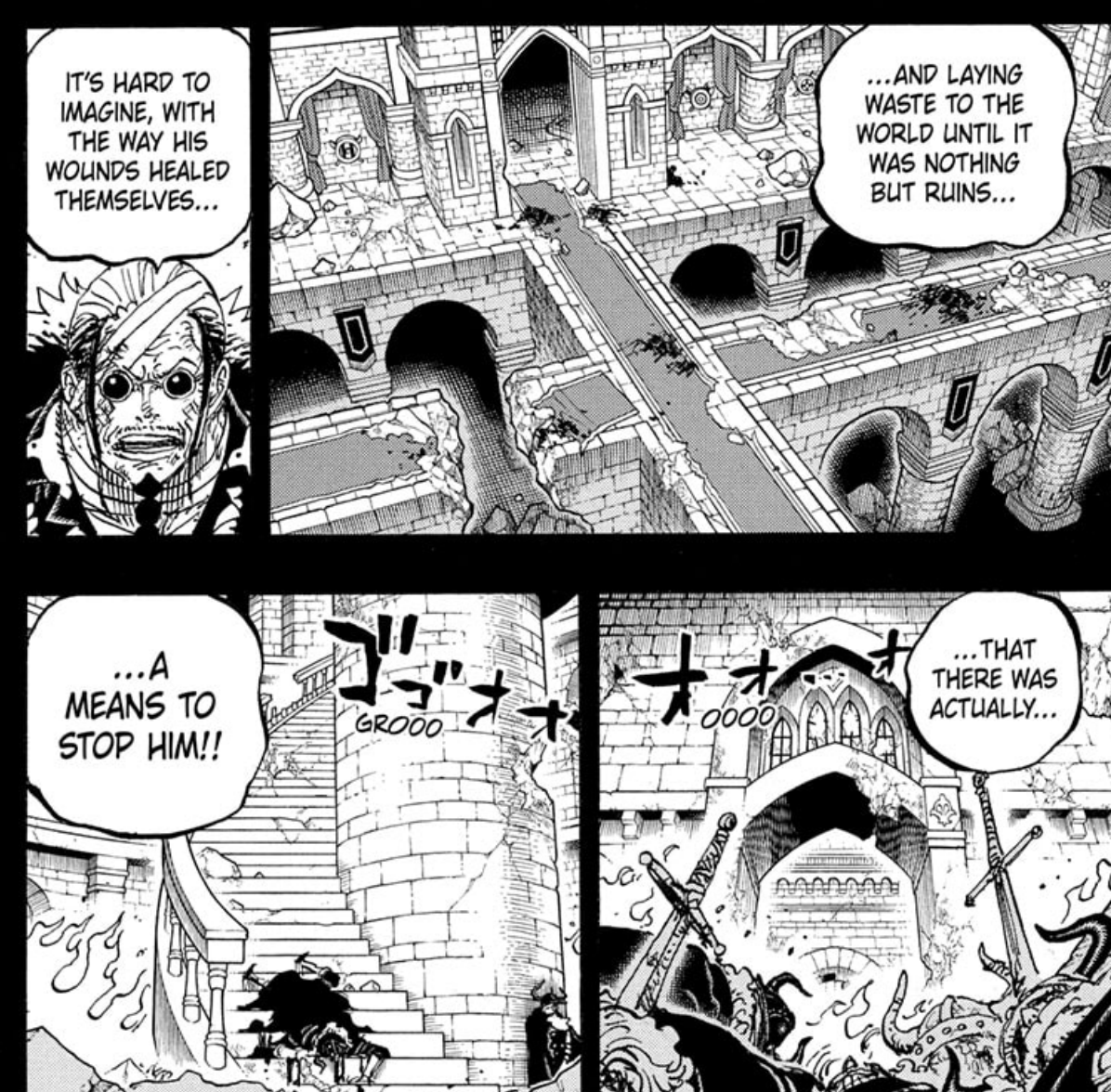
Gabin himself appears quite wounded, and seems to have a bandage covering the right side of his face. Considering that last chapter he didn’t show to have any scars, it would seem that it was in this battle that Gabin developed the scar next to his right eye that we see in the present, inflicted on him by the powerful controlled Harald. He also repeats what Jarul said that if Harald had left the castle on this day (with the fruit in hand, implicitly) he may very well destroyed the world. Shanks emerges fairly unscathed, but feels frustrated towards the Government and the mark he’s been given, which reinforces his desire to get rid of his arm with the mark on it, what would lead him to sacrifice it to the Lord of the Coast just two years after this event. In his recalling of his brief dialouge with Harald, Shanks remembers him mentioning bringing the “Dawn” to Elbaph, which once again associates the island with the concept of the Dawn of the World.
In the throne room, instead, Loki can only mourn his father’s death by covering his corpse with his own cape, but unlike the death of Ida, this time he tries to hide his tears but cannot hold them back, overflowing from his face. Despite wishing to not show his true feelings, this is one case where he is unable to cover the fully, even though no one else in the room is alive to witness him, but so deeply rooted is his instinct. Loki follows this line of logic by deciding to hide the truth about the incident in the castle, by deciding not to follow in Harald’s footsteps and to not have people lose faith in the light that Harald gave them, even if that means taking the brunt of the blame. Like we saw before, he is incapable of showing his vulnerability and he does not have faith that the people of Elbaph would accept him, and thus is willing to bear the cross of being blamed for Harald’s death if that gives the people some hope to grasp to. Jarul honors that promise, which is why he refuses to execute Loki, but plays along with his narrative out of respect for his wishes.
What I’m more interested in is Shanks, who supposedly defeated Loki at sea six years ago and then chained him up to the Adam Tree, so I wonder why Shanks did that or if he was somehow playing along with Loki, but it did seem like Loki did want to break out of those chains so I’m not sure how much he was interested in legitimately being chained up himself just to take the blame, but at the same time if Loki wasn’t willing I don’t see why Jarul couldn’t find some excuse or reason to free him. At the very least, this is consistent with what we were told that Loki set out to sea and earned a 2.6 billion bounty, and also why Jarul was considered the only survivor as the surviving guards just set out to sea with Loki (though again I wonder what happened to them when Shanks defeated Loki). Loki wished to take down the Government to avenge his father, which is how he got his bounty, but evidently couldn’t quite catch up with Imu.
Speaking of which, in the panel where Loki explains by the stairs what he wants to do, Shanks and Gabin appear prominently, but they are imposed to look larger by simply placing them closer to the camera; a later panel shows that they are indeed incredibly tiny and just resting atop a larger pillar, but the panel uses this effect to distinguish them more easily. These panels also finally give us a better look at Loki’s tattoos without his cape, which seem to be tattoos in the shape of a sun, not quite like the symbol of the ancient kingdom but most likely meant to be a sun given Loki’s association with wanting to be the Sun God.
Imu’s Weakness
Briefly cutting to Mary Geoise, we see Imu’s reaction to Harald’s death, who is massively startled. Seeing such a powerful Harald be killed, who Imu wished to make one of the strongest pawns the Government could have, makes Imu wonder “who” or rather “what” lurks in Elbaph, putting emphasis on the latter term, feeling the presence of the monster that attacked Harald but unable to determine quite what it was. This is also because the link between Harald and Imu was cut after Loki slashed away part of the mark on Harald’s arm. I was a bit confused by this last time, but upon closer inspection it seems that Loki’s claws carved through the mark and thus broke the symbol, thus cutting the connection between Harald and Imu, but it then slowly began to regenerate in the panel where we saw a close up of it, showing that upon regenerating again the mark would take control of Harald once more.
The Gorosei suggest sending someone else at Elbaph to take care of the matter, but Imu feels that this might just result in the deaths of more Knights, and claims that “Even for Mu, the contract comes at a price!!” (ムーにしても契約は代償を伴うのだぞ). This is bit vague and without much detail, but it does seem to suggest that there’s some general limit or caveat to how Imu’s covenants work, which would explain why they are only conferred to such a limited number of people. My best guess, even if it’s speculative, is that the marks can only be applied to a limited number of people, and potentially once that individual is killed for good, then that mark cannot be conferred to anyone else. Imu may be able to perhaps remove marks manually without this happening, which may be why he was so willing to kill Saturn, but if someone else does it then maybe that mark is lost forever. So if back then there were only 8 members of the God Knights, I wonder if now at present there are only 7 due to this number being reduced with Harald. Alternatively, maybe it takes a toll of some kind on Imu, and Imu is weakened any time one of his offered covenants is destroyed. Regardless, the one thing that seems very obvious is that Imu seems very hesitant to risk more knights dying, and certainly not out of affection for the knights. So I wonder what changed Mu’s mind to push more aggressively for a conquest of Elbaph in the present, perhaps out of desperation for the final conflict approaching.
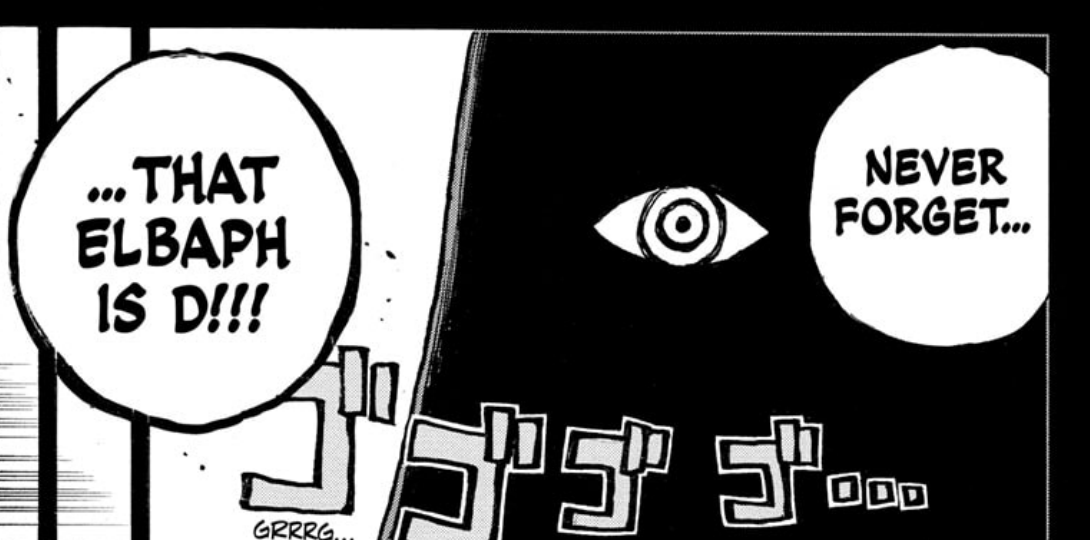
However Imu also feels that this result just proves what history has already shown: that Elbaph is simply not compatible with the Government, due to the fact that “Elbaph is D.”. This is a fairly vague statement (エルバフはDである) that when translated as literally in English might sound a bit awkward, but I think that what Imu is fundamentally saying is that Elbaph is alligned with the D. clan, which shouldn’t really be a surprise given how the people of Elbaph seemed to be so close with Joyboy and the D. clan in general, particularly with the beliefs in the Sun God Nika and the Dawn in general, which once again could present a connection with the D. initial itself. This may also be why the Government is currently trying to burn the library and erase the past of Elbaph because they want them to cut their ties with the history that connects them with the D. clan.
Ragnir
After a long long half year, finally the flashback ends, and Loki and Hajrudin are able to reconcile to a certain proint, agreeing to free him. In these panels where Loki has put his helmet down by the way, you can appreciate a lot more how, without his horns, his helmet really looks just like a straw hat. Their talk is interrupted however by the descent of a Draugr, one of the MMAs who has fallen from up top where the chaos is going on. Hajrudin and the rest of his crew go up with the lift, with Zoro and Sanji by their side if you zoom in on them. Sanji later jumps down from the lift to pick up Chopper and Gabin at their request, and then sky walks back to the lift so they can join in the ride, moving everyone from the Underworld up top.
Loki however simply claims that he’ll “fly” up there (飛ぶ), which reinforces the idea that his devil fruit allows him to fly. This puts us much more in the camp of him being some kind of dragon or Nidhoggr like we talked about than the Fenrir, because a wolf wouldn’t really be able to fly, whereas a dragon can, and once again the Nidhoggr being described in One Piece exclusively as a “lightning dragon” would reinforce the idea that Loki’s ability to generate thunder isn’t Ragnir’s but rather is Loki’s own innate ability. This makes the following scene a lot more interesting however: Loki unleashes an attack on the Draugr called “Nibelheim” (ニブルヘイム), which freezes the giant over. For starters, the attack being called Nibelheim is a reference to the Niflheim, one of the nine worlds of Norse mythology known as the primordial world that is frozen over. Fittingly, its kanji reading (原初世界) reads as “primordial world”, making the reference apparent.
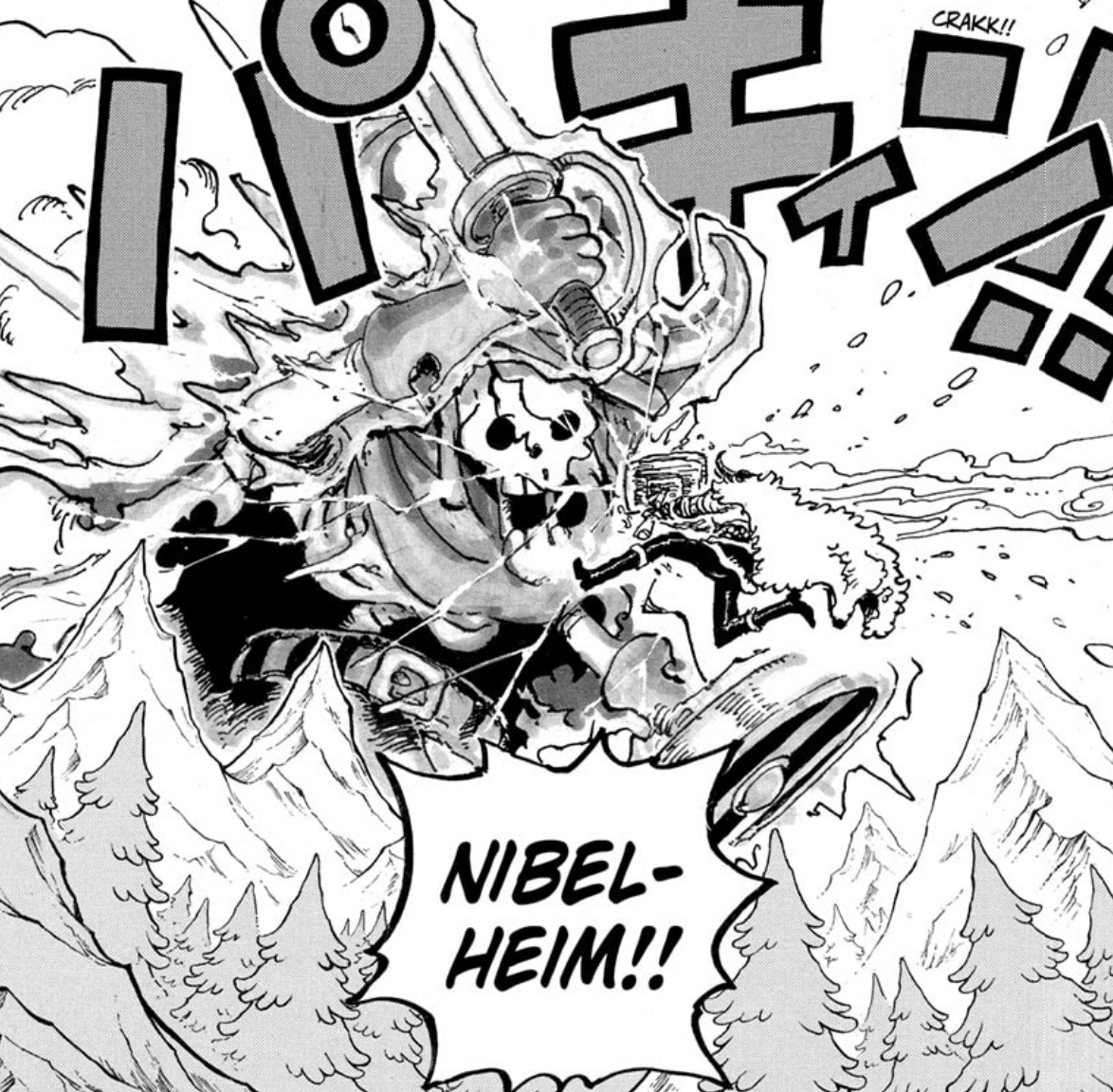
The odd thing is that here it isn’t spelled as “Niflheim” (ニヴルヘイム), but instead as “Nibelheim” (ニブルヘイム). Written with this katakana, instead of referring to the primordial world from norse culture, it’s instead referring to the iconic town of Final Fantasy VII, an iconic piece of Japanese modern pop culture. In that game several locations are named after norse mythology, such as the city of Midgar, but with slight variations to their names, such as Niflheim becoming Nibelheim. The reason for this spelling being different, in my guess, would be due to Oda making a common spelling mistake. After all, writing Niflheim correctly in katakana isn’t easy, and Oda may have more easily associated the name from the famous videogame being the correct spelling, particularly as Oda has claimed in the past to be a fan of Final Fantasy, infamously almost missing a chapter deadline during Arlong Park due to wishing to binge all of Final Fantasy VIII when it first released. So it most likely is meant to be “Niflheim”, but Oda instead here seemingly made a mistake and named it “Nibelheim” after the famous videogame.
Eitherway, the interesting thing is that ice powers don’t really correlate with what we saw before where Ragnir was able to summon thunder. This would however make sense if one is the power of Loki and the other is the power of the hammer,. If the thunder is a power related to the nidhoggr, then maybe the Ragnir’s power is to freeze things over. This makes sense as Loki tells Ragnir “Alright, let’s show them your power, Ragnir!!”, and the hammer replies with squirrel noises, suggesting that this is indeed the power of the hammer (not to mention the chapter being named after it), particularly with the zoom in where it appears to begin chilling. The thing is, this power doesn’t seem to quite connect with the powers of the ratatoskr or really any connection to squirrels in norse mytholgy, but like the nidhoggr having lightning powers in the world of One Piece, Oda could be taking some liberties, as at least this seems to confirm that Ragnir is a mythical Zoan too.
Recap
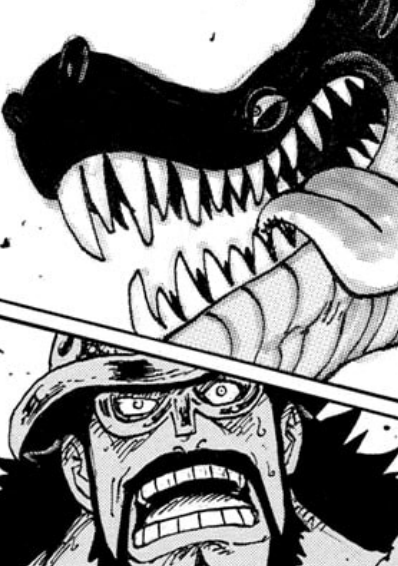
As Hajrudin and the others surface to the Sunworld, they witness the sheer chaos of all the MMAs running free. Among the MMAs we can see several draugrs, ghosts, bjorns, thunderclouds, fenrirs, víðópnirs, and even a Nika and a cyclops, though the latter comes from Greek mythology than norse (though creatures like the ghosts aren’t exactly just from norse mythology either). Particular emphasis however is put on the Nidhoggr, with even a close up panel of Hajrudin looking at said Nidhoggr, which just seems like Oda’s way of pushing even more the idea that Loki has indeed eaten the Nidhoggr fruit.
Oda gives us a proper map breakdown of the current situation, but since it’s still a lot to process let’s break it down carefully, as it’s been over half a year after all: as he reminds us at the start, the kids are being led by Gunko’s powers (who is currently possessed by Imu), which can influence direction, and protected by Sommers’s thorns, which make them untouchable, while Killingham’s MMAs are wrecking havoc to anyone that tries to stop them. As Gabin puts it, they have orchestrated a twisted “game”, which is the same term that Shamrock used to describe it at the start of the arc if you recall.
To orient ourselves on the map, the West Village lies on the western side of the Adam Tree, but that means that the left side of this map is north and the right side is south. All across the same branch is both the Warrior’s Spring, where the Owl Library and Walrus School are, whereas heading north at the tip is where the West Village (with Aurust Castle) is, and the location of the dock where the children are heading (if you remember, only those with the mark can use the Abyss, so the hostages must be taken to Mary Geoise by boat). In the middle next to the trunk is the lift from where we just came, with each of our groups splitting up.
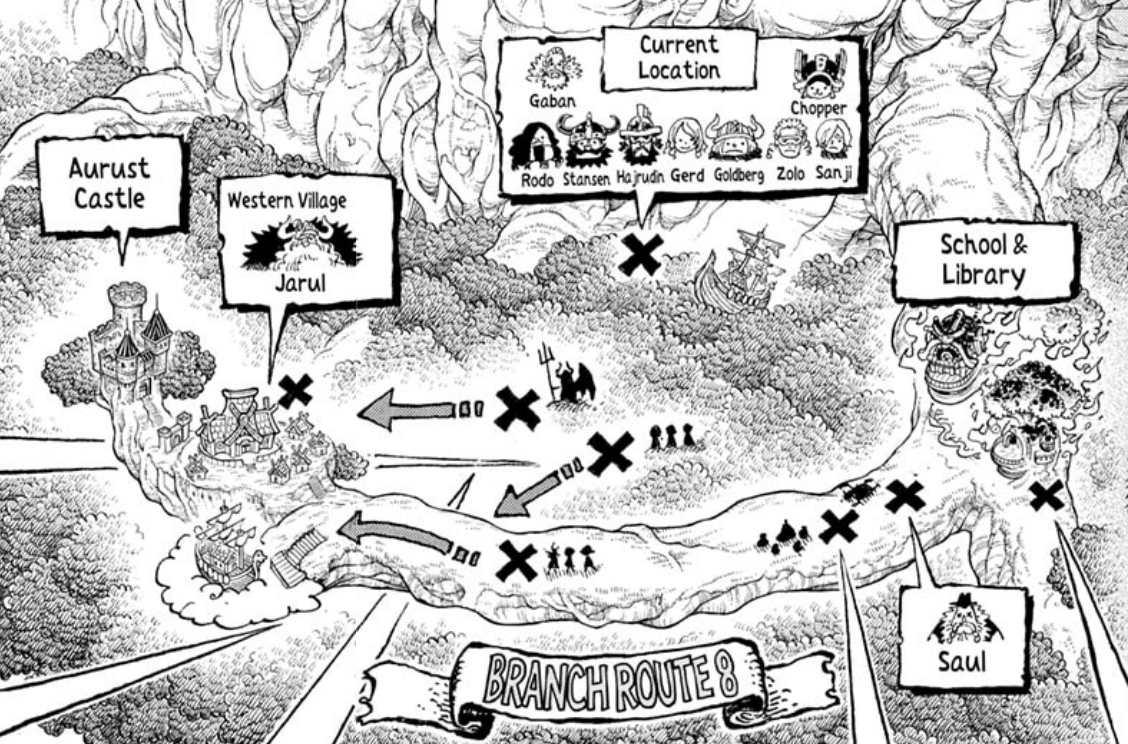
For starters, Sanji is heading towards the school since Nami, Robin, and the others are nearby. We don’t know if Chopper and Gabin will follow or if they will take a different direction. Killingham had, alongside forcing Ange, set the school and library on fire. It seems from the panel that the teachers and children were evacuated, but both are burning down, with the library in particular being a large concern due to all the books inside of it, and we don’t know what’s happening to Biblo the owl either. Killingham himself instead left the library and started leading the charge of the MMAs, though it’s not clear where exactly he is heading specifically of all places.
Not far from them on the branch Saul had been defeated by Sommers and the Straw Hats are still tied up, Robin in Sommers’s thorns and Nami, Usopp, Jinbe, and Brook in Gunko’s arrows, which they cannot undo. Fittingly, Nami is worrying about the kids, while Usopp is worrying about Dorry and Brogy. Jinbe mentions how Brook has gone off to somewhere, which is almost certainly trying to go after Gunko, as the two clearly share a relation of some kind, although Brook should still be tied as well. Since Gunko is a God Knight, we know that like Harald, it should be pretty impossible to break her possession unless her mark is physically destroyed, although that should only be temporary. Still, I wonder if Brook having powers that relate with the soul could achieve something.
Road leaves running off after the children found at the middle of the branch, since Bjorn turns out to be his little brother. And looking at Bjorn’s face and the fact he seemed to be more selfish and timid… yeah I’m surprised I didn’t notice the correlation earlier. Gerd and Goldberg chase after Road to go after the ten children. Also charging after them to save the kids are many of the giants such as Ripley, Oimo, and some of the mothers of the children.
Meanwhile at West Village is the target location of the docks as well as where Jarul currently is. Dorry and Brogy have been tasked by Imu to kill Jarul, as Imu has chosen them to be the new leaders of Elbaph, so they need to dispose of the closest thing Elbaph has left of a leader. Imu appears to be floating above the reversi giants, leading the charge towards the village, whereas Sommers appears to be somewhere else on a branch feeling like his role has been taken care of. So from our group, Hajrudin, with Zoro riding atop him, charge after Dorry and Brogy, as Zoro has a plan to stop them. The last time Zoro had some kind of plan was against Pica in the aptly named “plan number 5” since he had to go through a whole bunch of plans to choose one which worked, which may be just as reckless as that one of being sent flying to cut Pica in half, though in this case it seems it may have something to do with how reversi is played.
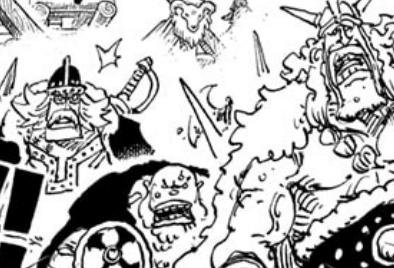
On a random note, among the giants of the West Village in a small panel you can spot Raideen, who was the same giant that had been training Hajrudin when he was little in Big Mom’s flashback, and who even earlier appeared in Dorry and Brogy’s flashback all the way back in Chapter 129 during Little Garden.
To rally together the people of Elbaph, Jarul decides to tell them the truth of what happened that day, although he paraphrases things a little to save Harald’s honor as well. None of what he says is technically a lie, but as Zoro puts it he’s rounding up things to protect Harald’s legacy. Instead of saying that Harald was naive and manipulated by a devil, and so that he needed Loki to kill him, he says instead that it was a devil who ended up killing Harald (which in a roundabout way it was). He also excuses the lack of truth on wanting to avoid a war with the Government, but he decides to take a stand now. Jarul basically manages to strike the perfect balance of what Harald wanted without his naivety allowing him to ruin it. He intends to retain the peace that Harald dreamed of and he intends to build a future where giants can stand side by side with humans. But at the same time, he refuses to let Elbaph be subjugated and enslaved, and thus turns fighting back against the Government as an act of liberation rather than sheer warfare. Oda continues to build on a long thematic he’s elaborated upon in the whole series, where the act of fighting back is important to achieve liberation, but it is also a very slippery slope of creating an endless cycle of warfare. It is for that matter that liberation should be a moderated and careful stand for a better ideal of equality and freedom rather than simply trying to supplant one ideal with another. And by taking this route, Elbaph can embrace both the peace that Harald and Ida envisioned, as well as protect their pride as warriors and embracing the culture that has taken them to this point.
Zoro’s Plan
Regardless, in the end, Zoro’s plan mostly amounts to attacking from above, as he strategizes with Hajrudin and Stansen while calling them “兄弟” (kyoudai), or “brothers”. While this could just be Zoro trying to be friendly, it does seem odd for him to use such a term, but it would make sense if this is a reference to the fact that the Giant Warrior Pirates have shared sake cups of loyalty to Luffy as part of the Straw Hat Grand Fleet. That would make them brothers in arms due to the pact, and Zoro is calling them as such to let them know he’s relying on them.
Against the giants Zoro unleashes his technique “Santoryu Ougi Rokudou no Tsuji” (三刀流奥義六道の辻). This move translates as “Three Sword Style Secret Technique: Crossing of the Six Paths”. You may recall that Zoro previously used this move against the kraken right after the timeskip to slice one of its tentacles, and also later used it against Prometheus in Chapter 1009 when combining it with Kin’emon’s flame-cutting technique. The “crossing of the six paths”, much like many of Zoro’s moves, likely refers to the six paths of Buddhism, but it could potentially be a play on words on “tsujigiri”, which refers to samurai who would slash people in crossings or open streets. You may recall that Zoro was accused of such a crime at the start of the Wano arc. So in this case it’s making a joke on the six paths of Buddhism as if it were a crossing where Zoro is slashing all those within it.
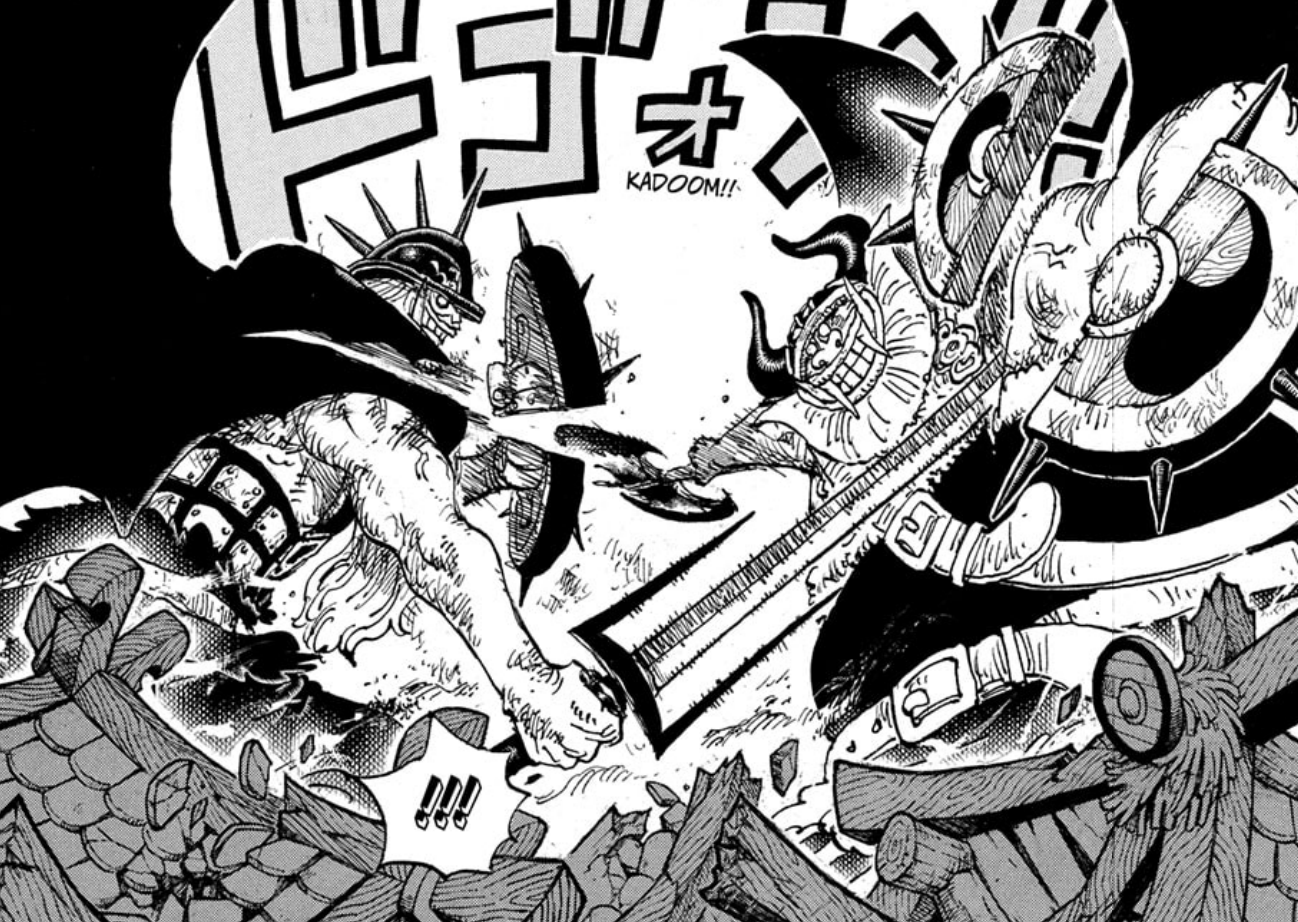
Dorry and Brogy try to attack Zoro but he dodges by creating a powerful gust of wind with his swords, which we’ve seen him use several times before such as when fighting against King to reorientate himself in mid-air. This causes Dorry and Brogy to slash each other, in a panel that is incredibly reminiscent of the one we first saw them dueling in Little Garden, with the only difference being that in this case they are cutting each other, but due to the effects of Domi Reversi they should regenerate, even if it may take a while given both of their enormous strengths. It would be quite funny if them clashing against each other would get them to get angry at one another and start hitting each other in spite of Imu’s orders while Mu is busy on the other side, essentially restarting their long feud at the worst possible time (for Imu, at least).
Brook and Shuri
Speaking of which, Brook manages to reach all the way to Gunko and calls out to her, but not as Imu, but rather as “Princess Shuri”. In Japanese it’s “Shuri-hime” (シュリ姫) and while it could be maybe romanized in different ways, I think I’ll keep it as just “Shuri” for the moment to keep it safe, as Shuri is a common Japanese female name. A lot of what Brook says checks out with what we assumed. As he says, if Princess Shuri were still alive, she would be nearing 80 years old now, which would mean she is in her late 70s. Of course though, we know that Gunko has achieved perennial youth since she looked just about the same as today 56 years ago when Xebec broke into the Room of Flowers. Brook is 90 years old, so it means that Shuri is only a bit more than a decade younger than him. But it could still check out in the images we saw in the flashback that maybe Brook was in his early 20s taking care of a young princess who was around the age of ten or less.
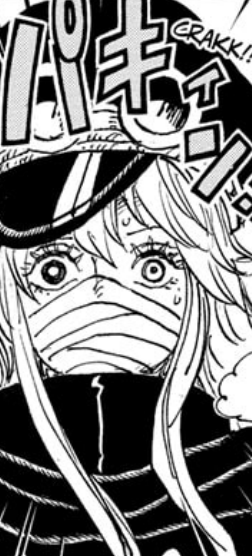
As a reminder, Brook mentioned very loosely in Thriller Bark that, prior to his days as a pirate in the Rumbar Pirates and ever meeting Laboon, he was long ago the knight commander of a certain kingdom. The term was that of “dancho”, the same position Shamrock holds in the God Knights as an example. But that’s really as far as we got to know about his past. Said kingdom would seemingly be one from the West Blue, as Brook is a West Blue native, but we can’t say completely for sure.
What most of us inferred and what we can also infer from this context is that Brook was the knight commander of a certain kingdom, working for that kingdom’s king, and in this case Princess Shuri was that King’s daughter. But oddly enough, although Brook says that Shuri used to enjoy his music, and we saw the two of them merrily together in their flashback, Brook seems to currently resent her. Not only does he say that he wished to forget about her (which could be Oda’s excuse as to why Brook never talked about her thus far), he says that “The one whose life you took was my benefactor!!!”, and particularly calling her by the epithet of “chichigoroshi no hime” (父殺しの姫), or “the princess that killed her father”.
In Japanese, the word benefactor, or “onjin” (恩人), carries a very strong connotation, as it means someone who you owe a lot to and who has either looked after you, supported you, or even saved you to an extent. Being the commander of the knights, it made sense that Brook was very loyal to his king, and it’s even possible that the king may have saved him or offered him this position in a time of strife. However, at some point, it would seem that Shuri decided to slay her father, with Brook not knowing what fully happened and eventually either running away or being separated from them, while still being devastated about the death of his benefactor. However, I’m willing to bet there’s more to this than we are first being led to believe.
As we saw in Gunko’s memories, she not only looked fondly up to Brook, but she also cried screaming out to her father. As we see here, Brook’s words give her strong heart palpitations, as indicated by the “dokun” (ドクン) sound effect, like a large heartbeat. This causes her to again regain her memories briefly, to which she dispels her arrows and tells Brook to run away, seemingly also undoing her transformation as the devil wings begin to rip apart and her eyes return to normal instead of having Imu’s eyes. We also saw when she kicked Brook that she clutched her heart in pain, so it seems that part of this control relates to the heart as well. This is briefly lived however, as indicated by the glare of Imu’s eyes returning and Gunko starting to speak like Imu again (using the “nushia” pronoun to refer to Brook). This seems to indicate the assumption that I’m sure many of us are making that Gunko, or rather back then, “Shuri” was not complicit in the King’s murder. If anything, it seems more likely that some case similar to what happened with Harald may have taken place, where Imu may have interfered in the affairs of some other country by either framing Shuri or taking control of her, which actually would provide a strong narrative parallel between Gunko and Loki, especially if the two of them end up clashing in this arc. But from Brook’s perspective, it’s possible that he may not have known about Imu’s powers or any control on Gunko and that’s why he assumed that she just betrayed her nation and all she stood for to kill her father.
The thing I’m more curious about is Gunko’s current status. If she originally was Princess Shuri of a West Blue Kingdom, then supposedly she wouldn’t have been born a Celestial Dragon (unless she’s a half like Shamrock and Shanks). However we know she’s currently known as “Manmayer Gunko”. We already speculated previously that Gunko may not be her original name, as it’s written with kanji that fundamentally mean “child soldier” (軍子). But Manmayer is one of the established Celestial Dragon Families (with at least another member in the form of the blue haired God Knight we saw in God Valley). We know that people like Harald could become a Celestial Dragon by joining the God Knights in special exceptions, but I don’t recall him ever getting a name, so I wonder if Gunko was “adopted” into the Manmayer family as a formality or if she really is a half. The connection deepens further with Brook mentioning that Shuri was connected in some form to the Holyland, so I wonder how it all relates. The odd thing about her, as mentioned before, is that she attained perennial youth way before she even was a God Knight, as she already had perennial youth in God Valley when she was still a servant blade. And if she did kill her father under Imu’s influence and was so willingly serving him all that time, then she must’ve already been mind controlled since the start, as she was following orders in God Valley, unlike someone like Harald (although we didn’t see much from her back then so hard to say if she was being blackmailed or whatnot). It definitely feels though, in some way or another, that Imu treats her as special, even using her as Mu’s vessel during this incident.
Goukoku
Anyway, Gunko briefly dispelling her powers liberates the straw hats except for Robin. Usopp believes it was due to his own psychic powers, trying to control them even in the following panel as he puts his hands to the air. Jinbe mentions that Ange followed after the kids too but believes that they may not be able to reach them in time, so I wonder if they’ll shift their efforts in trying to preserve the library instead, particularly as Jinbe should be able to use the water from the spring to put out the fire. And as evident from the scream, Sanji regroups with them as well.
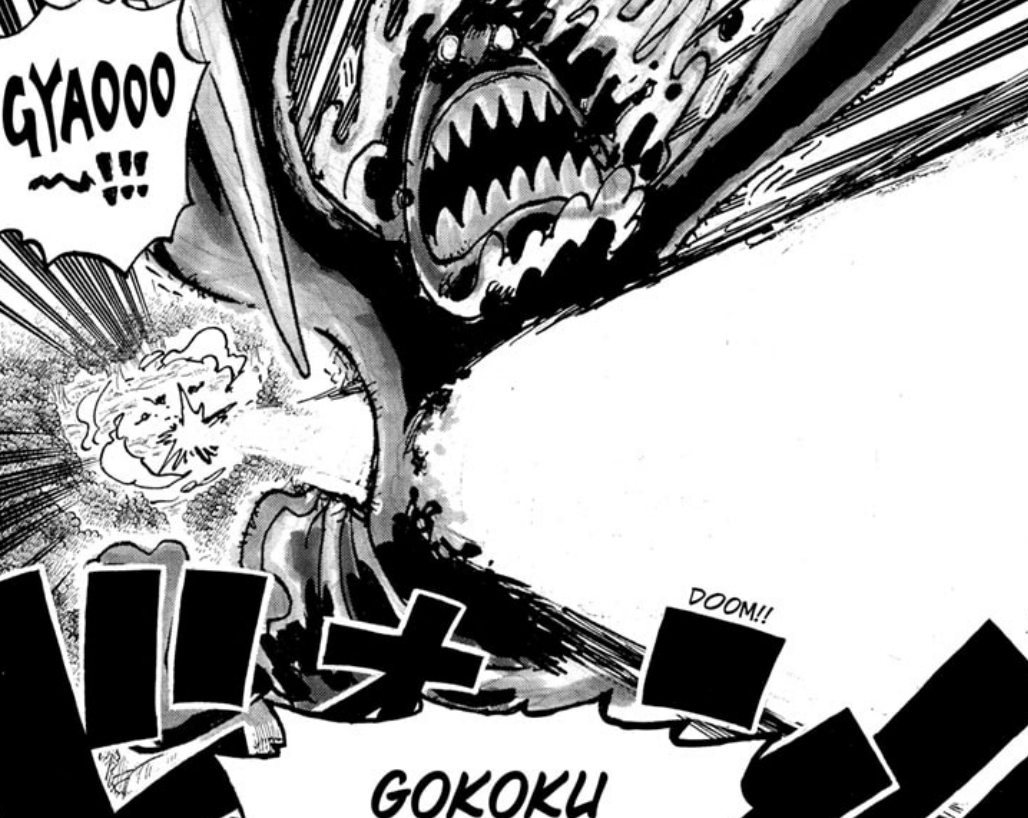
Meanwhile, while Sommers is leading the kids to the port, the mothers come in tow to rescue them. Beyond Ripley we also have Oimo, who one of the kids refers to as “grandpa”, which makes sense, as Oimo is already 153 years old after all. This lines up as if you recall in Chapter 1147, Oimo mentioned Olav being his grandson. A Nika MMA appears to fight them but they manage to stand their ground, as Ripley mentions that they are from a “generation of warriors”. This term actually harkens back to the start of the arc, where in Chapter 1134 Ripley mentioned how they were part of the last fading generation of warriors of Elbaph. To stop Nika, Gerd and Goldberg, alongside Road, unleash their own version of Hakoku. Instead of using Dorry and Brogy’s Hakoku (覇国, conquering nation) or Big Mom’s Ikoku (威国, Powerful Nation), they instead use “Goukoku” (轟国), which translates as “roaring country”. Indeed they let out a beam like a powerful roar or thunder, piercing straight through the MMA. Interestingly, they preface this attack with “sanshou” (三将), which means three generals, essentially meaning it’s a three way version of the traditional Elbaph attack.
The Nika is sent flying and crashing into the ship Sommers had intended to use, which means that the kids can’t be transported out by boat. This foils the Knights’s plans, but I assume there’s gotta be some other option that they will be taking as I doubt this conflict will be solved this easily.
 The Library of Ohara
My bet: she’s half Celestial Dragon, her mother being a Manmayer. This is why she has blue hair, just like the other Manmayer Godly Knight. For some reason, probably related to Nefeltari Lily, Imu is attracted to blue-haired women. This is why he has Gunko as his personal servant and has granted her perennial youth. It’s also the reason he wants Vivi.
LikeLiked by 1 person
Maybe Buggy also Manmayer, or Gunko’s son? lol
LikeLike
Ragnir does have the power to summon lightning, because Loki was able to summon lightning with Ragnir and Loki was still chained with seastone (Chapter 1142)
It is possible both can summon lightning, but we do know Ragnir can do it.
LikeLike
>None of what he says is technically a lie, but as Zoro puts it he’s rounding up things to protect Harald’s legacy
This isn’t the problem. Zoro is talking about how Jarul said that Loki is innocent, Zoro and Hajrudin both are saying: Loki may not have killed Harald, but he definitely isn’t innocent.
LikeLike
I hope the copyright claim gets resolved quick and you don’t have any issues for future videos. Videos from the past month seem to be up on the channel.
Take care of your health and don’t stress too much.
LikeLike
My head canon is that Gunko’s arrows are made of the same material of Bartolomeo’s barrier.
LikeLike