
Video version: https://www.youtube.com/watch?v=vRrjOyVfPBg
Covers
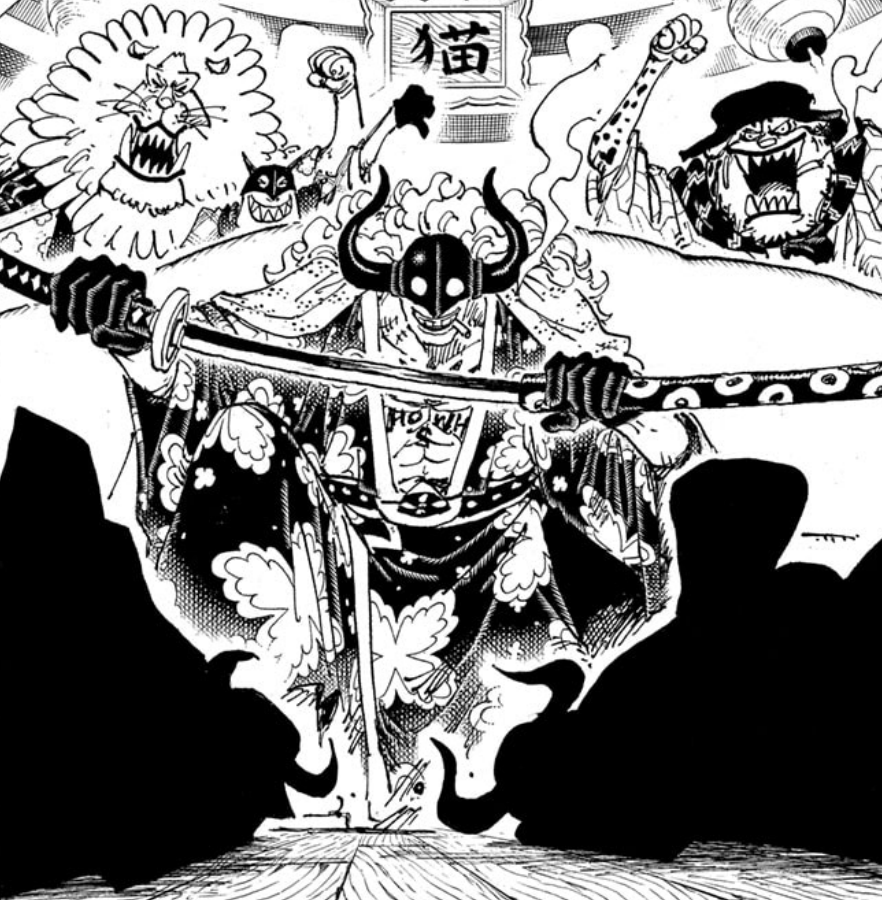
On the cover, Who’s Who has captured two “rebels”, being two shadows collapsing to the ground. While it may be hard to make out at first, these are pretty clearly the silhouettes of Ulti and Page One, and the fact they have been labeled as rebels seems to indicate that they may have tried fighting back against Who’s-Who for control of what remains of the Beasts Pirates, but were defeated by him, putting them in a rough situation now that their adoptive father, Kaidou, is gone. Could this point towards them helping to agree to work with Yamato? Or will Ulti simply be unwilling to get over her grudge?
Throne Room
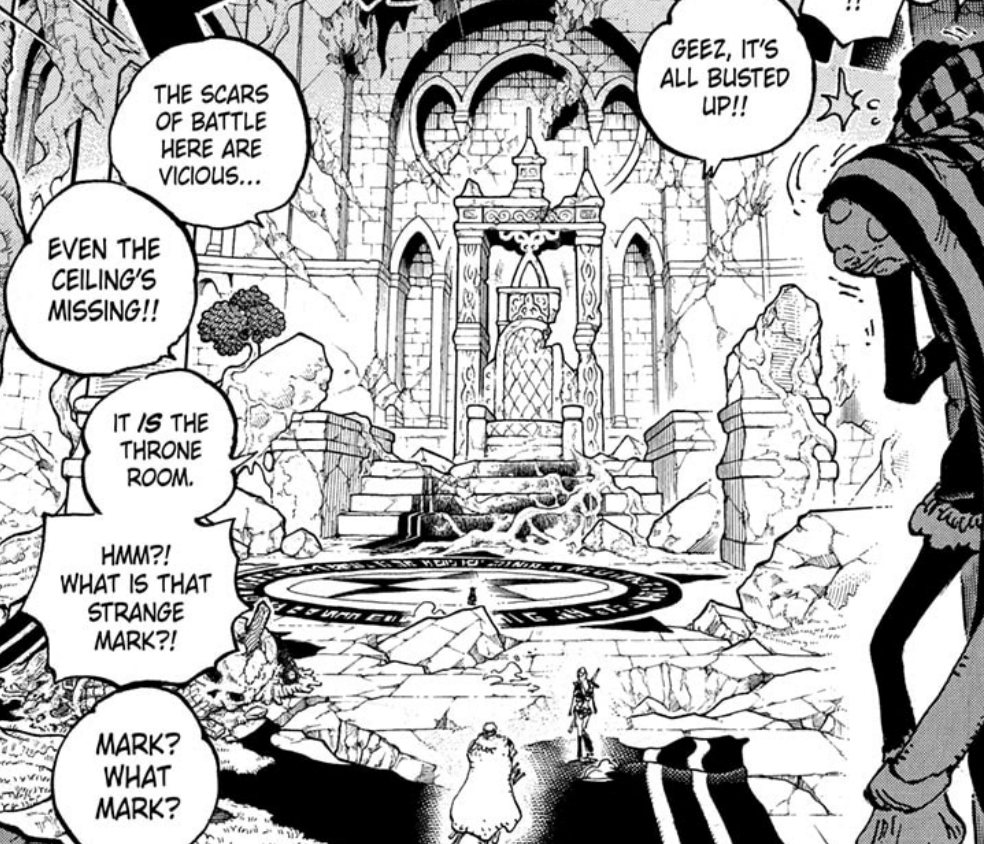
Back at Aurust Castle, the group continues searching for the key, but ultimately comes across the castle’s Throne Room, what in Japanese is usually called the Ou no Ma, or King’s Chamber. It’s as we saw it before, but we get a better look at it, showing how it’s very much in ruins. An interesting detail is the fact that on the wall, there’s a cut in the shape of three lines that seems like an attack caused by the claws of a large monster. Could this be hinting at Loki’s true powers, being some sort of clawed creature, or is this something else like Loki unleashing some of the Underworld beasts in this room? A skeleton is also still found on the ground. Furthermore, part of the roof has collapsed as we are told, either from the old battle, or from the arrival of Shamrock and Gunko, but eitherway, it seems they used that to sneak in.
Road spots said magic circle, which the Straw Hats don’t see at first since they struggle to see it from ground level, so they hop on his hand. Nami claims that she has read in a book before about these magic circles, claiming that in some far off country, they do rituals to try and summon devils. It’s worth noting that the Japanese word for “magic” used here, mahoujin (魔法陣), uses the kanji for “devil”, because magic was associated with devilish witchcraft, so in a sense this “magic circle” also literally refers to being a devil-invoking circle.
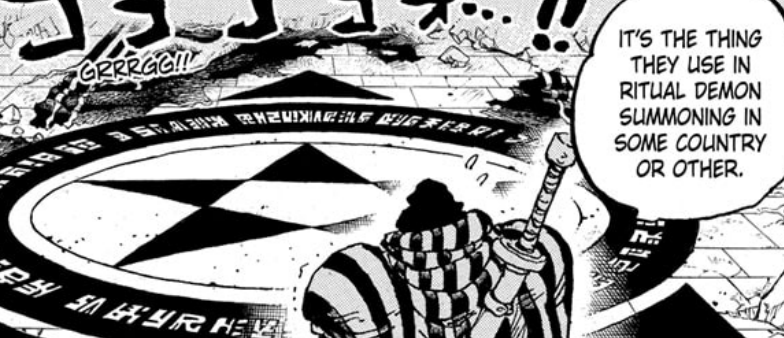
Nami’s claim about some country that uses these circles is likely referring to Harahettania, the country on Namakura Island where Brook was taken to during the timeskip. There we saw how the people used magic circles to invoke the Devil, who in reality likely is the myth that remained of Imu’s existence in the distant past, but they ended up summoning Brook instead, who they mistook as a devil. In that case, said circle was fairly similar, also featuring writing that differs from the standardized Koyogo language.
Luffy also recalls having seen the circle somewhere, as he clearly saw it during the Egghead Incident when the Gorosei spawned in, but can’t quite recall as usual. The group suddenly hears a voice, and Road grows scared and starts chanting the expression “shizumari tamae” (寝まりたまえ), which is essentially a ritual chant to ask spirits to begone, fundamentally meaning “go back to resting”. As they are stopped by a giant axe, Road drops Luffy, Nami, and Zoro, but Luffy grabs her with his arm to help her out and drops her onto Zoro.
Yaa-san
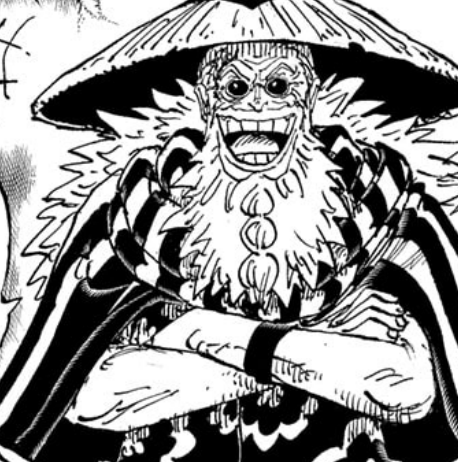
The mysterious man goes by the name of “Yaa-san”, finally solving the mystery of Collon’s father that has been set up for several episodes. This is clearly the man from the cover of Chapter 631, the man who told the Straw Hats to “come” to Elbaph, and the one who has been set up ever since. Most One Piece fans will surely recognize who he is, but let’s play along for now with the chapter, as he is called by the people of Elbaph as “Yaa-san”. San in this case is obviously the honorific of “mr.”, so he is basically called Yaa, with an elongated a sound. Road instead calls him “Yaa-shi”, using the honorific “氏” which is incredibly formal and considered a bit outdated, likely due to Road speaking like a weeb. Yaa-san claims to have come to the castle due to having felt a strong haki, but it now seems to be gone, showing that his observation haki likely picked up on Shamrock and Gunko.
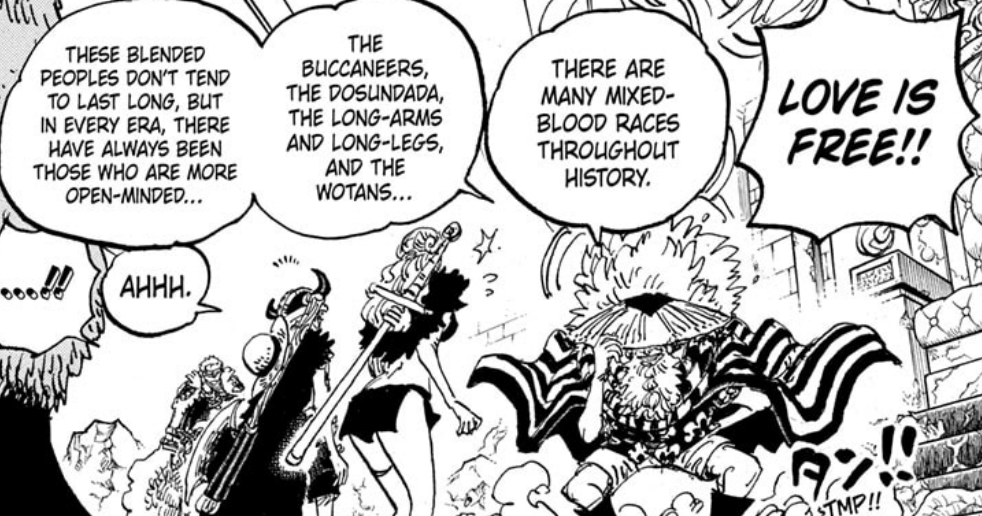
As we imagined, he is Collon’s father, and as we also imagined, Collon is 20 years old, while Ripley is 80, making her older than her husband. And though he laments that, Yaa-san also firmly believes that “love is freedom”, establishing one of the most fundamental themes of One Piece that love and friendship are things that trascend race, gender, or any belief. He even calls himself an “ai no dendoushi” (愛の伝道師), or a “missionary of love”, striking a pose that is incredibly similar to that of Oden, for reasons that should become pretty apparent where he got it from.
Race Biology Lesson
He begins talking about mixed races in the world of One Piece, mentioning the buccaneers, the dosundada, the longarmlegnecks, the watans, and so on. So I thought I’d take the opportunity to go over all the races and hybrid races in the world of One Piece. These races are often translated by some fans as “tribes”, but the word “zoku” 族 here is more accurately translatable as “race”.
In terms of pureblood races we have of course the most numerous of them all, ningen (人間), or humans. After that we have the sea-dwellers, the fish-men (gyojin, 魚人, and their female counterparts, fish-women) as well as the mermen (人魚, or their female counterparts, merwomen, or more commonly called “mermaids”). Then we have the sky people, or angels, tenshi (天使), as they are also called by others, which are divided into three sub-races, skypieans (who locally call themselves “skyfolk”, or sora no mono, 空の者), shandians, and birkans. Furthermore, there are the lunaria (ルナーリア), who are angels who have seemingly evolved in the past, implicitly through the use of the bloodline elements, to become more powerful and advanced.
Then we have the animal-like minks, as well as what are called “little people”, or “kobito” (小人), which we usually localize as “dwarves”, known more properly as the tontatta race. There are also the giants, or kyojin (巨人), but there’s a different unique race which we call the “ancient giants” (kodai kyojin, 古代巨人), far larger, with colored skins, and large horns. Furthermore, there are the “mystery giants” (nazo no kyojin, 謎の巨人), the race that the Yeti Cool Brothers pertain to, though we don’t know if that’s a hybrid or another unique race.
Closer to humans are the races of long limbs, what are known as the longarm race, or tenaga (手長), the longleg race, or ashinaga (足長), and the snakeneck race, or jakubi (蛇首), not to be erroneously called “longnecks”. And on top of it, there’s also the three-eye race, or mitsume (三つ目), who seem to have some affinity with the Voice of All Things.
Finally there’s the unique case of the Kuja (九蛇), because they are technically a hybrid race despite also being unique. This is because all kuja are fundamentally humans but can only give birth to females, meaning that they must reproduce with a man to have a child. We were told that kuja leave Amazon Lily when they grow up to find a suitor and return to their homeland to give birth to a girl, meaning they need to continue reproducing with male humans to stay alive, so they are inherently hybrid in some regard, always needing a male non-kuja parent.
Hybrid Races
With that said, we move on to hybrid races, mixes of other races. For starters, it’s worth noting that fish-men and mermen can procreate together without really creating hybrids, as their kids come out as either fish-men or mermen.
But with other races we have the boringly named half-fish-men, or han-gyojin (半魚人). In this case, it’s a hybrid between a human and a fish-man, and an example would be Dellinger, of the Donquixote Pirates, who was half fighting fish, hence the horns and spiked teeth. Other hybrids include Sapi, who you likely don’t remember, but was a fishmonger at Loguetown that interacted with Sanji, as well as Charlotte De-Chat, 44th son of Big Mom. In De-Chat’s case he looked a lot more like a fish-man, while Dellinger and Sapi looked closer to humans, so I guess it’s more of a matter of dominant or recessive genes.
We also similarly have half-mermen, or half ningyo (ハーフの人魚, probably 半人魚 as well). Kokoro from Water Seven had a kid with a local human, who was a half-merman, who had a kid with another human that became Chimney, who is 1/4th mermaid (4分の1人魚). Chimney doesn’t keep any mermaid traits anymore but is incredibly proficient at swimming, which is how she was able to save Luffy in the powerful whirlpools of Enies Lobby. At the same time, Big Mom’s daughters Charlotte Prim and Charlotte Praline are both half-mermaids as well, though look pretty much the same as normal mermaids.
We haven’t seen natural angel hybrids yet, but the Seraphim are special cases as they are all artificial hybrids. S-Hawk is a human-lunaria hybrid, S-Snake is a kuja-lunaria hybrid, S-Shark is a fish-man-lunaria hybrid, and S-Bear is a buccaneer-lunaria hybrid, which the vivre cards recalled is why he had extra endurance as well when Luffy was punching him.
In terms of long-limbed people, this is where it gets confusing, because as we mentioned, we have longarms, longlegs, and snakenecks. But in Whole Cake Island, Big Mom mentioned having a longarmleg, a special hybrid of longarms and longlegs. This is incorrectly translated sometimes as “longlimbed”, but the correct term in Japanese is teashinaga (手足長), or longarmleg. However, in this chapter, Yaa-san mentions the longarmlegneck race (手足首長), implying a triple hybrid between all three races. As such, it’s likely that longarmnecks and longlegnecks exist too, what a headache! Though beyond that there’s also Big Mom’s children who were either half longarms, longlegs, or snakenecks, as well as Pudding being a half-three eyes. Other bizzarre-looking Charlotte members existed, such as the pumpkin-looking Charlotte Katou or the devilish-looking Charlotte Dacquoise, but we have no info on their races. Big Mom also had a unique race called a “mushrooman”, or “kinokobito” (キノコビト) with four legs.
We haven’t really seen mink hybrids yet, but in this chapter we are told of the dosundada (ドスンダダ), who we don’t know who they are, but by the name we can assume they are likely half-human half-tontatta hybrids. We already have seen one in the form of Charlotte Normande, one of Big Mom’s final children, the result of what must have been a very brave father.
And finally we have the giants. On one hand, we already know of the giant-fish-man hybrids, as they are known by the name of “watans”. Often mistranslated with an “o”, their phonetic name likely stands for “water titans”, and are written with the kanji “gyokyojin” (魚巨人), or fish-giants. The only example we have in canon is Big Pan, the member of the Foxy Pirates who was half-mudfish, but due to being a hybrid also appearead far smaller than normal giants, being closer to around ten meters than twenty.
Furthermore, we were told just recently how ancient giants mixed with giants resulted in people like Harald, who retained horns and were taller than normal giants due to their heritage. Similarly, we speculated that people like Kaidou or Yamato likely are half-human half-ancient giant, what Kaidou described as being “oni”, which are likely an actual race now. But the question stands between half-humans and half-giants, because of course we see the case here with Collon. But Yaa-san also tells us that buccaneers are a hybrid race, as after all Ivankov did mention during God Valley in 1095 that buccaneers have the blood of giants. But then what hybrid race do they pertain to? Are they half-human half-giant? But if so, does Collon qualify as a buccaneer and why isn’t he as bulky as Kuma? I think the likelier explanation is that it’s a similar case as half-fish-men, who in some cases their dominant genes make them look more like fish-men, while other times as humans, so in this case Collon may be more giant-like, while someone like Kuma or his father Klapp were more human-like.
Scopper Gaban
Eitherway, let’s move on from this biology lesson as the group reaches the Treasure Room under the throne, mostly abandoned but where the key rests. However, the man claims that if Luffy wants to get the key, then he’ll have to fight him, as he reveals himself to be, surprise surprise to one’s shock, Scopper Gaban, the left-arm of the Pirate King.
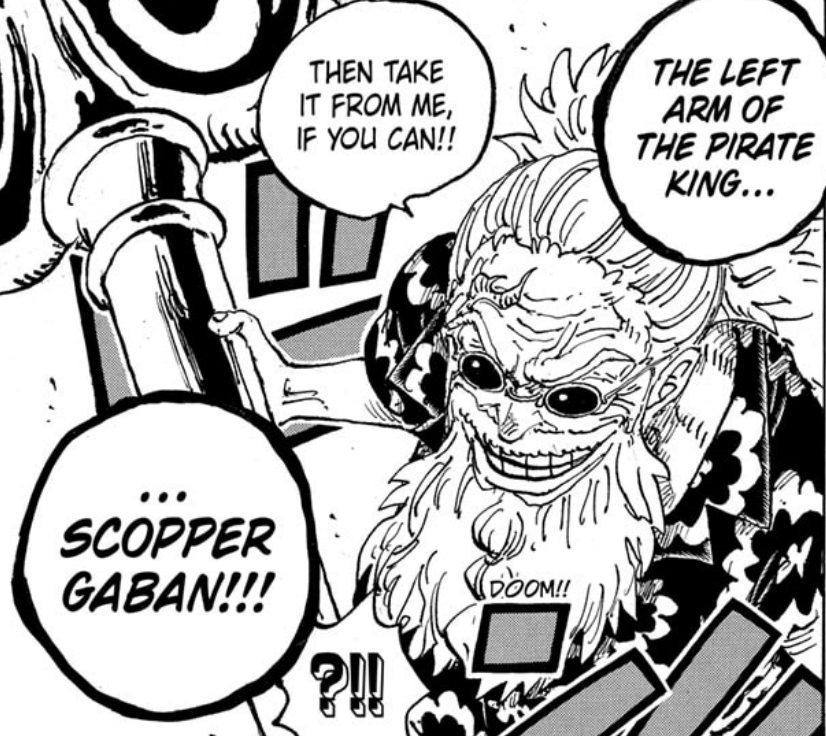
For starters, Scopper Gaban’s name has been in contention because while fans have written it as “Gaban”, in Japanese it’s actually “Gyaban”, with a “y”. This “gya” is likely where the ya in yaa-san comes from, which kinda gets lost if you translate it as “Gaban”. However, it’s also arguable that “Gyaban” has such a soft sound that writing it with just a G could also be a valid romanization, so it’s hard to say. It’s sort of similar to how a character like Kyros is actually pronounced as “kyu-ros”, but is romanized as “Kyros”, while still pronounced that way. His family name, Scopper, as keep in mind his actual name is Gaban, creates an obvious pattern in the names of the Pirate King’s crew, as Gol D. Roger obviously stands for “gold”, Silvers Rayleigh stands for “silver”, and Scopper Gaban stands for “copper”, the three podium metals in order.
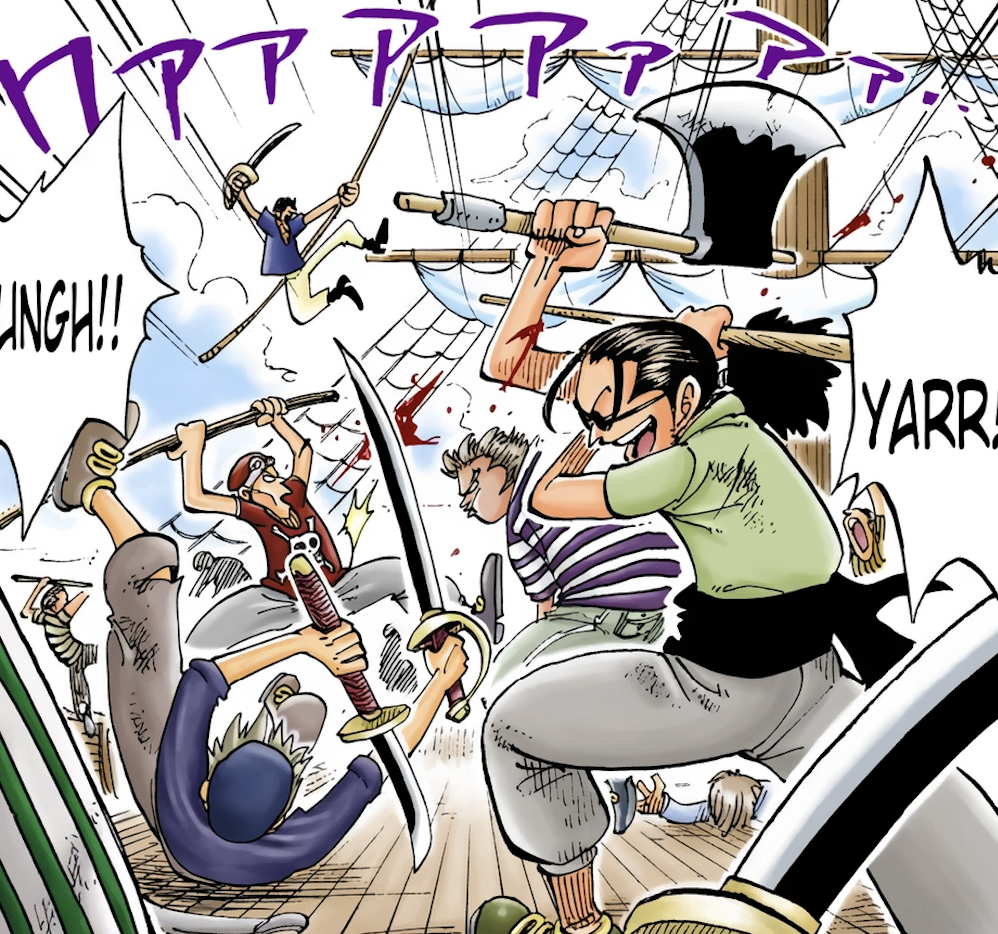
Eitherway, Gaban really needs no introductions, as he was the third most important man on the Pirate King’s crew. He first appeared in Chapter 19 during Buggy’s flashback, already seen wielding his iconic axes (though one fo them was obscured, making fans wonder for years what kind of weapon it was only to turn out to be another axe), reappearing in Chapter 0 and then finally Oden’s flashback. He was actually only originally named in a databook but was eventually named by Roger in Chapter 966. He fights with two axes, as the myth of how he came to be known as the “mountain-eater” within this chapter goes, and he also was seen charting out a map, suggesting he may have been the navigator of the Roger Pirates (which explains why exploring is his hobby). If Rayleigh was like Roger’s Zoro, Gaban was like Roger’s Nami, though in strength I’m sure you could compare him to one of the others as well, particularly with Luffy comparing him to Sanji.
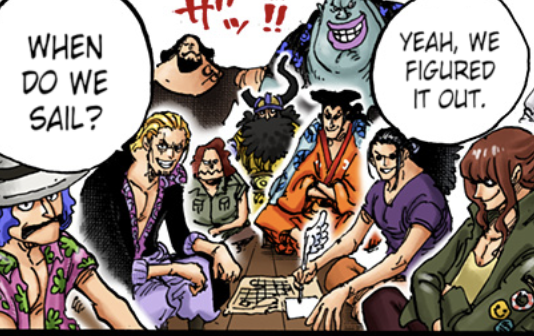
Now, Gaban has been living for over two decades on Elbaph, having married Ripley in the same way Roger settled with Rouge and Rayleigh with Shakuyaku. He appears a lot more laid-back, but still carries his iconic glasses. His beard is now longer, and his hair a lighter color, though I wonder if he did change his hair to be blonde, or if the colored manga simply made a coloring mistake in that cover. Though speaking of which, it’s pretty impressive he went all the way back to Reverse Mountain in the span of just two-in world months, but I wonder if he went back through the normal route or if he instead he traveled to the end of the New World and just climbed up Reverse Mountain.
Most interesting though is the scar on his face, making one wonder just who exactly caused such a wound on his face, particularly as he didn’t have it by the time the Roger Pirates disbanded. I also have to wonder, if he has lived in Elbaph all this time, then surely he must have tried to stop Loki… could even someone like Gaban have failed, with only Shanks having been able to later stop him? Or did something get in the way?
Luffy vs Gaban
As the duel begins, Gaban coats the key in haki and strikes Luffy with it. Luffy notices, as we see the key turn black from the armament haki as he gets ready to strike him. Black lightning sparks come out of the key strike, but it’s not clear if this is just from the Armament haki or if this is due to Conqueror’s haki, particularly with how confusing it’s been so far. Gaban similarly keeps dodging attacks in a similar way Luffy does, particularly when using advanced Observation, but again it’s hard to say for sure to which degree it’s honed.
As Luffy complains that Gaban knows nothing about Shanks, Gaban uses the expression “kuchi no hera nee gaki da” (口の減らねェガキだ), which literally means “you’re a kid who can’t shut his mouth”, which refers to a child who doesn’t stop talking and complaining. So in this case he quite literally shuts Luffy’s mouth by shoving the key inside of it.
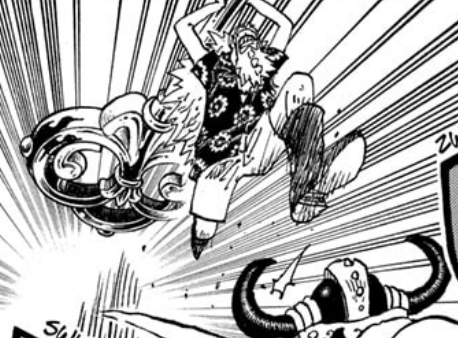
Gaban then unleashes a serious attack, which he calls “Yaso Takeru”, which translates to “Eighty Commanders”, or “Eighty Warriors”. This name has historical value, as it’s likely a reference to the same name used in the Nihon Shoki, one of the oldest historical texts to have survived in Japan. This text describes the “Yaso Takeru” as a force of eighty commanders who stood against Jimmu, the first emperor of Japan, and yet even in spite of such an overwhelming force, were still crushed and defeated by him. The attack is so powerful that it completely blows away one of the towers of Aurust Castle, sending it plummetting to the Underworld below. Though this also gives us a good frame of reference for where in the castle the throne room is located, adjacent to this tower. Luffy, joined by Zoro, strikes back transformed in Gear 5th, with his helmet horns having fused with his head just as we saw in the Block Country, and grabbing the axe he was carrying on his back. We also get a better look at Gaban’s eyes. But in the end, Gaban forfeits as Luffy has already gotten the key, but despite what he says, seemingly sensing that something might go wrong with Elbaph, he likely will join in the fight, particularly if his son Collon gets kidnapped.
The Abyss
At the Walrus School, the kids seem to spot Gunko’s bird, telling their teachers, which includes Ange as well as another bearded teacher. Gunko however heads to a secluded branch and prepares to summon another God Knight as mentioned. Just like Saturn did on Egghead, it seems that the summoning circles can be created by those who are conferred Imu’s powers, but this requires at least one person who has those powers, which is why Saturn had to head to Egghead on his own. Later in the chapter this is mentioned as those who have the “mark” (literally just “maaku” in Japanese, マーク), and those who don’t have it can’t travel through this summoning circle, likely as only Imu can confer the mark. This however means that the summoning cirlce in the Throne Room must have been placed there by someone with powers conferred by Imu, but then who in Elbaph could’ve placed that summoning circle there? It’s possible that perhaps these circles could last a long time, so maybe that original circle was placed a while ago, though surely not too far back that the other giants wouldn’t have noticed it. So… who was it? Was it God Knights during a previous visit or do we perhaps… have another traitor among us?
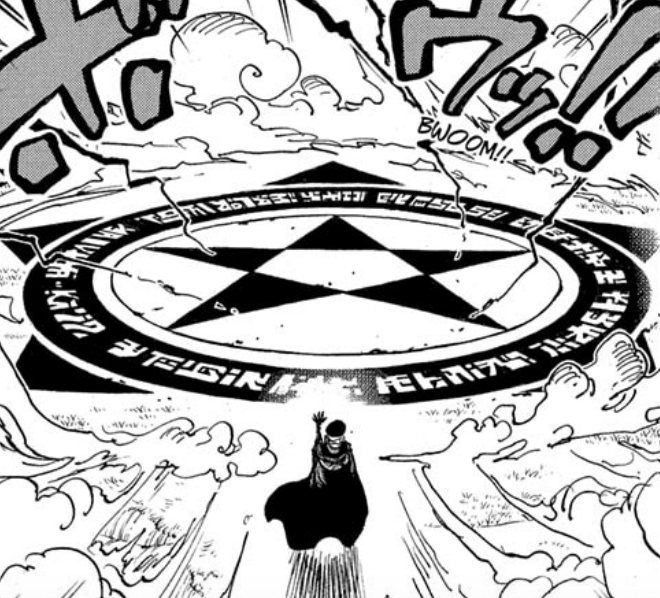
We do get however an actual name for these summoning circles, as they are called “Abyss”. The phonetic reading is “abisu”, which stands for “abyss”, but the kanji reading is that of “Gobosei” (五芒星). Now obviously, even if you don’t speak Japanese, this word should sound very familiar, because it’s almost identical to that of “Gorosei”. As I’ve previously explained, Gorosei means “The Five Elder Planets”. In the past, other translations localized it as “The Five Elder Stars”, because the word hoshi/sei in Japanese can mean “star”, but it generally means more widely “celestial body”. This is because in ancient times when these words were made, the lights in the night sky were simply known as “sei”, or stars, and the distiction between planets and stars only came with the development of science. English did eventually distinguish both with the words “planet” and “star”, but Japanese still generally doesn’t, which is where that confusion came from.
This however all ties in the current pun. Because while the “sei” in “Gorosei” refers to planets, particularly with the Five Elder Planets referring to the five closest planets that were visible in ancient times and that the Gorosei are named after, Gobosei here refers to “star”. Particularly, “Gobosei” translates to “five-pointed star”, what would be called a “pentagram” in English. And as we see, this pentagram is indeed a star with five spikes to it. The connection between the Gorosei and the Gobosei is pretty evident, particularly as the Elders also used these same summoning circles, but the nuance gets slightly lost in English due to the difference between planet and star. Regardless, the actual phonetic name used here is “Abyss”, which is fitting as it invokes the idea of an Abyss that takes you straight to hell.
Interestingly, as Nami mentioned last chapter, the people of Harahettania tried using these circles to summon the Devil through them, as this might be a practice that they may have picked up after witnessing a real Abyss being used. From the Abyss we see in several panels the sound effects “bari bari”, which represent the cracking of thunder and have often been used when Conqueror’s haki has been used (though also in other contexts), perhaps associating the black lightning with the same seen when haki is used.
However, not one, but two God Knights are summoned!
St. Shepherd Sommers
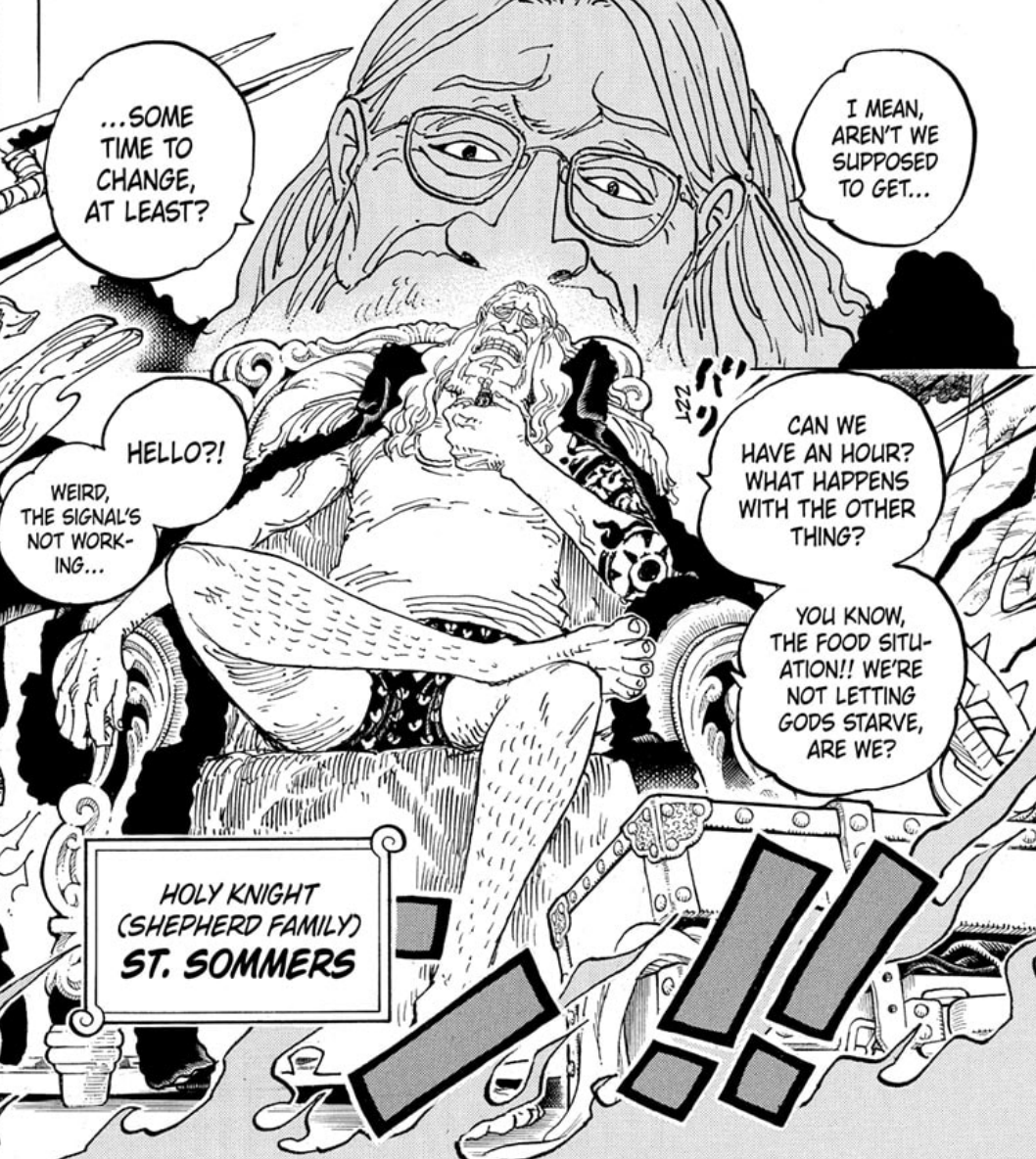
The first is St. Shepherd Sommers. His family name is “Shepherd”, which as you may realize is the same as that of St. Shepherd Juu Peter, one of the Gorosei, showing that they are part of the same family, and you can indeed see some resemblance betwen both of their appearances. This brings into question however what their relation is, particularly the question of if the Gorosei have children or not. Particularly being perennially youthful, do they have children that end up dying but have children of their own, or could they simply be distant relatives, with different Shepherd children having been born from the original founder 800 years ago and one of them eventually became Juu Peter who was promoted to Gorosei and granted special powers by Imu?
His first name instead is written in Japanese as “somaazu” (ソマーズ), which would translate as something like “Sommers”, a name that etymologically traces to the word for “summer” if that is the intended romanization. Interestingly, without the first kana of “so”, the remainder of his name, “maazu” is written just like “Mars”, the name of one of the other Gorosei. So his name could be Somars, but I find it weird given how he’s related to Juu Peter rather than Mars. Interestingly, in this case both of these God Knights do have the title of “sei” or “St.” next to them unlike Shamrock and Gunko, so I wonder if that was just a weird formatting choice by Oda rather than having much of a meaning to it.
Sommers however has been summoned pretty suddenly, to the point he was still talking on his den den mushi about having received orders to go to Elbaph, as evidenced by the baby den den mushi he’s carrying now not working anymore due to being out of Mary Geoise range. Perhaps more evident is the fact he’s comfortably sitting on his opulent couch in his heart-patterned underwear, only carrying a tanktop but a cape on top of it just to feel more majestic. Gunko gets pretty embarassed by him being in his underwear that she blushes and turns away and he still thinks that he’s in his home until he realizes that he’s in Elbaph. Alongside him also spawned in a chest, which happens to have clothing he suits himself up with, and his sword.
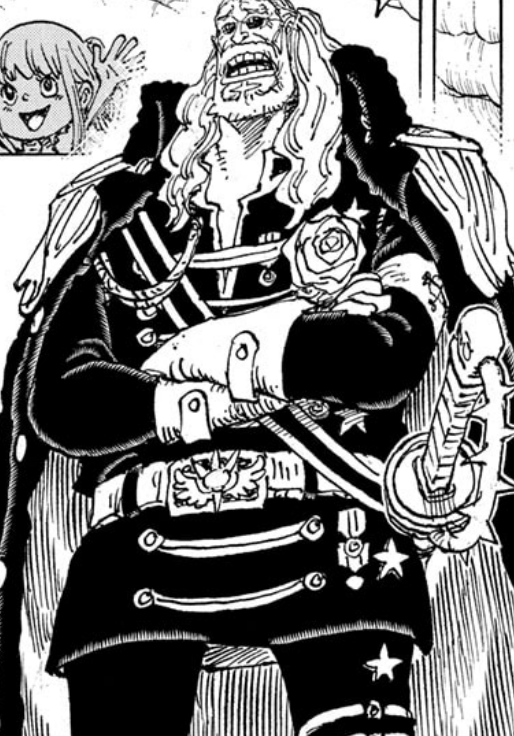
With his clothes he looks a lot more like a proper military general, and we get a better look at his sword, which appears to have a shape similar to Shanks or Shamrock’s sabers, but with a handle in the shape of a rose’s thorns. This is fitting, as on his chest aside from all the medals (which includes one on his boot as well) he also has a rose, which could hint to some form of rose theming or even powers. On his belt he carries a symbol which features the “hoof of the soaring dragon”, the symbol of the Celestial Dragons representing the claw of a dragon, but combined with two wings, which could perhaps in this case be the symbol of the God Knights. On his sleeve, better seen in the panel of the other fellow God Knight, is another mark, which looks like a cross similar to that seen in graves across the series, being a cross with a circle on top of it, but in this case having two horns popping out of it, like some demonic type of imagery. So maybe this could be the actual symbol for the God Knights, who knows.
He also appears to have a tattoo on his left arm, but it’s hard to see if it shows anything specific or just looks cool. Could this perhaps be the “Mark” they speak of to be granted powers, or is it just a tattoo? And speaking of symbols, his beard is in the shape of a cross. This could totally just be a coincidence and I’m looking too much into it, but Juu Peter’s name is written with the kanji for “ten”, “juu”, making his name literally “Ten Peter”. This kanji is depicted as a cross, just like the shape of his beard, so I wonder if that was intentional or just a coincidence. We don’t know what demonic power he has for now, but he’s likely to have one just like all the others.
St. Rimoshifu Kiringham
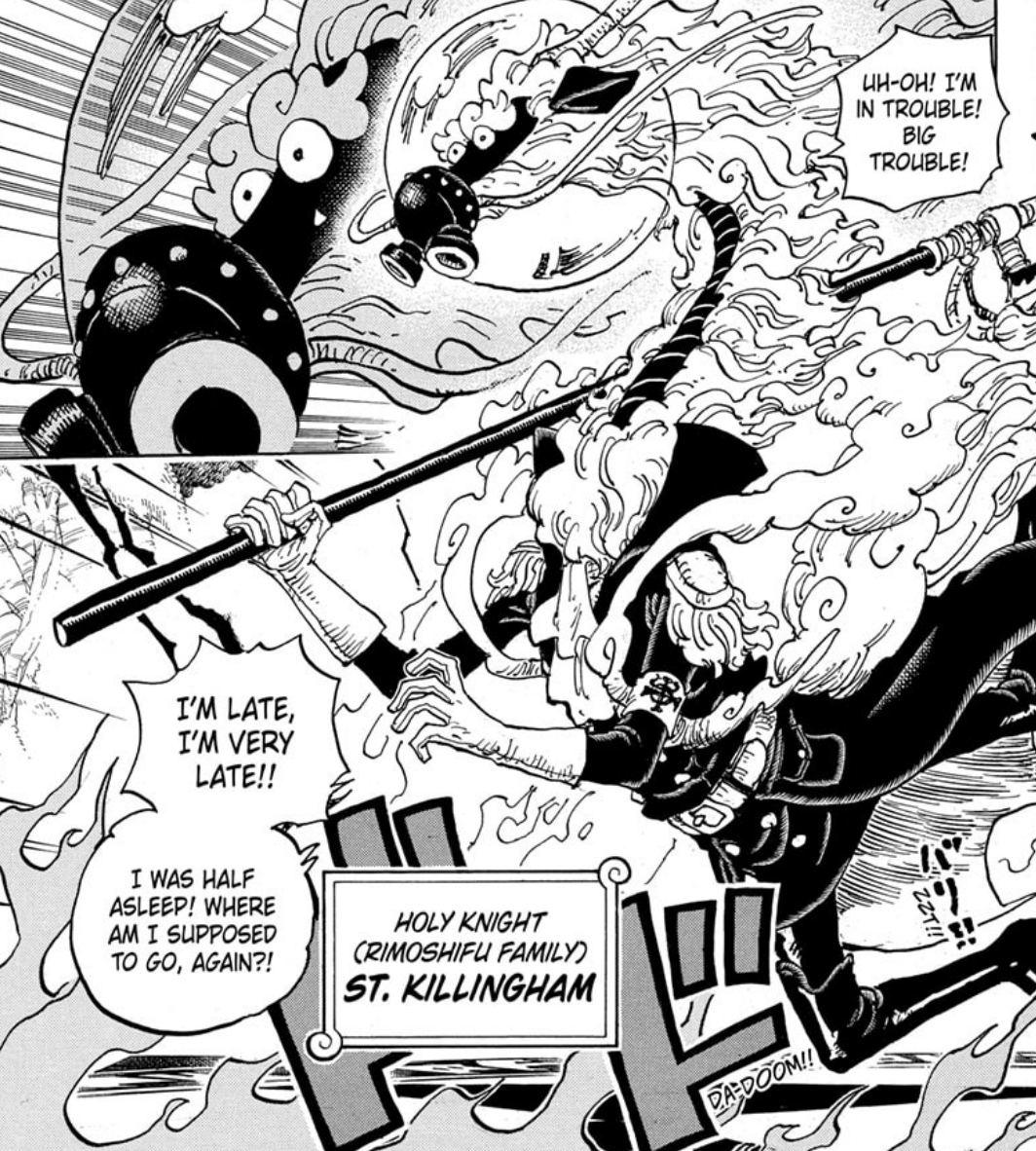
The other God Knight is St. Rimoshifu Kiringham. His family name, “Rimoshifu” is actually a new name we haven’t gotten before, being a newly revealed name for one of the Celestial Dragon families. We previously had half of them known, being Nerona, Nefertari, Donquixote, Figarland, Manmeyer, Jaygarcia, Marcus, Topman, Ethanbaron, and Shepherd, but with this one we now know 11 out of 20, and I’m sure before the end of the series we’ll find out all of them. Since it’s new though, it’s hard to say how we should romanize it, as in Japanese it’s written as the quite peculiar “Rimoshifu”, which could be anything from Rimoshifu, to Limoshifu, Limosheev, or anything inbetween. Given how he seems to be based on a creature from Chinese mythology, I thus wonder if it could be “Limshifu”, which is an actual Chinese name, but for the moment I’ll keep it as it is in Japanese just to play it safe.
His first name instead is “kiringamu”, which would be romanized as something like “Kiringham”. Names that bear “gham” at the end of it, like Birmingham, are derived from the etymology of “home”, thus referring to an old place and often associated with medieval towns and nobility. In this case though, the word “kirin” refers to a creature from Japanese mythology and it becomes very evident if you know anything about Japanese culture once you look at Kiringham’s design because the power he has is very clearly that of a kirin. But if you aren’t, this gets a bit lost in translation, so let me explain.
The kirin is a creature from Chinese mythology, which is there spelled as the Qilin (pronounced chee-lin), which was then imported to Japanese folklore as the demonic yokai beast, the “kirin”. It is depicted as being similar to a giraffe, as even in ancient China sometimes giraffes from far-off lands were mistaken as Qilin, but with a far more ornate mane and horns on its head, usually one but also depicted with two in latter depictions, though in this case Kiringham seems to be depicted with the accurate single horn. Fundamentally, think of it like an Eastern unicorn, but resembling more a giraffe than a horse. As a result, the modern Japanese word for giraffe is also “kirin”, though not to be mistaken with the beast depending on the context.
Though classified in Japan as a demonic yokai, it is one considered to be holy and revered, said to only appear during times of peace. Their arrival is said to herald either the birth or the death of a great leader or wise man. They generally do not pursue and attack others but will fight back if attacked, said to be able to generate some form of holy fire, being one of the most powerful sacred beasts in all of Eastern mythology. You may perhaps be familiar with the world-famous “kirin beer”, which depicts an actual kirin as its logo as well.
In this case, Kiringham does very much look like a kirin transformed in hybrid form, from the long neck, the ornate mane, and the single horn and long whiskers, though he is covering his head with a bubble and a gas mask, much like the Celestial Dragons that do not wish to breathe the air of other places, perhaps readying up to be deployed. He also has a hagoromo cloud scarf, though light-colored in this case, fitting the majestic appearance of the kirin compared to some of the other creatures, showing that he is awakened like all the other demonic creatures of the Gorosei, which he almost certainly pertains to, this likely being another devil power granted by Imu given how the kirin is still technically a yokai. The only exception so far has been Gunko because she has what seem like paramecia powers, but given how her powers are quite seemingly trying to evoke the image of an ittanmomen, the yokai that turns into bandages, I’d say she still fits the pattern of all of them having devil powers, which once again brings into question what Sommers’s power is, and if Shamrock himself has one too, as they might be all tied with receiving the “mark”.
It’s also worth noting that some believe that the God Knights may be themed after the zodiacs, particularly with the celestial theming of the Celestial Dragons. Some associated that Shamrock could be Gemini, due to being twins, Gunko could be Saggitarius, as it represents the arrow, and the bull-like God Knight we saw in God Valley could be Taurus. However, it’s hard ot really find a pattern for either Sommers or Kiringham (though granted we don’t know much about either), so wo knows if this pattern holds true.
Kiringham has a very peculiar weapon, as he has a long spear almost shaped like a trident, except one of the blades comes out lower. When transformed in his hybrid form, Kiringham appears to be considerably taller than even Shamrock, though Sommers appears to be pretty tall as well. Kiringham was similarly taken by surprise as he was trying to rush to some place he was expected to be summoned from since he had overslept.
For being so high and mighty though, both Sommers and Kiringham speak quite informally, with Kiringham referring to his “dancho” Commander Shamrock with the quite informal pronoun “anta”, to the point he seems to be bothering Gunko a bit slightly as well with how goofily and informally he speaks. And obviously, they don’t refer to each other with the “St.” titles, but just by their names.
Let’s Play a Game
However, it’s peculiar that two God Knights came instead of one. Peculiarly as even Shamrock didn’t seem aware of this, so I wonder if it was Gunko who opened up the Abyss but then it was Imu himself who hand-picked who got to go instead through telepathy or something like that, as if Gunko knew she would’ve likely told Shamrock. This is however because due to “orders from above”, Shamrock is requested to return back, with the orders likely having come from the Gorosei, particularly Garling who might still be the Supreme Commander of the God Knights, or maybe even Imu directly. This seems to do with the precarious situation the Holyland is in after the Levely, though I wonder if something more is happening, with either the Revolutionaries or particularly Blackbeard, that is making them worried enough to have Shamrock back. This is fitting, as having the power of the Cerberus on his sword, Shamrock essentially acts as the gatekeeper of Hell, of Mary Geoise. On the other hand though, I wonder if he really will disappear from this arc, or if something will hold him up to get inviolved.
Sommers makes an odd comment when asking why they are at Elbaph, asking Shamrock if he’s visiting Harald’s grave, suggesting some connection between the two. This deepends the conspiracy theory that has been brewing for a while that Harald may have been in cahoots with the Government and Loki was just trying to stop him, misunderstood by all. After being told the mission though, Sommers replies with “OK, OK.”, said in English even in the Japanese release.
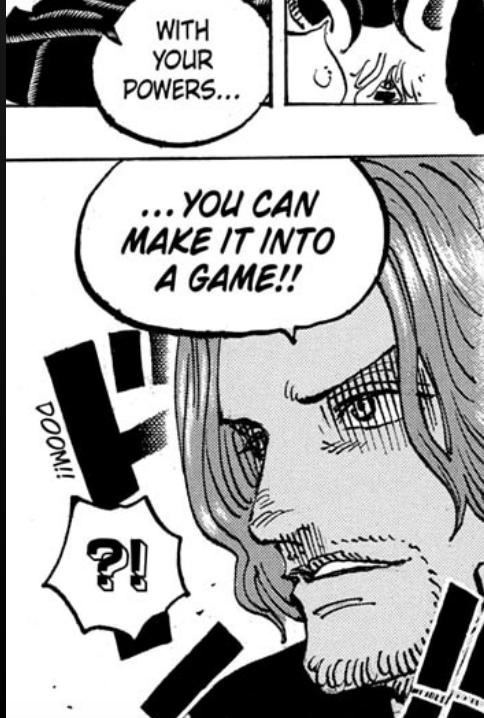
They want to bring them hostage at Mary Geoise to force Elbaph into submission, but would have to do so by boat since they don’t have the mark. Shamrock however suggests that given their powers, they should try turning this into a game. In this case the pronoun used here is “omaetachi” (お前達), which is a gender neutral second person plural pronoun, thus referring to the power of more than one person. Seemingly, Shamrock believes that by using their powers they can make this a twisted and sadistic game. He may not be taking this very seriously now, but this incident might serve as the spark of a much larger conflict to come!
 The Library of Ohara
Great one, as usual. What do you think of the theory that Gunko may be of low social extraction? It would explain all the differences (having a paramecia, using a super-formal tone – like she learned how to use it – not having a family name). Some say there’s a pattern in the revolutionary army of people having goggles, as she does… maybe she is a former revolutionary?
LikeLike
I hadn’t heard the theory about God’s Knights being patterned after zodiac signs, but it would make sense given that Celestial Dragons have an ongoing astronomical/astrological theme.
In this case, I think a Kirin could very easily be interpreted as an Eastern version of Capricorn. Sommers is a lot hard to place for now… maybe Virgo, given the rose theme?
LikeLike