
Join me in this MEGA analysis as we break down chapters 1135 and 1136 of One Piece! This is a long one, so strap in!!
Video version: https://www.youtube.com/watch?v=qZsRsHrQvQc
Covers
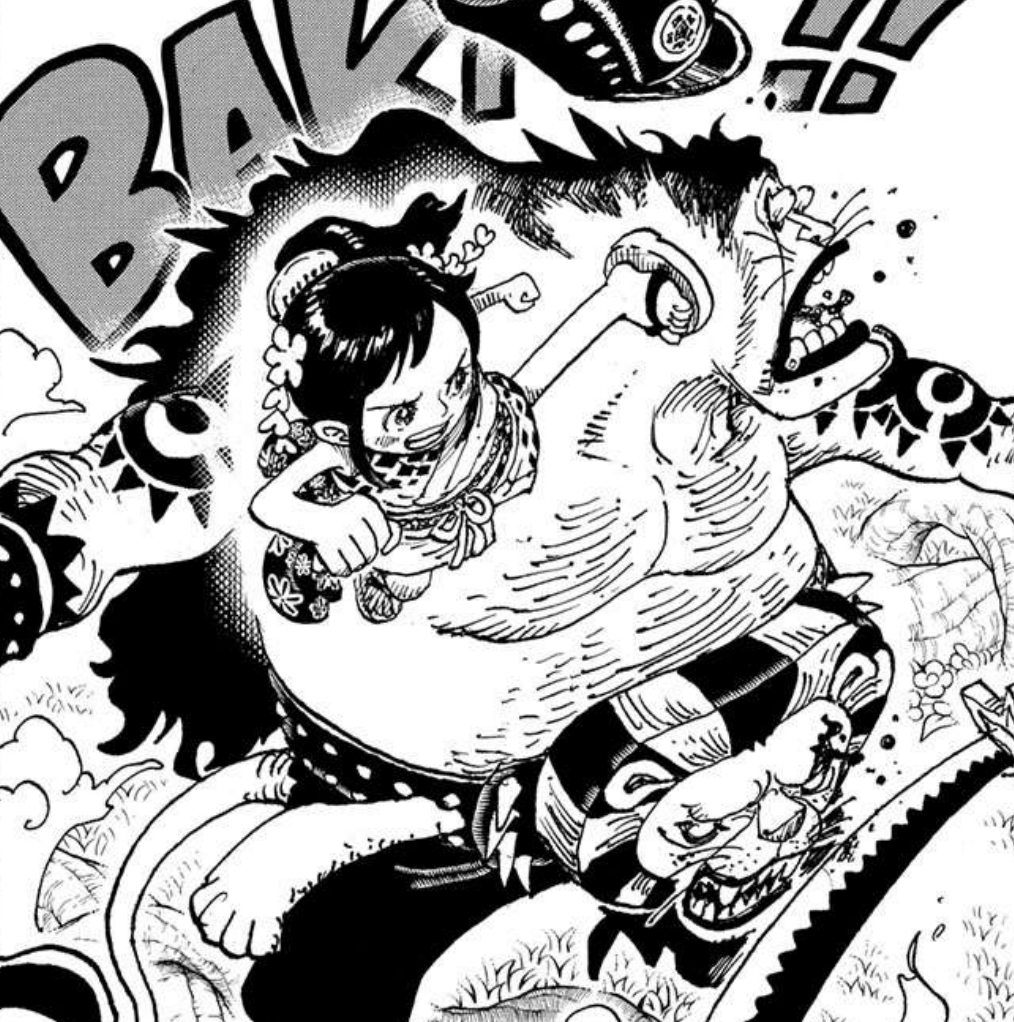
On the first cover, the situation is quite cleverly resolved by having Tama be able to rescue herself. History doesn’t repeat itself here as she has grown strong enough as a kunoichi to be able to free herself from Holed’em. Not as strong as an impact as Luffy’s Red Hawk of course, but strong enough to free herself. The kick causes not just Holed’em to bleed, but also his lion Kamijiro, as after all they share the same body and cough blood from both mouths.
Continuing with the next cover, Yamato takes the chance to apprehend Holed’em, who seemingly takes him to his boss… being Who’s-Who? The hideout definitely looks like his helmet, but it’s interesting to think he may have been the only one of the Tobi Roppo to escape. Maybe this might be a good opportunity to see what lays beneath his helmet.
Biblo
Within the owl library, Chopper and Bonney are perusing a large book. The script within it appears to be in koyogo alphabet, though it seems to either use a very stylized font or a slightly different alphabet, as none of it is really readable.
Saul introduces us to the “Lord” of the Owl Library, whose formal position is the Library Director. This is the owl Biblo, who oversees the library and causes all the books within it to grow giant. Just as we had guessed last week, this owl is in fact the fruit user that causes the books to grow large: as Vegapunk Lilith explains, Biblo has eaten the Iku Iku no Mi, making it an “ikusei fukurou”, or a “growing owl”. As she clearly explains, the word “Iku” is derived from “Ikusei”, or “to grow”, which is particularly attributed to someone who grows crops, or even grows animals or children. As such, the fruit would most naturally translate into the “Grow Grow Fruit”, allowing this growing owl to grow any inorganic objects that come within its territory, a power befitting of the island of giants.
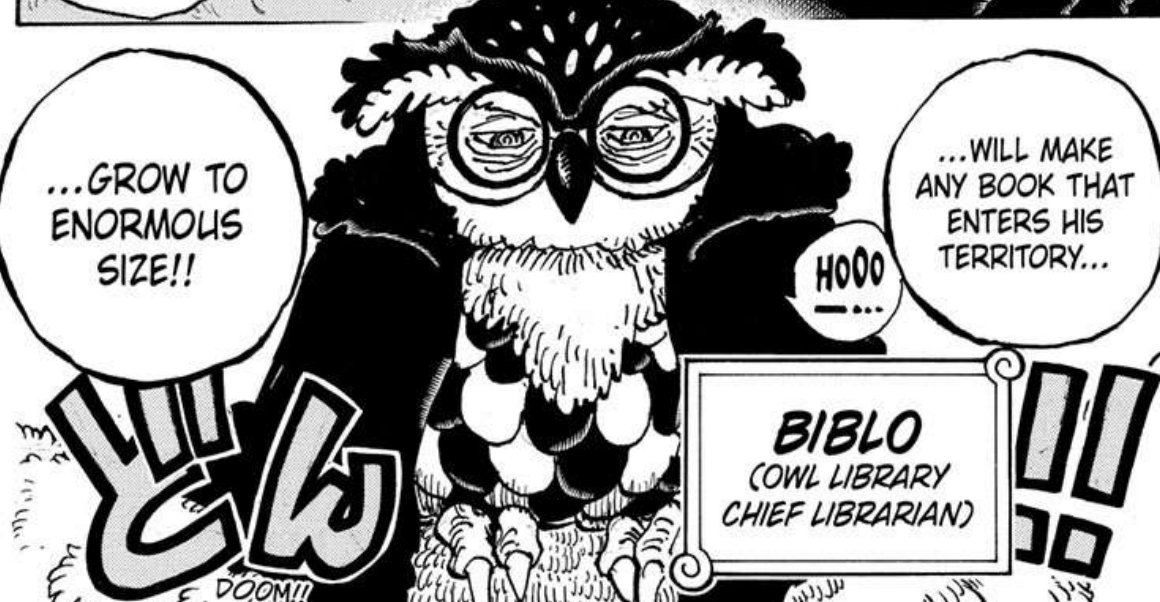
As Lilith explains, this only applies to inorganic objects, so it can’t grow people, animals, or plants for example. It also is able to grow objects in size when entering within its territory, which should shrink back to normal size when leaving, but conversely books that were originally big cannot be made small as Saul explains. The fruit only grows items, it cannot shrink them. Speaking of fruits, I do still wonder if Iscat from the Block Country was legitimately just a Neko Neko no Mi, or Cat Cat Fruit, Model: Lion zoan user, or if there was anything more to it.
Talking about Biblo’s design though, it evidently looks like an actual owl, though of giant size of course, with glasses on it. And this might seem familiar to you: the idea of an owl being portrayed as a wise teacher wearing glasses is one you’ve likely seen before, but… why? Well, the reason traces all the way back to ancient Greece, where the goddess Athena, goddess of wisdom, was associated with the image of the owl. As such, the owl and its solemnity have served as a symbol of wisdom since times immemorial, which is why said myth is being referenced here with Biblo. After all, as Saul says, Biblo has seemingly been alive for centuries, though I wonder just how far back. In fact, it seems to have stood in this spot all that time, so if anything the library may have been built around its roost.
This goes double when it comes to Biblo’s name. If you’re strictly an English speaker this might not sound so familiar to you, but if you speak a Latin language, such as Italian, French, or Spanish among others, you’d have realized very quickly what the name means, and it’s the fact that in those languages, library is always spelled the same way: biblioteca, bibliotheque, or something similar. This all derives from once again ancient Greek, where biblion meant “book”, and as such “biblioteca” means a library, a repository of books. From that word, we obviously get Biblo, the director of the Owl Library.
If Biblo is the Library Director, then perhaps that chair we saw next to it is to convene with the owl, even if it doesn’t seem to fully understand speech due to being a… well, owl, but it is still able to communicate to some extent, understanding the importance of the books. Chopper could probably speak with it, but it’s not something we see happening here.
In the large panel, we also see Lilith floating around with her dom shoes, while Bonney is playing around on one of the railings, even if the fall from there would be… quite steep for a child, though she’s definitely fallen from worse having fallen down from the Labophase.
Collon’s Dad
Back at the school, Luffy and begrudgingly Usopp are playing on the giant swings we saw last chapter, though swinging them so far that even the giants below look tiny by comparison.
Collon attempts to get a hit on Luffy, but he easily counters with an elephant gun, showing that he was just testing him to witness his strength, being a kid who is still in love with the strength of the giants of Elbaph, hence why he asked Shanks to take him on his ship with him. We also find out what the delivery the bartender made for Collon, which she claimed was the favorite food of his father and Ripley (in Ripley’s case being cowberries), showing that the two are in fact Collon’s parents. By the way, we also get the name of the bartender, being “Mato”.
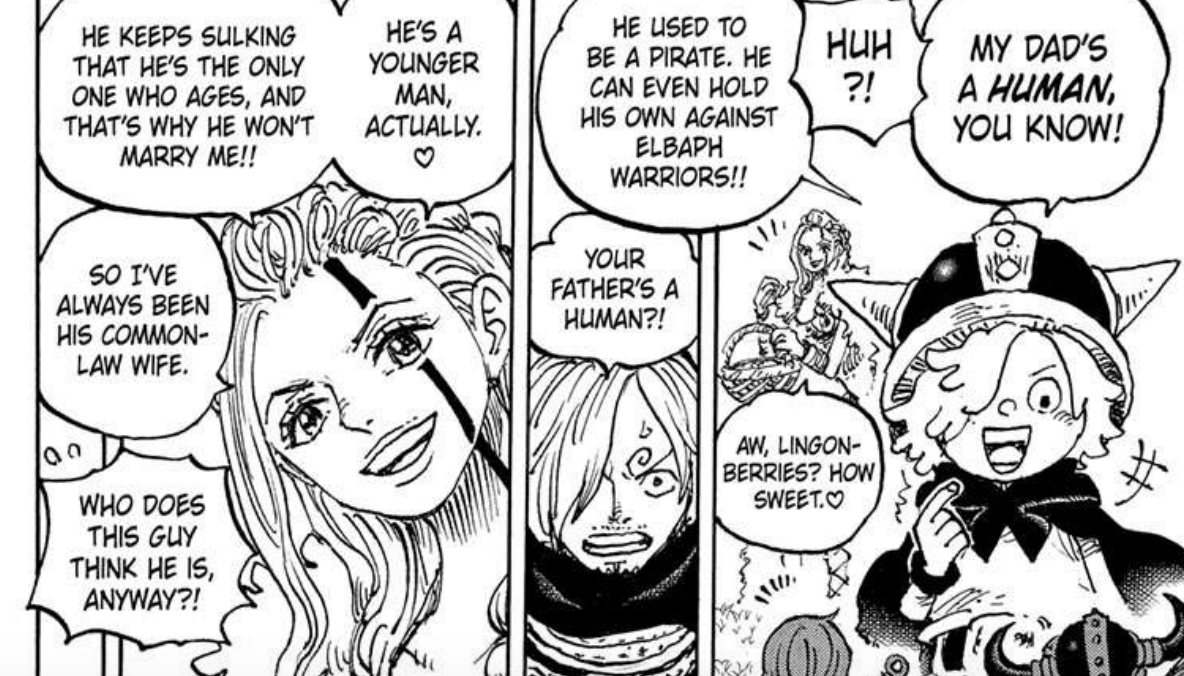
It turns out that Ripley is Collon’s mom, but even further is the fact that she had a kid with a human, whom Collon describes as a former pirate who won’t even lose to the likes of the giants of Elbaph. There is a good chance that this could be the silhouette we saw during the Louis Arnote speech, as it was human sized and feels narratively relevant to the story. After all, Mato seemed to indicate that Collon’s father is still on the island, since she gave Collon food to give to his father. Once again though, we are still kept in the dark over the identity of this former pirate. Could it be Louis Arnote himself, is it actually Scopper Gaban, or could the delusions of Shiki somehow come true?
Though many jokes will no doubt arise through Collon’s dad love for tall women, it is still a very heartwarming idea that even through such a big gap, love can still blossom no matter the race. It also shows that pretty much all hominid races in the One Piece world can reproduce with each other, much like our different races can, even in the cases of dwarves or giants. However, as Ripley explains, her husband feels self-conscious about the fact he grows older while she ages at a much slower rate, so he doesn’t want to get formally married to make her suffer once he grows too old, instead remaining in a common-law marriage with her.
Robin’s party, which includes Chopper, Vegpaunk, and Bonney, decide to remain at the library with Saul, essentially splitting up the Straw Hats once again. While they believe this to be just momentary, with the upcoming chaos this is likely to develop into something more serious. Franky also mentions an interest in the Treasure Tree Adam, hoping to get a better look at it, potentially suggesting he might split off as well.
Interestingly though, Saul explains that there are a few other trees like the Adam out there, perhaps explaining how the Sunny’s wood was attained with Elbaph’s isolationism, but the Adam of Elbaph is in fact the oldest of them all. This makes sense, as it is the same as the Sun Tree Eve. The Eve incrusted within the Red Line, going from the top sunlight all the way down to Fishman Island, is the original and likely most ancient of all of its type, what are scientifically called as the “yarukiman mangroves”, or “hypemangroves”. On the other hand, the trees of Sabaody or the Red Port were said to be all the same type as the Sun Tree Eve, but simply on a far smaller scale, showing a similar difference between the big original tree and its far smaller spawns, which is the case for both the Adam and the Eve. As Usopp once posed the question in Chapter 612, I do also wonder if there is a connection between the two.
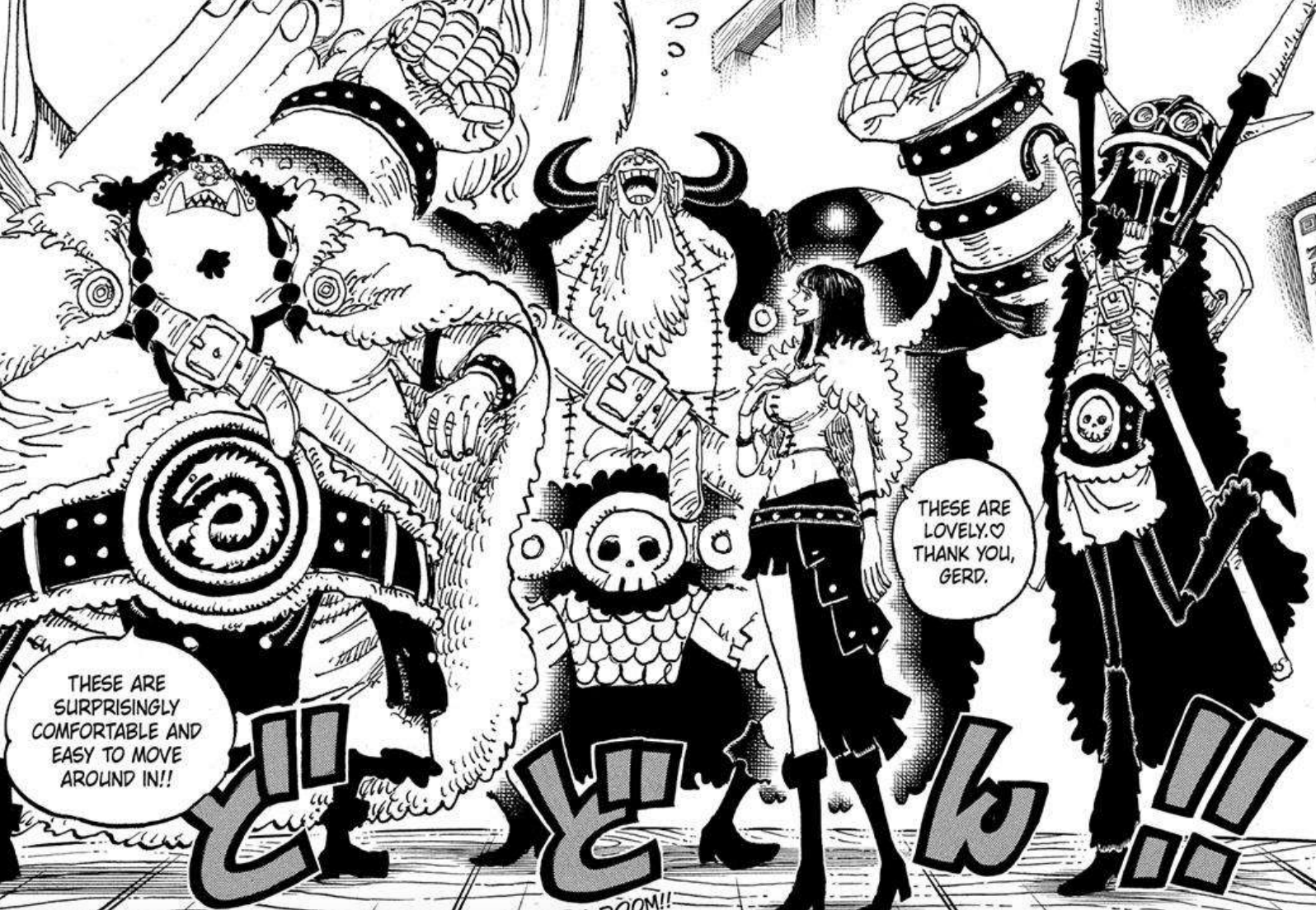
Gerd then provides clothes for the remaining Straw Hats, a hobby of hers, just in a healthier way than Road. Franky gets barrels for arms, as well as a beard and a skull belt similar to Loki’s, while Jinbe’s belt has the motif of a coiling snake, perhaps the Red Line jörmungandr snake, and his hair is also tied in braids like many of the giants. As such, we see Gerd going back to the village alongside Collon, Luffy, a usually fawning Sanji, Jinbe, Brook, Usopp, and what seem to be Nami and Zoro, leaving behind team Robin, Chopper, and Franky, with Lilith, Saul, and Bonney. We can also appreciate in this panel how the Owl Library is directly built into the branch itself.
God Knights
Switching back to the castle, we actually get the name of the place, being “Aurusuto” in Japanese. This could potentially translate into several different ways, such as just “Aurust”, but it’s more likely that it may be named after the English spelling of Owl, thus being Owlst Castle. Regardless, it’s hard to tell without a proper romanization.
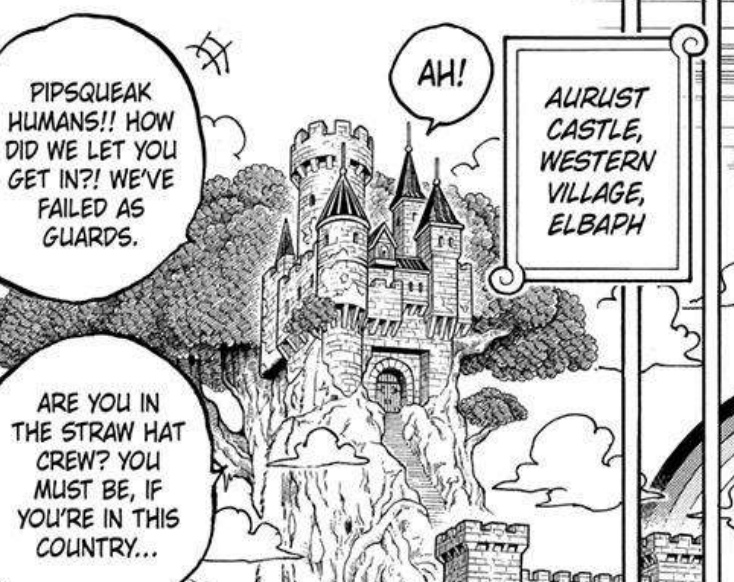
Here, we get a brief but much needed update on our intruders. Our dear Shonks doesn’t seem to do much this chapter, with the only thing we can really gaze from him being a sword that he appears to have at his hip. This sword is in the same shape as the Gryphon, Shanks’s sword, which is similar to Garling’s blade as well as the sword that was used by the silhouette appearing at the end of Vegapunk’s speech who we already had assumed was likely Shanks’s evil doppelgänger.
We do also seem to notice a very sneaky detail in Shonks’s silhouette that he does seem to have what looks like a left elbow. Which of course, if this actually were Shanks, would be impossible.
As for the girl, we don’t really get her name, but we do instead get a valuable clue, being her speech pattern in Japanese. As one might assume, her speech pattern is incredibly high and mighty, thinking very highly of herself. it is proud and arrogant, just like a Celestial Dragon would speak, but the clear difference is that she sounds at least more cultured than ignorant buffoons like Charlos. We are assuming these are God Knights, but it makes sense that they have more honor and decor than those who only care about their material desires.
As she speaks, the girl does make quite a clever play on words, as she states “Zu ga takai hireimono”, which literally means “your head is too high… insolent”. The expression “your head is too high” refers to someone who thinks too highly of themselves, what we’d perhaps call being on a high horse, and so the girl demands that this giant not think so arrogantly of himself. However at the same time, this is meant quite literally, as she forces his head from being too high into falling to the ground beneath her. She’s basically saying both that he shouldn’t be too arrogant and also that he should show proper respect by groveling his head beneath her like the inferior being that he is. She even clarifies: “Did you assume I was posing a question? It was an order. What do you not understand about “answer”…?”.
This order in particular as she stated earlier was “We are in search of the being called Loki”. The fact she calls him a “being”, or “jinbutsu”, also shows how they perceive creatures beneath them as inferior. It’s interesting however, as it shows that they don’t seem to be so interested in the Straw Hats right away, but rather wish to locate Loki. What is their reason for doing so? Do they wish to eliminate him, or maybe even want to free him to bring destruction to Elbaph?
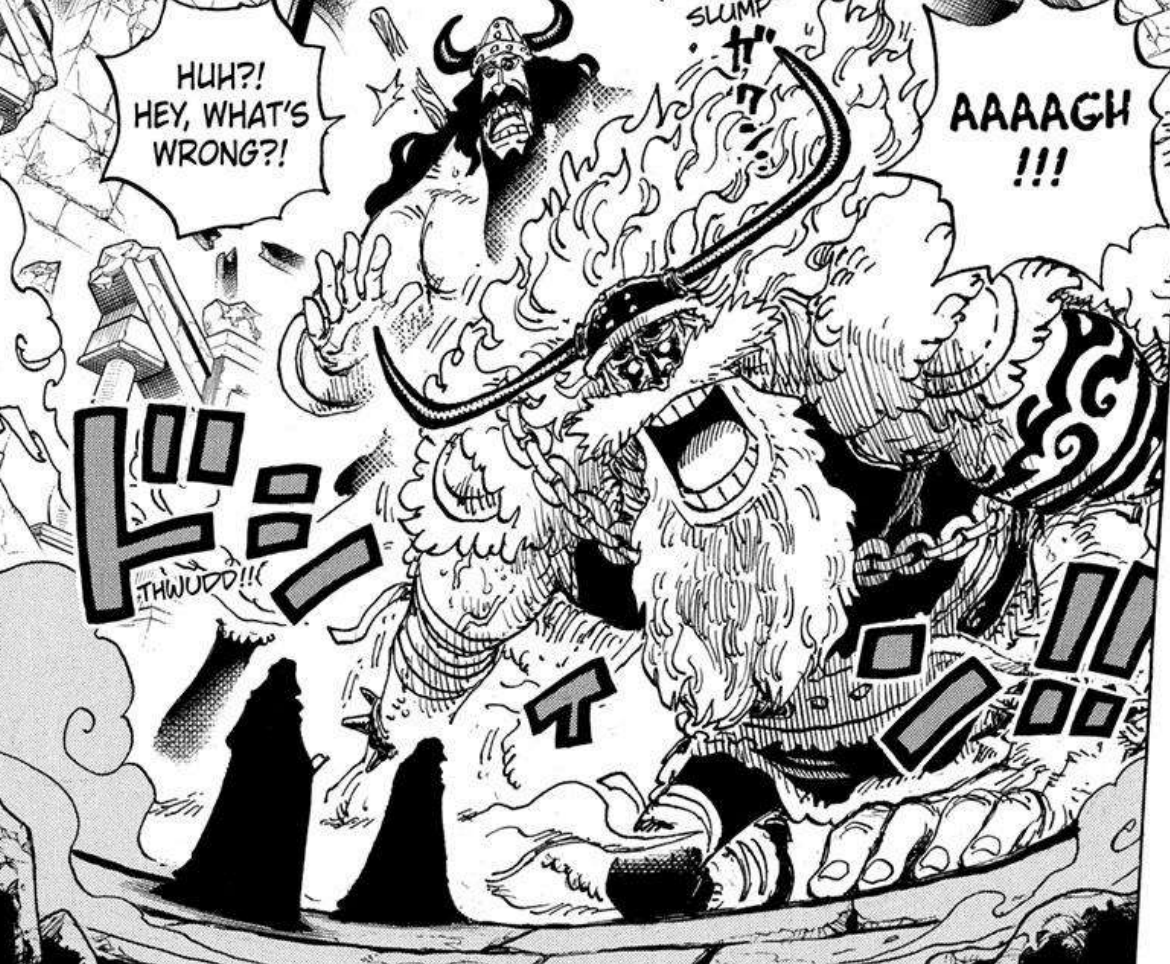
As the giants tell her that they can’t just divulge Loki’s location, the girl suddenly fires something really quickly. It’s hard to notice, but if you look closely, there are several bandages that are wrapping up the giant’s body, squeezing his muscles until he’s in so much pain he collapses, as the sounds “boki” and “baki” are heard, which represent bones being crushed. This suggest some type of bandage-based devil power, but we’ll get to that in just a second. Regardless, for her to bring a giant of Elbaph to his knees, a guard of the castle no less, shows how powerful she truly is…
Oldest in the World
Back at the West Village, we get a summary of all the giants the Straw Hats have helped, including Dorry and Brogy, Oimo and Kashi, Hajrudin, and Stansen. The giants praise Luffy as not just an emperor, but also a “daikaizoku”, or a “great pirate”, a title that has been exclusively used for people as powerful as Roger, Shanks, or Whitebeard previously in the series. We can see Zoro drinking in the corner, while Nami’s ears are about to burst from the loud cheers, as all the giants share a toast.

However, intruding upon the party is “Mountainbeard” Jarul, who we were already told a few chapters ago was still alive. He was one of the two captains of the Giant Warrior Pirates before Brogy and Dorry, who we saw in Big Mom’s flashback where Linlin killed his co-captain Jorul. He doesn’t look that much different, aside from the sword going through his head, which he claims the helmet blocked most of it, though I wonder in what battle since he got this attack, perhaps being against Loki. He’s also so tall that he even dwarves the likes of Brogy, who is 21.3 meters tall.
As his description explains, he holds the title of “the oldest person in the world”, a fact we were already aware of, given how he was 345 in Big Mom’s flashback 63 years ago, that now makes 408 years old. To be clear, he isn’t the oldest creature in the world. The oldest creature, that we know of at least, is Zunesha, whose age was stated to be over 1000 years old in the Vivre Cards. But if we’re technical, Jarul isn’t even the oldest person, as of course, we have the figure of King Imu, who we’ve been told has likely been alive ever since the Void Century. Of course, we don’t know how human Imu really is, but even the Gorosei as far as we know are humans who have been conferred devil powers by Imu, and Saturn alone was at least over 200 years old, so it makes you wonder just how old some of the rest are, as I feel at least one of them must’ve been over 400 years old.
Regardless, it has been implied that is through the power of the perennial youth operation, or at least some power Imu is able to share with them, so Jarul is the naturally-aging oldest person in the world, as well as the publicly known oldest person in the world. This is due to the fact that giants live longer than humans do, though in Jarul’s case he appears to be extraordinarily old, similar in age to what would be a centenary for us.
To put it into perspective, when Jarul was born four centuries ago, Noland hadn’t even set foot on Jaya yet. When he was 200 years old, Emet ended up raiding Mary Geoise. That’s just how old he is.
The other oldest character we know of who isn’t a giant through normal means would be the Birkan Haredas at 97 years old, being followed by the only other two nonagerians, Streusen and Brook. There is a special case in the case of Dr. Kureha, who is currently 141 years old, but as she has claimed, there is a secret behind her perennial youth, a secret that no one is ever willing to listen to, despite us readers being very curious. Maybe it has to be with the previous user of the Ope Ope no Mi being a certain incredibly famous doctor…
Resting on Jarul’s hand, Luffy enjoys the ettosaurus meat, claiming that it tastes like dinosaur meat, referring to the time that he ate dinosaur on Little Garden with Dorry. This of course makes sense because despite the giants of Elbaph calling it a moose, the ettosaurus is in fact a dinosaur. In the foreground, we see Collon dancing around, particularly doing what is likely to be the Nika pose, particularly accentuated by his smile. Jarul also mentions that it’s rare for humans to make it past the Underworld, but not unprecedented, as obviously Ripley’s husband is currently hanging around.
The other Straw Hats interact with the giants in different ways: Usopp tells the tale of how they fought Oars, an ancient giant and thus connected in some way to giants. Some giants marvel at Jinbe for his skin being such a distinct blue color. Sanji tells them of a place he considers like Paradise, being Mermaid Cove, referring to the port town on Fish-Man Island where Sanji had his greatest nosebleed.
The Harley
Road apologizes to the Straw Hats for his actions, even though he admits to enjoy being dominated by Gerd, literally calling her an “S” in Japanese, or a “sadist”, but explains the reason he was roleplaying was to fulfill the inner dream of the people of Elbaph to “become the Sun God”, which is why he was calling himself the “Lord Sungod”. Road however believes that the Lord Sungod embodies the idea of ruling over the entire world, whereas other giants argue that the Sun God is the God of Liberation (Kaihou no Kami), others a God of Destruction (Hakai no Kami), or even a God of Laughter (Warai no Kami).
This is a practice that we’ve actually seen before in other cultures as well, particularly that of the people of the sky. The people of Skypiea referred to their ruler as “God”, as did the people of Birka, the other major sky island. And given how they might potentially share some connection with the Void Century, they also may have taken this tradition of wanting to become like the Sun God as a form of control, with that ultimately seeping into their culture.
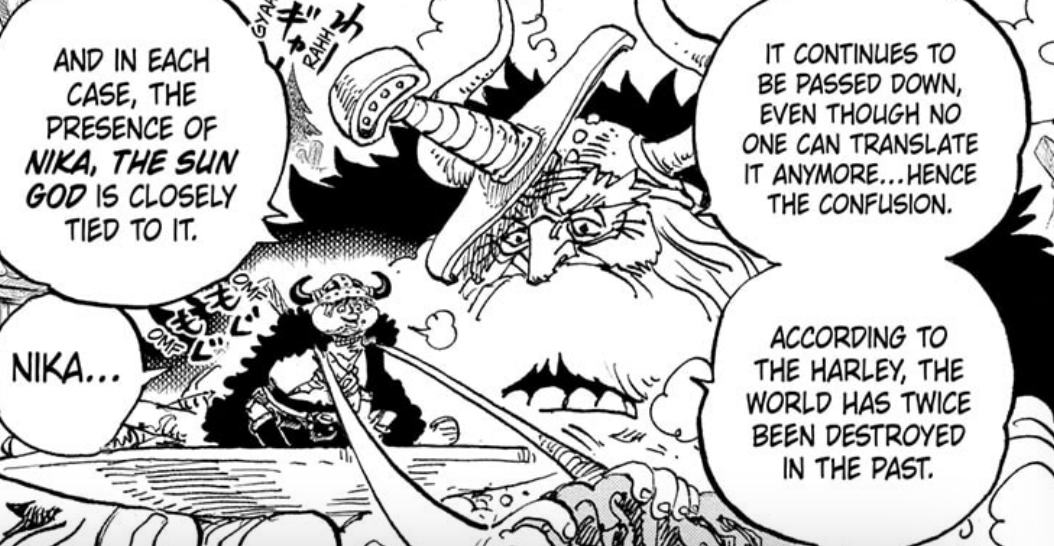
Jarul then introduces us to something that in Japanese as the “ハーレイ”, which would translate as something like “Harley”, what he describes being a “shinten” (神典), or in other words a holy script. In fact, in the next panel, Jarul even overlays the phonetic word “harley” over the kanji of “shinten”, making it one single word. The kanji for this word literally use the kanji for “god scripture”, meaning it’s a compilation of mythical accounts regarding this religion. You can compare it to holy scriptures such as the Bible or the Quran, but in this case this could be more comparable to the Edda, being the Icelandic compilation of Norse culture that has served as one of the most important bibles for preserving viking mythology. So in this case, the Harley is likely Oda’s version of the Edda, a book that describes ancient Elbaph history but told through a slightly more mythological lenses. Jarul himself even explains that the word “Harley” is so old that there is no real meaning.
The fascinating thing here however is that Jarul reveals that according to the Harley, the world has already been destroyed twice. Not once… but twice.
And this single comment potentially revolutionizes our very understanding of One Piece history as we know it. Because our historical understanding so far is of course the story of the Void Century. 900 to 800 years ago, an ancient kingdom rose to prominence, leadered by the first pirate, a man they called “Joyboy” who became the user of the Hito Hito no Mi, Model: Nika, transforming him into the mythical figure of the Sun God Nika. However, losing against the Allied Powers of Nerona Imu and 19 other rulers, Joyboy and his forces were defeated, and a great calamity was unleashed upon the world, drowning it in 200 meters of sea level, submerging most of the world.
Two Calamities, Two Nikas
And yet… the Harley would suggest that this wasn’t the first calamity to unleash upon the world, but rather, the second. Unless it’s somehow telling of two calamities happening right after another, which doesn’t seem to quite be the case given how it’s worded, if there was another calamity, it would’ve had to have been before the Void Century. After all, there just simply is no record or hint of any major calamity in the past 800 years, and without wiping an entire century like the Government did, it’s not something that could’ve happened in that period, meaning it had to have been some time prior to 800 or 900 years ago. Specifically, Jarul says “ハーレイによれば世界はすでに二度壊れている そしてその都度太陽の神ニカの存在が刻まれておるのだ”, which literally translates into “According to the Harley, the world has already been broken two times. And in both of those occasions, the existence of the Sun God Nika was recorded”.
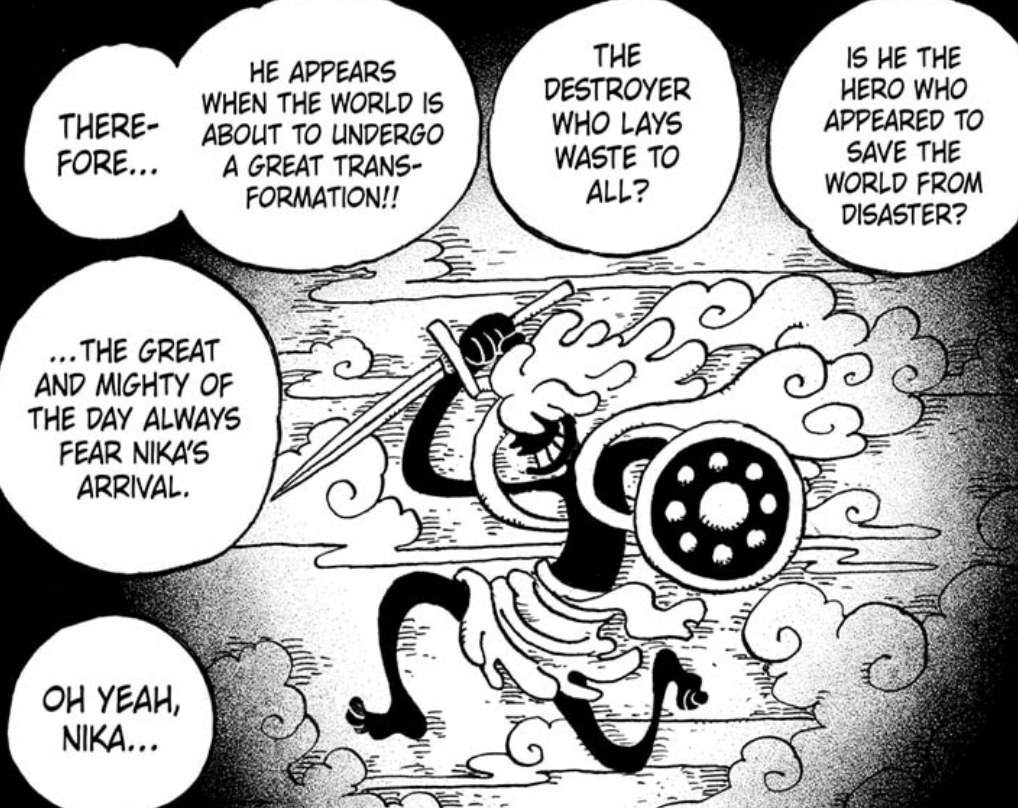
This indicates that at both of these calamities Nika was present. In the case of the Void Century, we know quite well what this was, being the individual called Joyboy who ate the Hito Hito no Mi, Model: Nika, and thus transformed into the Warrior of Liberation. But we had always assumed that Joyboy was the first Nika, but… what if he wasn’t? To our understanding, Nika is not a real person, this has been stated several times by many different people, that Nika isn’t real, just a fictional being that people venerated that became reality through a mythical devil fruit. So how do we explain this Nika existing before even Joyboy?
Well, let’s explore the three different scenarios that could explain this conundrum:
- The first possibility is that, quite simply, Joyboy was not the first user of the Hito Hito no Mi, Model: Nika. Sometime prior to the Void Century, during a time of a great calamity, a user appeared, awakening the Hito Hito no Mi, Model: Nika. After this user’s death, the fruit would continuously evade others until it would fall into the hands of Joyboy, becoming the second Nika. This is the safest and most logical theory, but it does bring out an oddity, being that this would mean that devil fruits have existed since long in the past, even before the Void Century itself. Our prevailing theory at the moment is that the Sea Devil, the creator of all devil fruits, is most likely Nerona Imu, there’s a massive avalanche of evidence to suggest that’s the case, but if this were the case, it would mean that devil fruits have existed since long before the Void Century.
However, there’s nothing saying that Imu wasn’t already immortal prior to the Void Century, as maybe they bided their time for centuries until they were finally able to execute their master plan. Or alternatively, the Sea Devil is an entity that has existed since even before the Void Century, and Nerona Imu only became that entity later on, perhaps through also eating a mythical fruit in a concept similar to Nika, or in some other unknown way, so it’s all certainly possible and likely the most logical explanation.
- The second possibility is that, Joyboy was the first user of the Hito Hito no Mi, Model: Nika, but the Nika present during the previous calamity wasn’t a fruit user, but rather an actual person. Maybe a “Nika” did indeed exist in even more ancient times who saved the world, but his exploits became myth and legend, which eventually gave birth to the existence of a devil fruit. While this would check out at first, I don’t think it’s quite the case, as Jarul seems to describe both accounts of Nika being one and the same, even describing Nika as having pure white hair and a scarf of white clouds, which are characteristic of Zoan awakenings, suggesting the first Nika also awakened through a devil fruit, and thus both of these Nika supposedly being devil fruit users.
But it’s also possible that it’s just a conflated myth of this original Nika and thus the original Nika and the original Sea Devil may have been separate entities to those incarnated by their fruits. This duality could even help make a lot of sense in explaining the great duality we’ve seen across the series. Originally, during the first calamity, we may have gotten the duality of Nika and the Sea Devil. Then during the Void Century, we got the duality of Joyboy, the second Nika, and Nerona Imu, the Sea Devil. And then in the present, we have a new Nika in the form of Luffy, and perhaps a new Devil in the form… of Blackbeard.
Speaking of this, we actually get the Harley’s mythical depiction of Nika, shown as a warrior in a loincloth with, just as Jarul said, pure white hair and white clouds, as well as a cartoony aesthetic with its rubberhose limbs. At the same time, Nika is also here seen with a sword and shield, unlike the sword and spear he was previously depicted with, which makes one thing very noticeable: the fact that he’s another Mihawk victim- I mean, the fact that the shield he carries bears the symbol of the ancient kingdom, being a sun with eight circles around it. This symbol has been used for the flag of Alabasta, the symbol of the Shandians, the symbol in Kuma’s church, the crest of the Kouzuki clan and the Minks, or even the flags in Road’s Block Country among many others. This symbol is known to be associated with the ancient kingdom and the D. clan, but they perhaps in turn may have taken it from a potentially even older myth of Nika.
- However, there is a third possibility that is far more creative yet simple in the end: the fact that maybe this original Nika and even this whole original calamity… were all fictitious, or at least, in part. What if the first Nika really was just a mythical creature that never existed? Maybe the calamity was indeed real, or maybe only to some extent, but people’s desires to be saved created the mythical figure of Nika that eventually got conflated with the myth of the Void Century. After all, the Harley is this old text that likely played through a long game of telephone, so it isn’t impossible. Maybe this original depiction was described as having white hair and white clouds and that’s why it looks that way in Zoan awakening. However, again, given Jarul’s words this seems less unlikely, but not impossible.
However this brings yet another potential game changer. We’re getting into theory territory here, but in my mega theory, I proposed the idea that the One Piece treasure is actually the original laugh tale starring the fictional character of Nika as its main character. And I assumed this was a tale that was developed during the Void Century. But if I were to be true in this case, if Nika existed prior to the Void Century then… how old is the One Piece? Was Joyboy like Roger, a pirate king who found and cherished the One Piece but ultimately didn’t create it, only left it behind? Just… how far does the origin of Nika and the One Piece go?
In the end, we can’t say for sure. The truth is simply still too muddled. But we can pivot to another big mystery we need to answer, which is… what was the first great calamity? What could be the great disaster that happened prior to the Void Century?
When was the Great Calamity?
Well, despite what some think, we actually know a decent bit about the Void Century. What’s most well documented is the period that precedes the Void Century, spanning from some period in the past all the way to the year 600, the start of the Void Century. This was the period known as the “Era of Slaves”. Discrimination, persecution, and slavery were rampant during this period of time, where tyrannical human kings were in control of power and abused those under them, particularly those of other races. The fish-men were said to have been driven from the surface to the ocean floor, forcing them to found Fish-man Island there, whereas the Tontatta were entirely enslaved by the Donquixote Family. It was a period of great suffering, one that likely was what led to the events of the Void Century, with people being fed up by the oppression, wishing to become pirates and be free. It was all an escalation of the suffering that came beforehand.
But what if this first calamity was the one that perpetrated the world into such a state of suffering. And what could it be to have “broken the world” in the same way that the great flood did. Well, one thing comes to mind, perhaps one of the oldest unexplained mysteries in this entire story: the Red Line and the Grand Line. Both of these formations seem to have existed since prior to the Void Century, such as the Lunaria having had a Godland settlement atop the Red Line prior to Mary Geoise. And it doesn’t seem like the great flood had much to do with them. So what if these formations, which just like the flooding don’t seem very natural at all, weren’t created during the second cataclysm, but during the first one. The abnormality of such a linear and vertical continent and the unusual magnetisms of such a straight ocean could perhaps finally be explained.
As for when the first cataclysm took place, we mentioned it being before the Void Century, but what if it did also have something to do with the ancient weapons? Could that help us not just understand how it happened but also give us a time frame? After all, it is said the ancient weapons like Poseidon are reborn every several hundred years, a stretch of time that seems to be around 700 to 800 years, having been born towards the end of the Void Century and now again in the present.
So what if we go backwards from the end of the Void Century on the year 700 to 700 years prior… we get… Year 0. The current One Piece story uses the Kaienreki calendar, or the Sea Circle Calendar, which places the story at the year 1524. The Void Century ended on the year 700 and so Year 0 would be 700 years prior to that. I’ve always wondered what happened during Year 0 but what if… it really was this, the first calamity. What if an event of historical proportions took place, marking that as the original starting year of the current calendar. What if Nika was even a figure revered like Jesus that his first appearance, birth, or awakening came to be known as the Year 0?
Duality of Nika and Loki
Moving on from this mind-bending reveal though, Jarul adds a very interesting comment about Nika: “Is he a hero who appears to protect the world from being broken apart further? Or is he a destroyer seeking to break it all? At the very least, when the world’s very shape is changed, those are the time when he appears!! Therefore, those in power at the time fear the possible appearance of Nika”. Once again, he presents the concept of duality, where Nika is perceived by some as a liberator and bringer of hope while others see him as a bringer of destruction. To be fair, this makes sense. Nika has always appeared during times where the world’s very shape has been changed as he says, but we also know for a fact that Joyboy was heavily involved with the ancient weapons during the Void Century. From what we currently historically understand, Joyboy seemingly had good intentions, and meant to use the ancient weapons for a change for good, but perhaps the very fact that he was in possession of them at some point may have confused the records that would remain of him with some conflating him for a destroyer rather than a savior. After all, even Vegapunk said the same thing that he couldn’t judge if Joyboy was meant to be an agent for good or evil.
But what is interesting is that Loki definitely took the interpretation of Nika from this side of the myth, believing that Nika is someone who laughs at others and instead of being silly for the sake of making others laugh, that he is a mischievous god who plays pranks and brings destruction. This is why, since youth, Loki has wanted to be like Nika, bringing destruction in his wake. Though interestingly, Jarul claims that so did Harald, strengthening the idea that the fruit they passed down may have something to do with that whole idea.
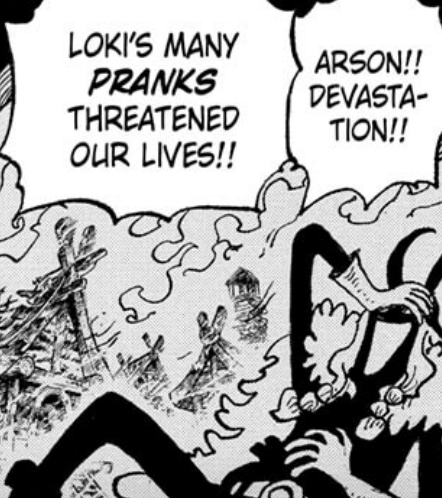
Loki’s birth was already cursed, having been prophesied to kill his father. He was born right before Linlin’s raid on the West Village, a fact we can verify as it was literally mentioned all the way back in Chapter 866, and a year after his birth, his mother died, with other disasters following. At age 10, having befriended the beasts of the Underworld as mentioned before, he unleashed them upon the villages, and later on would play pranks in the form of bringing destruction and arson. Yet he viewed it all as a prank, laughing at his enemies just like Nika would, in his own twisted way of it.
The giants even mentioned that during Harald’s absence, this all became worse, but it is odd that Harald would be absent. Was he out of the country and for what reasons? Could this even be during the period of the Rocks 40 years ago given the long age of giants? Following this however, Loki murdered his father and ate the fruit in his possession, leading to the conflict we were told about. Jarul tried to stop him but was stabbed in the head, leading to the sword we see on him now. We also get a quick glimpse at a shadowed Harald (perhaps being saved for an eventual flashback) being shown in what looks like a painting in the castle, sitting upon the throne. We can’t quite see his face, but he does appear to have some sort of mustache, beard, or protrusion coming out of his face. But then 6 years ago, Loki set out to see to cause even more rampage, but was ultimately stopped by Shanks, who brought him back to Elbaph, just as we had assumed.
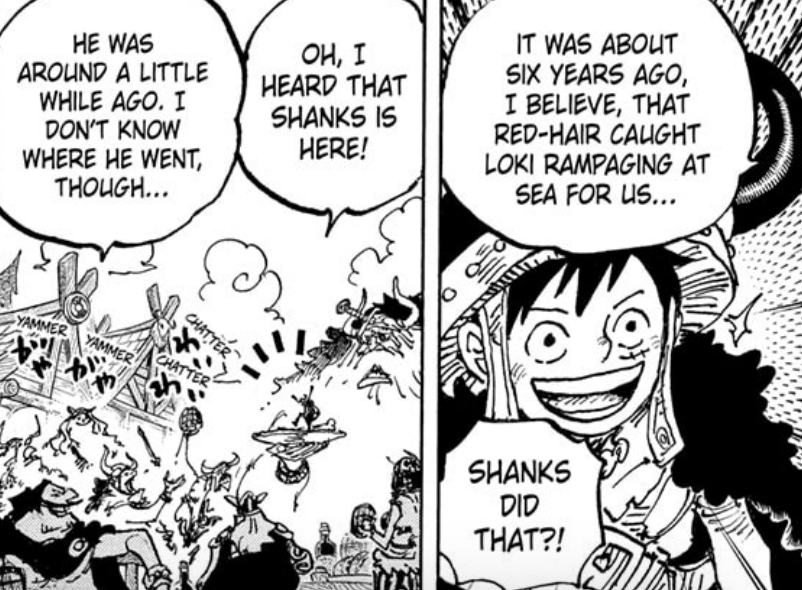
This also likely confirms what we had assumed that Shanks’s rise to becoming a Yonko 6 years ago may have been due to him defeating the feared Loki who even the Government was growing concerned about, giving him such a high bounty, as the times coincide. Just like how his defeat of the Music Devil King Tot Musica and the destruction of Elegia gained him his first bounty over a billion, his defeat of Loki likely brought him even more recognition. But it all adds more mystery to Loki’s claim that Shanks was a coward. Was it for sparing his life and giving him back or is there more to it?
This however all puts into question Loki’s character, as Luffy questions if he’s really a bad guy, getting the impression that maybe he really isn’t that bad. On one hand, this is how Luffy feels about him, and we’ve also seen how he seems to care a lot for the mysterious Mosakou. Yet at the same time, he said he was going to kill Luffy and is even willing to let his pet wolf die later in the chapter because he accepts that is his fate. It certainly makes him an interesting complex and layered character whose true morality still isn’t fully clear.
So perhaps this creates a possibility that might explain the truth behind Loki’s fruit. Jarul told us about the ambiguity of Nika’s true morality. Some believe him to be a god of salvation while others view him as a god of destruction, likely especially conflated during the Void Century with the ambiguity of Joyboy’s actions with the ancient weapons. Even now, at present, Luffy was foreseen to destroy Fish-man Island, but is this a destruction for good or for evil? As such, both of these interpretations may have taken shape as different myths, and formed two different mythologies. Not necessarily the fact that there were two Nikas, those seem to have historically existed at different times as Jarul explains, but rather that there may have been two different interpretations of the same Nika.
I proposed since his introduction that Loki’s claim about being the Sun God may not just be wanting to be like the people of Elbaph do, but him actually having become the Sun God through his fruit, perhaps there being some other interpretation of Nika. And now it sounds like it could really be the case… so what if Loki actually did eat the Nika fruit… but a version of Nika that was based on the myth that he’s a destroyer rather than a savior, thus embodying the Warrior of Destruction (hakai no senshi) compared to Luffy being the Warrior of Liberation (kaihou no senshi). This might even explain how Loki literally set ablaze the villages of Elbaph with sun-like fire, all while laughing to himself just like Nika did.
In spite of all this though, Loki offered Luffy to tell him where Shanks is in exchange for the key to free him. This of course is almost certainly a lie, as Loki wouldn’t really know where Shanks is and even Loki literally though that he’d kill Luffy right after being freed. However, Zoro, and then joined by Nami, our original trio, decide to accompany Luffy and at least gauge the situation, with the assistance of Road. Road particularly claims to be Nami’s servant, but Zeus establishes the hierarchy that he’s Nami’s first servant and Sanji is the second servant, making reference to their little debate from Chapter 903. As they approach the castle, we can see that the gates have been smashed. But last time we saw them, they didn’t seem smashed, so this was likely done by the two Celestial Dragon intruders.
Gunko’s Devil Powers
Speaking of them, we see they’ve swiftly reached Loki, who by the way, we get his laugh, being “Do ga ha ha ha”. Shonks and the girl elaborate that they haven’t heard from the Cipher Pol agents they sent to the island in 20 days, only claiming to have been abducted by a large crow. It is now evident that these were the previous people found in Road’s Block Country, having been abducted by his crow Mugin and forced to play in his RPG. And so, the Government has instead decided to send two of their God Knights, who even Loki calls them as such, though their reason why they are here isn’t fully clear yet.
Loki seems to imply that the Government desires his power, given his enormous strength, but I guess it speaks to the Government’s arrogance that they think they can control Loki.
We get even more of the girl’s speech pattern, sounding even more sophisticated and classy than she did before. Shonks, on the other hand, speaks too little to really get much of a feel of his speech pattern, likely an intentional choice. to keep the mystery. Oda even keeps being sneaky and covering the left side of his face, all but confirming there really is no scar there. We get a side profile later that covers his eye with his hair, but even then it really doesn’t look like there’s a scar there.
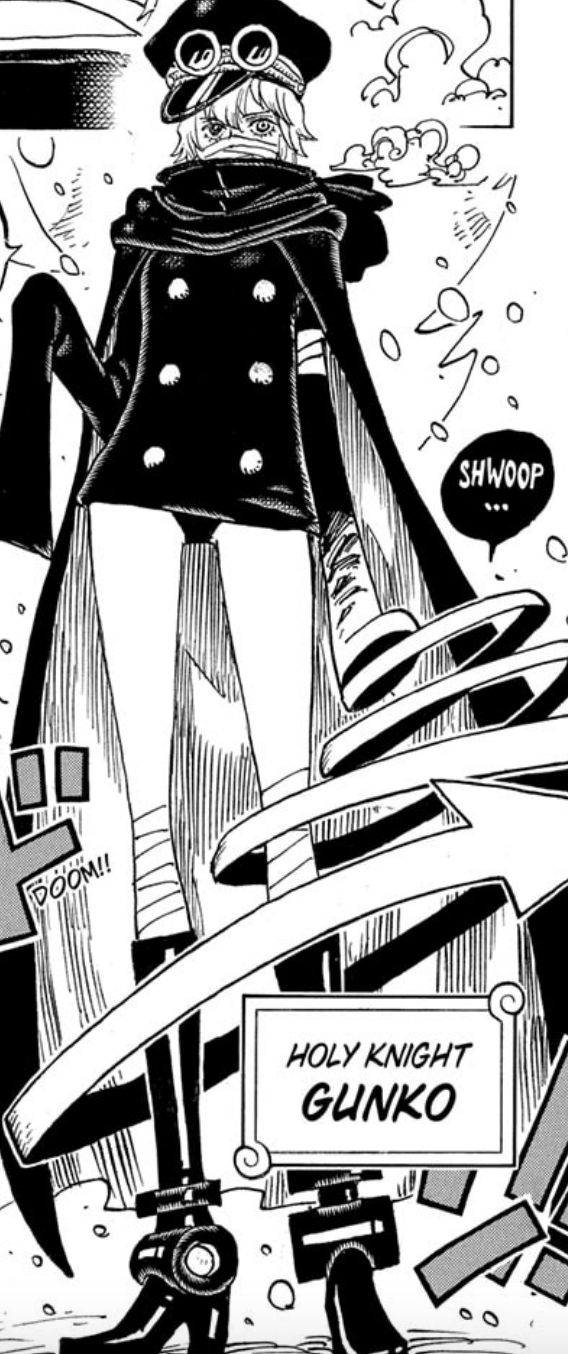
More importantly though, we get the girl’s name and appearance, being called “Gunko”. Her name is written in kanji but has a phonetic katakana reading. The kanji are those of “gun” and “ko”, the first meaning “military” and the second meaning “girl”. Thus her name literally just translates as “military girl”, or “army girl”, and her text box also confirms beyond any doubt that she is one of the God Knights. Sadly however, we don’t get the name of her Celestial Dragon family, yet more oddly enough she doesn’t carry the title of “Saintess” that female Celestial Dragons like Shalria bear, or even that of “Saint” for that matter.
As we had noticed before, she wears a sort of military-style hat, but her outfit in general is more similar to that of a gakuran, which is a type of traditional school uniform in Japan. Gakuran, or western-style school uniform, is a type of old-style school uniform that looked a bit militaristic due to its older influence when it became used. In anime, it is often generally associated with delinquent characters, which makes Gunko’s appearance quite interesting. The militaristic theme is even visible in her name, as mentioned. Gakuran female outfits were often known in some cases for having quite short skirt length, which might be the reason for her skirt being so short that… well, she basically has no pants, though obviously that’s just Oda exaggerating things.
As we had noticed before, she has a sort of military or pilot’s hat, but she also has heterochromia, being the condition of having both eyes being different colors, in this case one light and the other dark. We don’t know if this is just natural heterochromia or if there is some deeper reason such as a power or past incident. She also seems to have a… well, hatred for pants, and long sleeves, as well as weird boots. These long sleeves in particular tie with her power, which we see here better as she is able to turn her clothes into a flying sash, one she can command as it strangles the poor great wolf to death. That is why she wears long sleeves, so that she has enough fabric to transform.
This lines up with her using the sashes to strangle the muscles of the giant earlier, but I wonder what kind of power this is. A boring answer would be that this is some sort of sash creating Paramecia fruit, like an Obi Obi no Mi that creates sashes and bandages, but honestly that would both be very lame and kind of not fully add up. After all, keep in mind that this is one of the God Knights, who got teleported to the castle via a summoning circle, so much like the Gorosei she too likely is some form of demon. But then what demon would allow her to just create sashes like that?
Well, the answer is pretty obvious if you’re familiar with Japanese culture, but may not be at all if you’re not familiar with it. We know the Gorosei are mostly inspired by demonic creatures from different mythologies, some from global mythology such as the sandworm, the pale horse (though in this case it’s called the bakotsu), or the feng xi, but we also get Japanese demonic creatures such as the gyuki or the itsumade. So in this case it would make a lot of sense if this was the ittanmomen.
The ittanmomen is descriped as a series of sashes that come to life, moving around the air and strangling others just like we see Gunko doing here, often killing others by asphyxiation or by crushing them with their sashes. In some modern depictions, the ittanmomen is also depicted as a female who generates those sashes, one of the more modern depictions you might be familiar with being Daki from Kimetsu no Yaiba, who similar uses sashes to kill others. And as such, this would be a perfect fit for Gunko, making her a demonic creature from mythology much like the others who have attained Imu’s favors.
And yet it doesn’t stop here because there is one characteristic of Gunko’s powers that just simply… make no sense. And it’s the fact her sashes seem to end in the shape of a devil’s tail. But… why? Because we had seen Imu using this very same devil tail to kill Cobra and attack Sabo. So how could Imu have what seems to be Gunko’s powers?
Well, the boring answer could be that they just look alike and the reason why is because she’s also some kind of devilish creature like Imu, or simply something in Imu’s image. But on the other hand, what if these two really are one and the same?
What if Gunko… is actually King Imu- okay no, I’m just kidding. I’m not saying it’s impossible, but obviously that’s quite not likely what’s happening here. But what if Gunko’s power is indeed Imu’s power. Specifically, what if this opened the door for the possibility that Imu isn’t restricted to one single power… but may actually possess all the powers that they confer to others?
What if Imu gave Gunko the ability to become an ittanmomen because Imu also has that ability, which he used against Cobra and Sabo? Does that mean that Imu could also transform into a gyuki or itsumade, for example? After all, when Sabo attacked Imu, they transformed into this big creature with large fangs, and yet right after Imu transformed into this weird hominid creature with large arms and some form of beak, and later became just a large pair of eyes. What if Imu’s powers as the devil are so flexible that the powers they can confer are also the powers that they possess, making Imu a being of strength beyond our imagining.
What is the truth that holds the history of the Nikas of the past as well as the Sea Devil who most likely became the King of the World? What other secrets do the folds of history hold?
 The Library of Ohara